The pharmaceutical industry has long been one of the slowest sectors to fully embrace digital transformation. But in today’s world, where consumers and healthcare providers alike use online channels to research conditions, treatments, and even purchase products, digital marketing in the pharmaceutical industry has become not just a nice-to-have but a strategic imperative.
As agile startups and digitally-savvy competitors move quickly, legacy pharma companies must evolve from B2B models to more direct, consumer-and-HCP-engaged, omnichannel approaches. In doing so, the role of digital marketing in the pharmaceutical industry expands beyond simple promotion — it becomes a way to modernize the customer (patient / HCP) experience, build trust, and deliver measurable growth.
In this guide, we’ll explore what digital marketing in the pharmaceutical industry really means, why it matters in 2025, the core strategic pillars, the major trends at play, how compliance fits in, and how companies can win. We’ll also highlight how MarketBeam supports this transformation in regulated industries.
What Is Digital Marketing in the Pharmaceutical Industry?
Digital marketing in the pharmaceutical industry refers to the use of digital channels, technologies, and strategies to engage patients, healthcare providers (HCPs), caregivers, and other stakeholders — in a way that is highly targeted, measurable, and aligned with regulatory constraints.
Unlike broader digital marketing in other sectors, pharma’s digital efforts must contend with stricter rules around claims, promotion, safety & adverse event reporting, medical-legal-regulatory (MLR) review processes, and audit readiness. Thus, successful digital marketing in the pharmaceutical industry does not simply mean “posting on social media” — it means doing so with full compliance, meaningful engagement, and an integrated ecosystem spanning content, data, channels, automation, and analytics.
Why Digital Marketing Matters More Than Ever in 2025
-
The consumer and HCP journey has gone digital. Patients and doctors no longer rely solely on sales reps or print journals. Many search online, engage in forums, check social media, and expect seamless digital experiences. Digital marketing in the pharmaceutical industry enables reaching these audiences where they are.
-
The shift from B2B to B2B2C / D2C models. Pharma companies are increasingly competing not just with other brands but with digital-first entrants, health-tech platforms, and direct-to-consumer channels. A robust digital marketing strategy in the pharmaceutical industry allows companies to extend their reach and influence beyond traditional distribution.
-
Omnichannel and personalized engagement. Modern audiences expect tailored messages, consistent experiences across devices and channels, and relevant content. Digital marketing in the pharmaceutical industry harnesses automation, data and segmentation to deliver these personalized experiences.
-
Measurability and optimization. Unlike legacy offline channels, digital marketing in the pharmaceutical industry offers tracking, attribution, and analytics — enabling smarter resource allocation, faster learning cycles, and stronger ROI.
-
Competitive necessity. With digital-savvy competitors gaining ground, companies that fail to invest in digital marketing in the pharmaceutical industry risk being left behind.
Core Pillars of Digital Marketing in the Pharmaceutical Industry
Here are the foundational areas where pharma marketers must accelerate:
Content Marketing & Education
Producing high-quality, relevant content for both patients and HCPs is vital. Because much of the buyer journey is research-driven, content strategy enables trust, thought leadership, and long-term engagement. Tailor messages to buyer personas (patients, caregivers, HCPs) and stages (awareness, consideration, decision).
Search Engine Optimization (SEO)
Being easily found is critical. Health-related search queries remain high (e.g., one in 20 searches via Google relate to health) and doctors increasingly rely on online resources. Optimizing content for search (both for patients and HCPs) is central to digital marketing in the pharmaceutical industry.
Social Media & Employee Advocacy
While pharma has restrictions on types of promotion, social media still offers rich opportunity for engagement, listening, and community building. Employee advocacy (empowering your field teams to share approved, relevant content) further amplifies your reach. When done compliantly, social media is a key channel in digital marketing in the pharmaceutical industry.
Paid Media & Programmatic Advertising
Paid search, display, social advertising and retargeting help ensure your message reaches the right people at the right time. In digital marketing in the pharmaceutical industry, these tactics must be married to compliance workflows and proper tracking.
Marketing Automation & CRM
With many channels and touch-points, managing interactions manually becomes inefficient. Automation enables scalable, personalized outreach and lifecycle management. For digital marketing in the pharmaceutical industry, integrating automation with compliance (e.g., logging approvals, audit trails) is a differentiator.
E-commerce & D2C
The rise of e-commerce in pharma (forecasted strong growth) means many companies need to adopt direct sales or digital fulfilment models. Digital marketing in the pharmaceutical industry must therefore enable the full journey: awareness → research → purchase → loyalty.
Trends Shaping Digital Marketing in the Pharmaceutical Industry in 2025
Patient-Centric Marketing & Personalization
Pharma is moving towards marketing that treats patients and HCPs as individuals with unique needs rather than generic categories. This includes personalized messaging, interactive digital experiences, tailored journeys. Digital marketing in the pharmaceutical industry is increasingly about building relationships, not just pushing product.
Data-Driven Decision Making & Predictive Analytics
Big data, machine learning and predictive analytics allow marketers to anticipate needs, personalize content, and optimize campaigns. Digital marketing in the pharmaceutical industry increasingly relies on analytics to refine segmentation, attribution, and spend.
Influencer & HCP Engagement
While influencer marketing in pharma needs extra care, it is growing in importance. Collaborating with credible voices (HCPs, patient advocates) helps build trust. Digital marketing in the pharmaceutical industry now has to integrate these collaborations while still remaining within regulatory frames.
Virtual & Augmented Reality (VR/AR)
These immersive technologies are no longer futuristic. In pharma marketing, VR/AR can help demonstrate mechanism of action, engage healthcare professionals in novel ways, or educate patients. Digital marketing in the pharmaceutical industry is adopting these ‘new frontiers’ to stand out.
Telehealth, Remote Monitoring & Omnichannel Touch-points
With the rise of telehealth and remote patient monitoring, pharma brands have more digital touchpoints than ever. Digital marketing in the pharmaceutical industry must integrate into this ecosystem — connecting online education, virtual visits, mobile apps, wearables and more.
Regulatory & Compliance Evolution
Regulators are catching up with digital innovation. New guidelines around social media, data privacy, record-keeping, and patient-engagement apply. Digital marketing in the pharmaceutical industry must keep pace — ensuring governance, traceability and audit readiness.
Global Collaboration & Partnerships
Pharma companies increasingly partner with tech firms, med-tech platforms, patient advocacy groups and digital agencies. These collaborations help scale digital marketing in the pharmaceutical industry, bring new capabilities, and accelerate transformation.
Regulatory Compliance: The Cornerstone of Digital Marketing in the Pharmaceutical Industry
In the world of digital marketing in the pharmaceutical industry, compliance isn’t optional — it’s foundational. Because pharma promotion is tightly regulated (e.g., by the U.S. Food & Drug Administration (FDA), the European Medicines Agency (EMA), HIPAA, and other regional authorities), any digital efforts must incorporate robust review, audit-trail, content governance and monitoring.
Key compliance considerations include:
-
Ensuring promotional claims are scientifically accurate, balanced (benefits & risks).
-
Routing all digital content (web, social, email) through Medical-Legal-Regulatory (MLR) review processes.
-
Maintaining records of approvals, versions, publishing dates and activities for audit.
-
Monitoring social media for adverse-event signals and ensuring proper escalation.
-
Ensuring data privacy (consent, anonymization) when digital marketing touches patient/HCP data.
-
Using secure publishing tools that enforces role-based access, workflow governance, audit logs and archiving.
Here’s where MarketBeam shines:
-
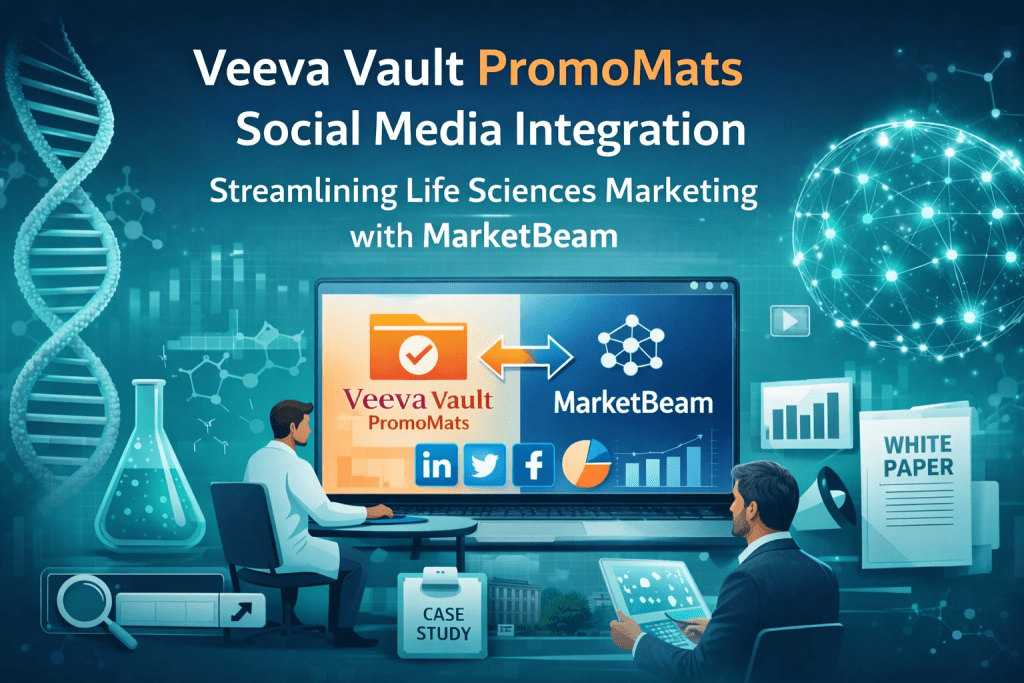
MarketBeam integrates directly with industry review platforms such as Veeva Vault PromoMats, enabling marketers to publish only after approved content has passed MLR review. marketbeam.io+2marketbeam.io+2
-
MarketBeam offers AI-powered pre-checks (flagging missing disclaimers, off-label claims, tone risks) ahead of publishing. marketbeam.io+1
-
It provides full audit-ready logs: every action, comment, approval is tracked for regulators. marketbeam.io+1
-
It supports controlled employee advocacy, so only approved content is shared, reducing risk of “rogue” posts. marketbeam.io
-
Strong security and compliance: GDPR compliance, encryption, role-based access, official social-media partnerships. marketbeam.io
By embedding compliance into the DNA of digital marketing in the pharmaceutical industry, companies can move faster, safer, and with confidence.
Challenges and Opportunities Ahead
Challenges:
-
Legacy mindsets & slow internal processes: many pharma companies still rely on manual approvals, siloed teams and long cycles which hamper agility in digital marketing in the pharmaceutical industry.
-
Data fragmentation & attribution issues: Tracking across channels, devices, the “death” of third-party cookies, and multi-touch journeys create measurement complexity.
-
Complex regulatory & global compliance: Different markets mean different rules; scaling digital marketing in the pharmaceutical industry across geographies requires governance frameworks, localization and regional review.
-
Balancing innovation with risk: Adopting new technologies (VR/AR, influencer, telehealth) is exciting, but each introduces new compliance risks.
-
Talent & capability gaps: Digital skills, data analytics, user-experience design — pharma needs to up-skill to make digital marketing in the pharmaceutical industry work at scale.
Opportunities:
-
Competitive advantage: Early adopters of digital marketing in the pharmaceutical industry can outperform slower peers, build brand equity, engage patients and HCPs meaningfully.
-
Operational efficiency: Automation, workflow improvements and integrated platforms like MarketBeam reduce cost, speed up time-to-market and improve ROI.
-
Personalization and experience leadership: Companies that move beyond generic messaging to tailored, omnichannel experiences stand out.
-
New business models: D2C, digital therapeutics, remote monitoring platforms create new touchpoints and revenue streams — digital marketing in the pharmaceutical industry is the gateway.
-
Data-driven insights: Rich analytics allow companies to adapt faster, optimise campaigns, refine segmentation and prove value to stakeholders.
Conclusion: The Future of Digital Marketing in the Pharmaceutical Industry
The era of digital marketing in the pharmaceutical industry is no longer ahead — it’s here. Companies that continue to treat digital as an add-on will struggle. Instead, pharma must embed digital marketing into the core of their commercial model: content, channels, data, automation, compliance.
By adopting modern platforms, embracing automation, and aligning marketing, medical, legal and regulatory teams, pharma marketers can gain speed, control, and agility. And with tools like MarketBeam — built for regulated industries — you get the dual benefit of high-performance digital marketing and rigorous compliance.
As we move through 2025 and beyond, expect digital marketing in the pharmaceutical industry to become ever more patient-centric, data-driven, omnichannel and integrated with medical-commercial ecosystems. Those who lead this shift will shape the future of pharma.
FAQs
Q1: What is digital marketing in the pharmaceutical industry?
Digital marketing in the pharmaceutical industry refers to the use of digital channels and strategies (content, SEO, social, paid media, automation) specifically within the pharma context — which involves regulating bodies, medical review, compliance oversight and a focus on patients and HCPs rather than pure consumer promotion.
Q2: Why is digital marketing important for pharma?
Because patients and HCPs are increasingly researching and purchasing via digital channels; a strong digital presence allows pharma companies to meet them, engage meaningfully, personalise messaging, measure performance, enhance brand trust, and stay competitive in a changing industry.
Q3: What are the major trends shaping pharma digital marketing in 2025?
Trends include patient-centric marketing, data-driven decision-making, influencer/HCP engagement, VR/AR experiences, telehealth and remote monitoring integration, omnichannel journeys, and evolving regulatory compliance frameworks.
Q4: How can pharma companies ensure compliance when doing digital marketing?
They should integrate their marketing workflows with MLR review, use platforms that provide audit trails, enforce role-based approvals, monitor social channels and employee advocacy, ensure secure data practices, and employ tools that flag compliance issues (e.g., off-label claims) before publishing.
Q5: How does MarketBeam help with compliant digital marketing in pharma?
MarketBeam offers a purpose-built platform for regulated industries: it integrates with Veeva Vault PromoMats to embed MLR review into social and digital publishing; applies AI-powered compliance pre-checks; supports employee advocacy with safe sharing; provides audit-ready logs; and enables publishing, monitoring and analytics across channels — thereby enabling digital marketing in the pharmaceutical industry with full compliance confidence.
With MarketBeam, MedTech companies can manage influencer content, track engagement, and automate compliance—all within one secure platform.
👉 Learn more about Social Media Compliance for MedTech