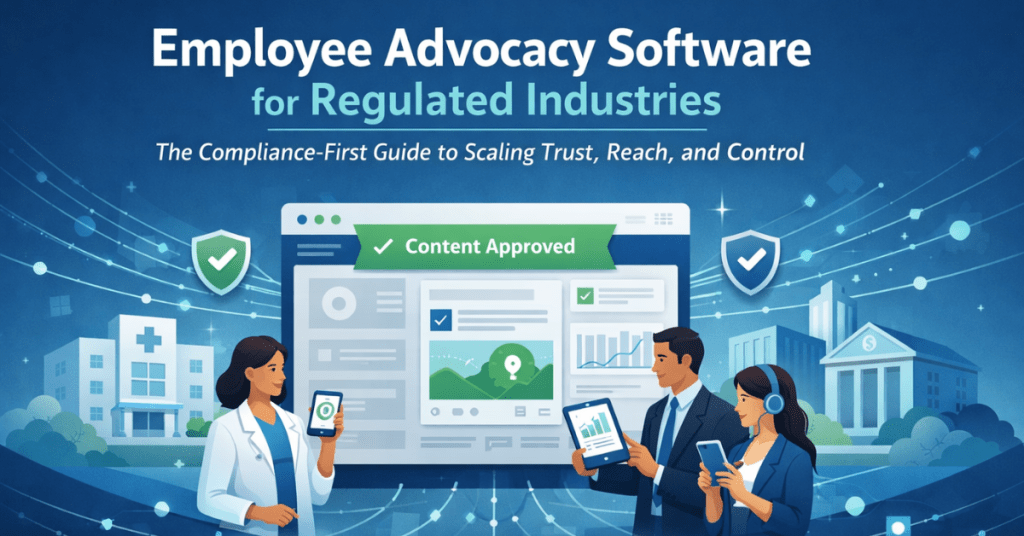
Employee advocacy has emerged as one of the most effective ways for organizations to extend brand reach, build credibility, and engage audiences on social media. When employees share content, it is perceived as more authentic, more trusted, and more influential than corporate messaging alone.
However, for regulated industries, employee advocacy is fundamentally different.
Pharmaceutical companies, life sciences organizations, healthcare providers, financial services firms, and fintech brands operate under strict regulatory oversight. Every piece of communication—whether published by a brand or an employee—can carry legal, compliance, and reputational risk.
This is why Employee Advocacy Software for Regulated Industries must be built differently.
This guide explains:
-
What employee advocacy means in regulated environments
-
Why generic advocacy tools fail under regulatory scrutiny
-
What capabilities regulated organizations require
-
How compliance, marketing, and sales can align through advocacy
-
How platforms like MarketBeam enable compliant advocacy at scale
Understanding Employee Advocacy in Regulated Industries
Employee advocacy refers to the structured process of enabling employees to share company-approved content through their personal social media profiles.
In non-regulated industries, this often looks informal:
-
Employees choose what to share
-
Messaging is lightly guided
-
Oversight is minimal
-
Risk is low
In regulated industries, this approach is not viable.
Employee advocacy in regulated environments must operate within:
-
Regulatory frameworks (FDA, EMA, FINRA, SEC, FCA, HIPAA, GDPR)
-
Internal compliance policies
-
Content approval and audit requirements
-
Ongoing monitoring obligations
As a result, Employee Advocacy Software for Regulated Industries is not a marketing add-on—it is compliance infrastructure.
Why Employee Advocacy Is Critical for Regulated Industries
Despite regulatory complexity, employee advocacy is becoming increasingly important for regulated organizations.
1. Declining Organic Reach
Social platforms continue to reduce organic reach for brand pages. Employee networks often deliver 5–10x greater reach than corporate channels.
2. Trust Deficit in Corporate Messaging
Audiences trust individuals more than institutions. Employee-shared content consistently outperforms brand-only posts in engagement and credibility.
3. Long Sales Cycles and Relationship-Driven Buying
In pharma, healthcare, and financial services, buying decisions are complex, regulated, and relationship-driven. Employee voices play a critical role in education and trust building.
4. Rising Cost of Paid Media
Paid advertising is becoming more expensive and more restricted. Advocacy offers a compliant way to extend reach organically.
The challenge is not whether employee advocacy should exist—but how it can exist safely.
The Compliance Risks of Employee Advocacy in Regulated Environments
Without purpose-built employee advocacy software, regulated organizations face serious risks.
Common Compliance Risks
-
Off-label product discussion
-
Unapproved financial claims
-
Missing or altered disclaimers
-
Inconsistent messaging across regions
-
Lack of audit trails during inspections
-
Inability to supervise employee activity
Manual policies and training alone cannot manage these risks at scale.
This is why Employee Advocacy Software for Regulated Industries must enforce governance automatically, not rely on trust or memory.
Why Generic Employee Advocacy Tools Fail in Regulated Industries
Most advocacy tools on the market were designed for:
-
Technology companies
-
Employer branding programs
-
Retail and consumer brands
These tools prioritize ease of sharing, not regulatory control.
Structural Limitations of Generic Tools
-
No built-in legal or MLR review workflows
-
No enforcement of mandatory disclaimers
-
Employees can edit approved messaging
-
No post-share monitoring
-
No centralized audit logs
In regulated industries, these gaps create unacceptable exposure.
Generic advocacy tools assume low risk. Regulated industries operate under constant scrutiny.
What Defines Employee Advocacy Software for Regulated Industries
Employee Advocacy Software for Regulated Industries must be designed around governance, not retrofitted for it.
Below are the core capabilities that distinguish regulated-ready platforms from generic tools.
1. Pre-Approved Content Libraries
Employees should never be responsible for deciding what is compliant.
A regulated advocacy platform must provide:
-
Centrally managed content libraries
-
Content approved by legal, compliance, or MLR teams
-
Version control to prevent outdated messaging
-
Clear labeling of content purpose and audience
Employees select from approved options only, eliminating risk at the source.
2. Mandatory, Non-Editable Disclaimers
In regulated industries, disclaimers are not optional.
Employee Advocacy Software for Regulated Industries must:
-
Automatically append required disclaimers
-
Prevent employees from editing or removing them
-
Apply platform-specific disclaimer formats
-
Support regional and regulatory variations
This ensures compliance without slowing down participation.
3. Role-Based Access and Segmentation
Not all employees can share the same content.
A compliant advocacy platform must support:
-
Role-based access (sales, medical, leadership, advisors)
-
Region-specific content visibility
-
Product-level restrictions
-
Audience-appropriate messaging
This reduces both compliance risk and internal confusion.
4. End-to-End Audit Trails
Audit readiness is non-negotiable in regulated industries.
Employee Advocacy Software for Regulated Industries must capture:
-
Who shared what
-
When it was shared
-
On which platform
-
What content version was used
-
Whether it was edited, deleted, or commented on
These records must be easily retrievable for inspections, audits, and internal reviews.
5. Post-Publication Monitoring and Supervision
Compliance does not end when content is published.
Regulated advocacy platforms must monitor:
-
Comments and replies
-
User interactions that introduce risk
-
Potential adverse events
-
Misleading third-party responses
This is particularly critical in pharma, healthcare, and financial services, where engagement itself can create regulatory exposure.
Employee Advocacy in Pharmaceutical and Life Sciences Organizations
Pharmaceutical and life sciences companies operate under some of the strictest communication regulations globally.
Common Advocacy Use Cases
-
Disease awareness and education
-
Corporate thought leadership
-
Scientific milestone updates
-
Employer branding
-
Field force enablement
Unique Compliance Challenges
-
Off-label discussion risk
-
Adverse event identification
-
Fair balance requirements
-
Global vs local regulatory differences
Employee Advocacy Software for Regulated Industries allows pharma organizations to enable advocacy without opening compliance gaps.
Employees amplify only what is approved, while compliance teams retain full oversight.
Employee Advocacy in Healthcare Organizations
Healthcare organizations must protect patient privacy while maintaining trust and authority.
Advocacy Opportunities
-
Public health education
-
Employer branding
-
Professional thought leadership
-
Research awareness
Compliance Considerations
-
HIPAA and patient privacy
-
Ethical communication standards
-
Professional conduct guidelines
A regulated advocacy platform ensures healthcare professionals can participate safely without exposing sensitive information or violating regulations.
Employee Advocacy in Financial Services and Fintech
Financial services face strict oversight from regulators such as FINRA, SEC, and FCA.
Advocacy Use Cases
-
Market education and insights
-
Advisor credibility building
-
Thought leadership from leadership teams
Regulatory Requirements
-
Record retention of all communications
-
Supervision of employee messaging
-
Clear separation between education and advice
Employee Advocacy Software for Regulated Industries transforms advocacy into a supervised, auditable communication channel.
Aligning Marketing, Sales, and Compliance Through Advocacy
One of the greatest benefits of regulated advocacy software is organizational alignment.
Marketing Teams
-
Extend reach beyond brand pages
-
Maintain message consistency
-
Measure amplification impact
Sales Teams
-
Share relevant, compliant content
-
Build credibility with prospects
-
Support social selling initiatives
Compliance Teams
-
Maintain centralized oversight
-
Reduce manual review effort
-
Ensure audit readiness
Instead of working in silos, teams operate within a shared governance framework.
Measuring Employee Advocacy in Regulated Industries
Measurement must reflect both performance and compliance.
Key Metrics to Track
-
Employee adoption and participation rates
-
Reach amplification vs brand channels
-
Engagement quality (comments, saves, shares)
-
Compliance incidents prevented
-
Audit readiness indicators
Employee Advocacy Software for Regulated Industries provides visibility without compromising governance.
Best Practices for Implementing Employee Advocacy in Regulated Industries
1. Design Governance First
Define compliance workflows before launching advocacy.
2. Educate Employees Continuously
Advocacy succeeds when employees understand both value and boundaries.
3. Centralize Content Ownership
Marketing and compliance must co-own the content pipeline.
4. Start Small, Scale Confidently
Pilot with controlled groups before expanding organization-wide.
5. Monitor and Optimize
Continuously review engagement and compliance signals.
The Future of Employee Advocacy in Regulated Industries
Employee advocacy will continue to evolve—but regulation will only intensify.
Future-ready platforms will include:
-
AI-assisted compliance pre-checks
-
Automated risk detection in comments
-
Deeper CRM and sales attribution
-
Always-on audit intelligence
In regulated industries, advocacy without governance will not survive.
Conclusion: Employee Advocacy Requires Compliance-First Technology
Employee advocacy is no longer optional for regulated organizations. It is a critical channel for reach, trust, and engagement.
However, unmanaged advocacy introduces unacceptable risk.
Employee Advocacy Software for Regulated Industries must combine amplification, control, monitoring, and auditability by design.
Platforms built for regulated environments enable organizations to scale advocacy safely—without slowing down growth or compromising compliance.
With MarketBeam, MedTech companies can manage influencer content, track engagement, and automate compliance—all within one secure platform.
👉 Learn more about Social Media Compliance for MedTech