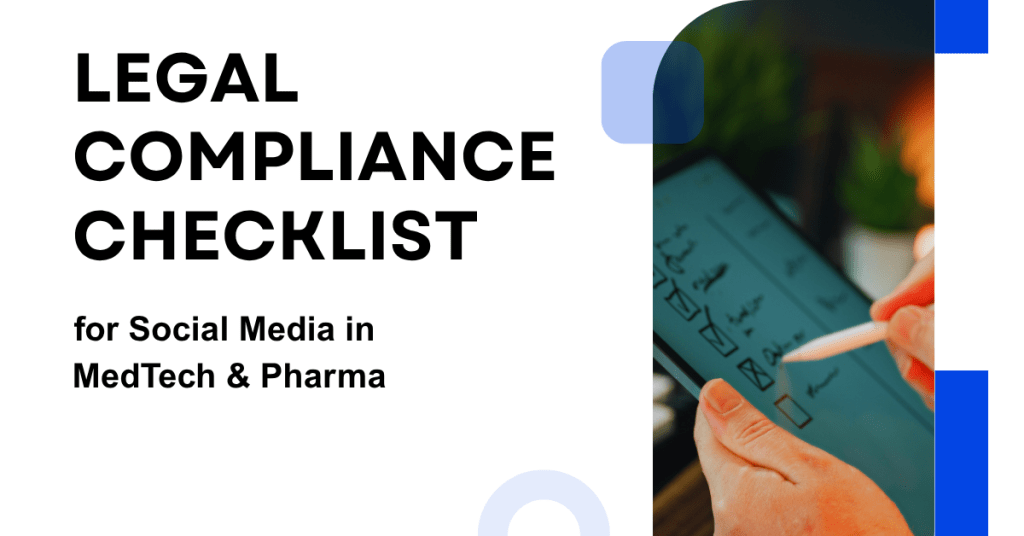
In the fast-moving world of digital engagement, the pharmaceutical and MedTech sectors face a complex web of regulatory and legal demands. From Food and Drug Administration (FDA) social media guidance 2018 to global data-privacy laws, companies must be vigilant to keep their social media operations compliant. This blog outlines a robust legal compliance checklist for social media in MedTech & Pharma — helping you stay aligned with best practices in social media pharmaceutical marketing, digital marketing in pharma, and social media in the pharmaceutical industry.
Why Social Media Legal Compliance for MedTech and Pharma Matters
Social media offers enormous opportunity for pharma brands on Facebook, Instagram, LinkedIn and other social networks — but it also raises very high stakes:
-
The FDA’s Office of Prescription Drug Promotion (OPDP) monitors promotional content including internet posting and social media channels.
-
Regulations such as 21 CFR 202 govern drug advertising and promotional materials—covering claims, fair balance, risk disclosures, and more.
-
Failure to comply can result in an FDA social media warning, regulatory enforcement actions, damage to brand reputation, and costly remediation.
-
At the same time, “underutilizing” digital marketing in pharma means missing competitive advantage: trends in the pharmaceutical industry show more investment in social media drug-promotion campaigns, pharma social media compliance monitoring and influencer programs.
With so many moving pieces — from FDA regulations on pharmaceutical advertising to posts about medical devices or unbranded vs branded messaging — a checklist and SOP become essential.
1. Content Approval & Intellectual Property (IP) Rights
-
Obtain approval before sharing or reposting third-party content: If a research study, news article or patient testimonial is to be reused in your social media campaign, make sure licensing, attribution and permissions are clear.
-
Ensure proper attribution when using third-party content: name the author, source, or original publisher.
-
Verify that all images, videos, and graphics are either:
-
Created in-house
-
Licensed for use (stock images, rights managed)
-
Public domain or fair use
-
-
Ensure all trademarks, logos and brand names are legally allowed: Avoid misuse of third-party marks.
🚫 Red Flags: Reposting a patient story without signed consent; using images from a Google search without copyright clearance; sharing a news article or research paper without permission.
✅ Compliant Example: “Reposting with permission: Dr. Smith’s recent study on diabetes research. Read more:”
2. Off-Label Promotion & Regulatory Compliance
When dealing with pharmaceutical products or medical devices, regulatory rules apply strictly. Key items:
-
Ensure all claims, promotions, and product mentions align with regulatory approvals (FDA, European Medicines Agency (EMA), Central Drugs Standard Control Organisation (CDSCO) in India).
-
Do not promote or encourage off-label uses in any form. Recall that OPDP and FDA guidance documents include “off-label promotion” as a high-risk area.
-
Include a fair balance of benefits and risks in all promotional content, per FDA regulations on advertising and promotional materials.
-
Use disclosures and disclaimers where appropriate: “This post is for informational purposes only and does not constitute medical advice.”
🚫 Red Flags: “Many doctors also prescribe this drug for migraines” (when migraines are not an approved indication); highlighting only benefits of a drug/device without mentioning risks; posting a branded social media post with no disclaimer.
✅ Compliant Example: “Our medical device is FDA-approved for post-surgery pain management in adult patients. Common side-effects include mild swelling. Consult your doctor before use. Learn more: [link].”
3. Patient Privacy & Data Protection (HIPAA, GDPR, PDPB)
-
Do not share patient health data (PHI) or personal details without explicit written consent.
-
Follow US HIPAA, EU GDPR, India’s PDPB (Personal Data Protection Bill) for handling patient-related content.
-
Avoid engaging in direct patient conversations about their medical conditions in comments or DMs. Ensure that social media teams redirect users to official channels.
-
Ensure online forms, data-collection mechanisms and lead-capture campaigns comply with privacy laws.
🚫 Red Flags: Reposting a patient testimonial without a signed consent form; sharing before-and-after medical images of a patient without legal approval; collecting patient data via social media comments or DMs (which may breach HIPAA/GDPR).
✅ Compliant Example: “Here’s a testimonial from one of our patients (shared with permission). Always consult your doctor before starting a new treatment.”
4. Influencer & Third-Party Endorsements (FTC, ASCI, Pharma Codes)
Social media marketing in pharma increasingly uses influencers, brand ambassadors and third-party partners — but the compliance risk is high.
-
Ensure influencers disclose sponsorships (e.g., “#Ad”, “#Sponsored”).
-
Provide pre-approved compliant messaging for influencers so that they don’t inadvertently make off-label claims or misleading statements.
-
Monitor influencer content to prevent off-label promotion.
-
Ensure third-party partnerships comply with FTC (U.S.), ASCI (India), EFPIA (EU) advertising regulations.
🚫 Red Flags: An influencer posts “This drug cured my back pain instantly!” without disclosure; no paid-partnership tag; influencer discusses off-label uses.
✅ Compliant Example: “As a paid partner with [Company], I’ve tried their FDA-approved knee brace for arthritis pain relief. Learn more: [link].” (#Ad, #Sponsored)
5. Social Media Engagement & Legal Liability
Engagement on social media is dynamic — but legal liability arises quickly. Here’s how to manage:
-
Monitor and moderate user-generated content (UGC) and comments to remove or address misinformation.
-
Have a response protocol for customer complaints, adverse events or regulatory inquiries.
-
Do not offer medical advice — ensure your responses say things like: “We cannot provide medical advice on this platform — please consult your healthcare provider.”
-
Train employees on how to engage legally on social media — especially when talking about pharmaceuticals, medical devices or health conditions.
🚫 Red Flags: A user asks: “Can I take this drug with my heart medication?” and the company replies: “Yes, it should be fine.”; employees discussing unapproved drug uses in comments.
✅ Compliant Example Response to User Comment:
“We cannot provide medical advice on this platform. Please consult your healthcare provider for personalized guidance.”
6. Adverse Event (AE) Reporting & Escalation
A critical part of social media compliance monitoring: identifying and escalating potential adverse events mentioned via social media channels.
-
Have a process to capture, record and escalate adverse events (AEs) or safety-complaint mentions that occur in comments, DMs, or posts.
-
Social media teams must be trained to identify language: “I had severe nausea and heart problems after using this drug…” — that’s a potential AE.
-
Document and report any safety complaints or side-effects as required by your regulatory obligations.
🚫 Red Flags: User comments: “This drug gave me severe nausea and heart problems.” → No response, no escalation, no documentation. Deleting adverse-event complaints without proper report.
✅ Compliant Example Response:
“We take safety concerns very seriously. Please report any side-effects at [company safety-portal link] or consult your doctor immediately.”
7. Crisis Management & Legal Preparedness
When things go wrong — a viral negative post, a compliance breach or regulatory action — you need to be ready.
-
Maintain a legal and regulatory crisis team, with defined roles.
-
Develop a social media crisis response plan covering: misinformation, regulatory violations, adverse-event disclosure, patient privacy breach.
-
Conduct regular audits of social media content for legal risks — including trending issues like astroturfing, influencer misuse, and shadow posts.
🚫 Red Flags: No plan for handling misinformation or negative PR; allowing unauthorized employees to post without oversight.
✅ Actionable Step: Create an internal crisis protocol outlining:-
Who handles regulatory violations?
-
Who responds to media/legal inquiries?
-
How to issue official statements or corrections?
-
🧠 Final Takeaways: Legal Best Practices for Social Media
-
Obtain approvals for third-party content before sharing or reposting.
-
Avoid off-label promotion — ensure balanced benefit/risk statements and regulatory alignment.
-
Follow data-privacy laws (HIPAA, GDPR, PDPB) when handling patient or health-related content.
-
Ensure influencers disclose sponsorships (#Ad, #Sponsored) and use compliant messaging.
-
Monitor and escalate safety concerns (adverse events) appropriately.
-
Have a crisis management plan for social media issues and regulatory risks.
-
Stay current with guidance documents: FDA guidance, FDA social media warning bulletins, digital marketing trends for pharma companies, and updating your SOP accordingly.
By integrating this checklist into your social media strategy and adopting a structured approach, your MedTech or pharma organisation will be better positioned to succeed in “social media for pharma” while staying compliant.
❓ Frequently Asked Questions (FAQs)
1. What is FDA social media guidance 2018?
The FDA social media guidance 2018 outlines how pharmaceutical and medical-device companies can use social media and online platforms responsibly. It covers requirements for fair balance, risk disclosure, accuracy, and transparency in digital marketing and internet posting. It also provides direction on how to correct misinformation online.
2. What is 21 CFR 202 and why does it matter for pharma social media?
21 CFR 202 is the section of the U.S. Code of Federal Regulations that governs prescription drug advertising. It applies to social media pharmaceutical marketing because posts, videos, or influencer content are considered advertising if they mention a brand name or therapeutic claim. Non-compliance can lead to FDA social media warnings from the OPDP (Office of Prescription Drug Promotion).
3. What are the common reasons the FDA issues social media warnings to pharma brands?
The FDA issues social media warnings when companies:
-
Make off-label claims (promoting unapproved uses of a drug or device).
-
Present benefits without balanced risks.
-
Omit mandatory disclaimers or references.
-
Fail to disclose paid partnerships or promotional intent.
-
Misrepresent product performance through influencer or UGC content.
4. How can pharma companies ensure digital marketing compliance on social media?
To ensure digital marketing in pharma remains compliant:
-
Use pre-approved content workflows (such as MarketBeam’s MLR Pre-Check).
-
Include risk/benefit balance and disclosures.
-
Archive every post with timestamps for audits.
-
Monitor mentions for adverse events and escalate as required.
-
Train staff regularly on FDA advertising and promotion guidance and OPDP FDA updates.
5. What’s the difference between branded and unbranded pharma content under FDA guidance?
-
Branded content directly names a product and must comply with 21 CFR 202.
-
Unbranded content focuses on disease awareness and may have more flexibility but still must avoid implying off-label use.
The FDA guidance for industry and FDA rules for unbranded to branded transitions clarify how to manage both responsibly.
6. How should companies handle off-label mentions or questions on social media?
If users mention or ask about off-label use, the company should not respond with clinical opinions. Instead, they should:
-
Direct the individual to official medical-information channels.
-
Record and report the query as per the MLR process.
-
Avoid public discussion to stay within FDA off-label guidance 2017 and OPDP rules.
7. What are the key trends in the pharmaceutical industry affecting social media marketing?
Recent trends in the pharmaceutical industry show rapid adoption of:
-
AI-driven compliance monitoring tools.
-
Digital marketing campaigns targeting healthcare professionals.
-
Pharma social media campaigns for patient awareness.
-
Increased enforcement of FDA regulations on advertising and promotional materials.
-
Growth of biopharma marketing companies using data analytics and automation.
8. How does MarketBeam help maintain social media legal compliance?
MarketBeam automates and simplifies social media compliance monitoring for regulated industries.
-
It integrates with Veeva PromoMats for compliant publishing.
-
Uses AI-based MLR Pre-Check to flag non-compliant claims.
-
Tracks adverse-event mentions in real time.
-
Provides audit-ready logs to align with FDA guidance documents, EMA, and CDSCO standards.
This makes it an ideal solution for teams managing pharma media and social media for pharma globally.
9. What should companies do after receiving an FDA social media warning letter?
If your company receives an FDA social media warning, immediately:
-
Suspend the non-compliant post or campaign.
-
Notify your compliance and legal teams.
-
Correct the misinformation and provide documentation to the FDA OPDP.
-
Conduct internal audits and retraining to prevent recurrence.
10. Where can I find official FDA guidance documents on social media and drug promotion?
You can access all current FDA guidance documents on the official FDA website.
Important resources include:
-
FDA Social Media Guidance 2018
-
FDA Advertising and Promotion Guidance
-
OPDP FAQs on Internet and Social Media Promotion
-
FDA Guidance Comparative Claims Medical Devices
Avoid FDA Social Media Warnings Before They Happen.
Detect off-label claims, missing disclaimers, and high-risk phrases with MarketBeam’s AI-powered MLR Pre-Check and Veeva integration.
✅ Stay compliant with 21 CFR 202, FDA Advertising & Promotion Guidance, and OPDP standards.
➡️ Book a Compliance Demo
With MarketBeam, MedTech companies can manage influencer content, track engagement, and automate compliance—all within one secure platform.
👉 Learn more about Social Media Compliance for MedTech