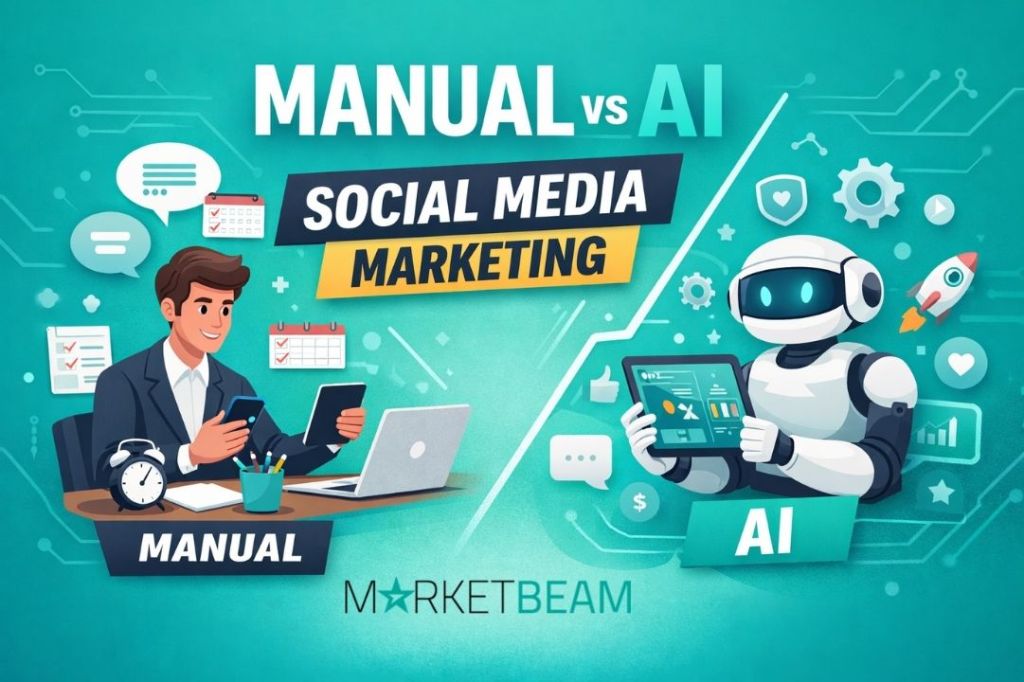
Manual vs AI social media marketing is one of the biggest decisions businesses face in 2026, especially in industries like pharma, fintech, and life sciences. With the rise of social media automation, employee advocacy software, and compliance-driven marketing, companies are shifting from manual processes to AI-powered platforms like MarketBeam.In 2026, social media has become a critical growth channel across industries, but the way companies approach it is rapidly changing. Businesses in sectors like biotech, pharma, healthcare, and fintech are no longer just experimenting with digital platforms they are investing heavily in social media automation, employee advocacy programs, and compliance-driven marketing systems. This shift raises an important question: is manual social media marketing still relevant, or has AI completely taken over?
The answer lies in understanding how both approaches function, especially in highly regulated environments where social media compliance, governance, and approval workflows are essential.
The Shift from Manual to AI-Driven Marketing
Traditional social media marketing relied on human effort at every stage, from content creation to publishing and reporting. Teams would manually schedule posts, track performance through basic metrics, and coordinate approvals over emails or spreadsheets. While this approach offered creative flexibility, it struggled to keep up with the demands of scale, speed, and accuracy—especially in industries like digital marketing in pharma industry or life science digital marketing, where compliance is not optional.
AI-powered platforms such as MarketBeam have transformed this landscape by introducing automated social media posting, intelligent scheduling, and advanced analytics. Instead of relying on guesswork, businesses can now use data to drive decisions, optimize timing, and maximize social media reach across multiple platforms simultaneously.
Challenges of Manual Marketing in Pharma, Biotech, and Fintech
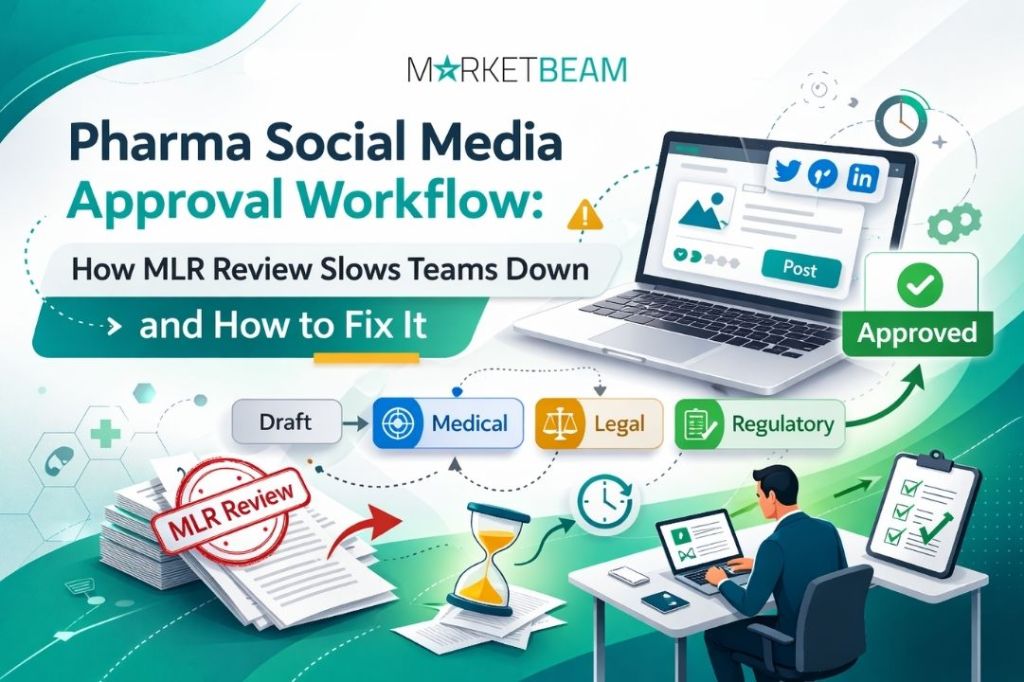
Manual social media marketing becomes particularly difficult in industries governed by strict regulations. In the pharmaceutical sector, for instance, every piece of content often goes through a medical legal regulatory review (MLR review pharma) process before it can be published. This creates delays, increases operational overhead, and limits the ability to respond quickly to market trends.
Similarly, in fintech, compliance with FINRA social media rules requires careful monitoring and documentation of all communications. Without dedicated social media compliance software, businesses risk penalties and reputational damage. In healthcare and life sciences, where scientific content marketing and biotech advertising demand accuracy and credibility, manual processes can lead to inconsistencies and inefficiencies.
As a result, relying solely on manual efforts makes it extremely difficult to scale campaigns, maintain compliance, and achieve consistent growth in digital marketing for life sciences or healthcare social media marketing.
How AI is Transforming Social Media Marketing
AI-driven platforms are designed to solve exactly these challenges. By integrating social media compliance tools, automated approval workflows, and intelligent publishing systems, they allow businesses to operate at scale without compromising on governance. Tools like MarketBeam enable companies to manage everything from content marketing for life sciences to digital marketing for fintech companies within a single ecosystem.
One of the most powerful capabilities of AI marketing is the ability to automate repetitive tasks. Features like scheduling social media posts, automated content publishing, and cross-platform distribution significantly reduce manual effort. This is especially valuable for organizations managing multiple brands or accounts, where understanding how to manage multiple social media accounts efficiently becomes a key challenge.
AI also enhances decision-making through real-time insights. Businesses can track engagement, analyze audience behavior, and calculate performance using metrics such as marketing reach calculator models and employee advocacy analytics. This data-driven approach ensures that campaigns are continuously optimized for better results.
The Role of Employee Advocacy in AI Marketing
Another major advantage of AI-powered systems is their ability to scale employee advocacy. Instead of relying solely on brand pages, companies can leverage employees as trusted voices to amplify content. An effective employee advocacy platform allows organizations to distribute approved content to employees, track engagement, and measure ROI.
This approach is particularly effective in industries like pharma and biotech, where trust and credibility are crucial. Employee advocacy programs not only increase visibility but also humanize the brand, making it easier to connect with audiences. Many organizations have already seen success through employee advocacy examples and structured employee advocacy program management, where employees act as brand ambassadors across LinkedIn and other platforms.
In comparison, manual advocacy efforts are difficult to coordinate and scale, making AI-powered employee advocacy tools a far more efficient solution.
AI vs Manual: Which Performs Better?
When comparing manual and AI-driven approaches, the difference becomes clear in terms of efficiency, scalability, and compliance. Manual marketing offers more direct control and a personal touch, but it struggles with consistency and speed. AI marketing, on the other hand, excels in automation, analytics, and governance, making it ideal for businesses that need to operate at scale.
This is particularly evident in sectors like digital marketing pharma, biotechnology marketing, and financial services social media, where campaigns must balance creativity with strict compliance requirements. AI ensures that content is not only published efficiently but also adheres to regulatory standards such as pharma marketing compliance and social media risk and compliance management software protocols.
Manual vs AI Social Media Marketing Comparison
| Factor | Manual Marketing | AI Marketing |
|---|---|---|
| Time | High | Low |
| Scalability | Limited | High |
| Compliance | Risky | Automated |
| Analytics | Basic | Advanced |
| Efficiency | Low | High |
The Hybrid Approach: The Real Winner
Despite the advantages of AI, manual input still plays an important role. Creativity, storytelling, and human connection cannot be fully replaced by automation. The most effective strategy is a hybrid model where AI handles execution, analytics, and compliance, while humans focus on crafting meaningful narratives and engaging with audiences.
For example, businesses can use AI for social media publishing platforms, automated scheduling, and compliance checks, while marketing teams focus on developing compelling campaigns for life science branding or pharmaceutical digital marketing strategy. This balance allows companies to achieve both efficiency and authenticity.
Final Verdict
AI social media marketing is clearly the better choice for businesses aiming to scale, especially in regulated industries like pharma, biotech, and fintech. It provides the tools needed for automated publishing, compliance management, and data-driven growth. However, manual marketing still has value in maintaining a human touch and building genuine relationships.
For companies looking to stay competitive in 2026, the goal should not be choosing between manual and AI, but integrating both effectively. Platforms like MarketBeam make this integration seamless by combining automation, analytics, and advocacy into a single solution.
Conclusion
The future of social media marketing lies in intelligent automation supported by human creativity. As industries continue to evolve, businesses that adopt AI-driven strategies while preserving authenticity will be the ones that succeed. Whether it’s digital marketing for medical devices, life science lead generation, or pharma social media strategy, the combination of AI and human insight will define the next generation of growth.
FAQs: Manual vs AI Social Media Marketing
What is manual vs AI social media marketing?
Manual vs AI social media marketing refers to the difference between human-driven content management and AI-powered automation tools that optimize posting, analytics, and engagement.
Is AI better than manual social media marketing?
AI is better for scalability, automation, and analytics, while manual marketing is better for creativity and human connection.
Can AI fully replace social media managers?
No, AI cannot fully replace humans. The best approach is a hybrid model combining AI automation with human creativity.
What are the benefits of social media automation?
Social media automation helps in scheduling posts, improving consistency, increasing reach, and saving time.