In pharma, social media cannot move forward without control. Every post, caption, image, comment, and campaign may pass through multiple reviewers before it goes live. That is why a strong pharma social media approval workflow is not just helpful. It is necessary. When the workflow is unclear, teams lose time, campaigns get delayed, and compliance risk increases. When the workflow is structured well, teams can publish faster while still protecting the brand.
Many pharma companies still depend on long email threads, manual file sharing, spreadsheets, and disconnected review systems. At first, this may seem manageable. But as content volume grows, the system starts to break. One reviewer asks for edits in a slide deck. Another reviewer comments by email. A third person works from an older version. Marketing waits for sign-off while deadlines move closer. This is where the real problem begins. The issue is not MLR review itself. The issue is the lack of an efficient pharma social media approval workflow that supports speed, visibility, and compliance at the same time.
Why pharma teams need a social media approval workflow
Pharma companies operate in one of the most heavily regulated marketing environments. Social media content must be accurate, approved, and aligned with internal and external standards. Even a short post may raise questions around scientific accuracy, fair balance, risk disclosure, off-label interpretation, or adverse event handling. Because of this, social content often needs review from marketing, medical, legal, and regulatory teams before it can be published.
This is exactly why a pharma social media approval workflow matters. It creates a defined path from content creation to approval to publishing. It helps teams know who reviews what, when they review it, and what happens next. Without that structure, every asset becomes harder to manage. Review cycles become unpredictable, team members lose confidence in the process, and publishing becomes inconsistent.
A strong workflow also helps reduce the invisible costs of slow approvals. These costs include missed campaign timing, lower team productivity, delayed launches, and poor coordination across departments. In many cases, the content is ready, but the process is not.
What MLR review means in pharma social media
MLR stands for Medical, Legal, and Regulatory review. In pharma, MLR review exists to ensure that content is accurate, compliant, and appropriate for the intended audience. It plays a central role in protecting the company from regulatory issues and maintaining trust in brand communication.
When social media content enters MLR review, it may be checked for product claims, disease-state language, safety information, approved brand messaging, local regulatory requirements, and references to supporting materials. The shorter format of social media does not remove these concerns. In fact, it often makes the review more complex, because teams must communicate clearly in a limited space.
A well-designed pharma social media approval workflow makes MLR review easier to manage. It does not eliminate review. It organizes it. That distinction is important. Pharma teams do not need less compliance. They need less inefficiency around compliance.
How MLR review slows teams down
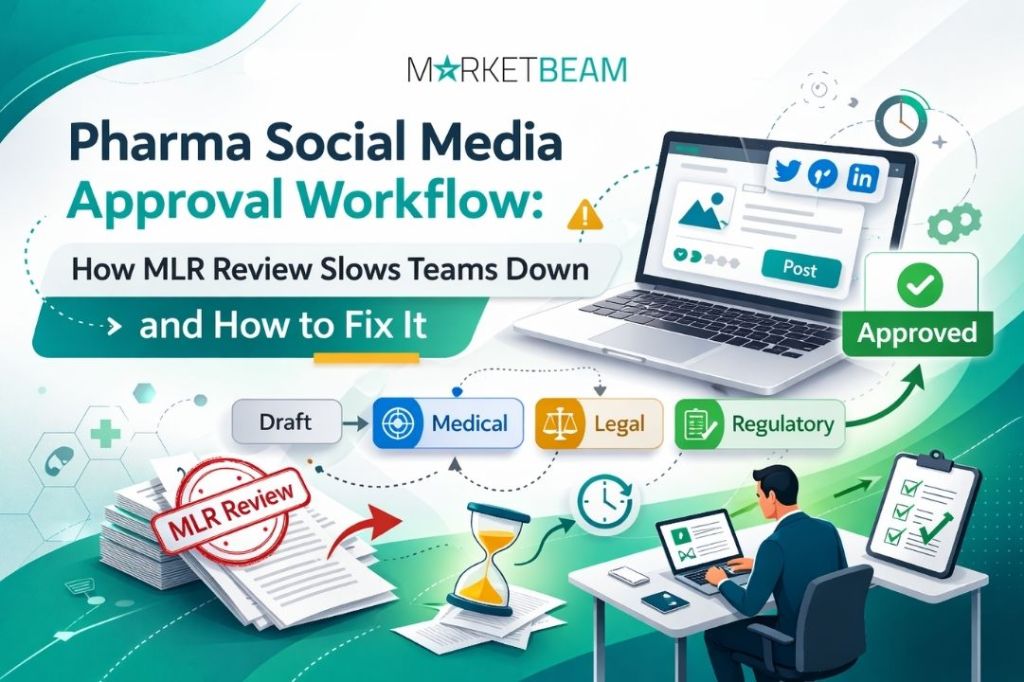
MLR review becomes a bottleneck when the workflow around it is fragmented. One of the most common problems is manual handoff. Marketing creates a draft and sends it for review. The reviewer comments on a PDF. Another person requests changes in email. Someone else updates the copy in a shared document. Then the revised version goes back for another round. This process repeats until nobody is fully sure which version is final.
Another major issue is sequential review. In many organizations, content goes from one team to the next in a fixed line. Medical reviews first, then legal, then regulatory. If one team suggests a change, the content may return to the beginning of the line. That creates long cycle times, especially for time-sensitive campaigns. A better pharma social media approval workflow reduces unnecessary waiting and brings more structure to how approvals are routed.
Lack of standards is another source of delay. When teams do not have approved templates, reusable language, or defined review criteria, reviewers spend time fixing the same problems again and again. Social posts that should be simple become over-reviewed because nobody knows what has already been approved. The result is slower publishing and higher frustration on all sides.
Visibility is often poor as well. Marketing may not know whether a post is waiting on legal, sitting with medical, or already approved with conditions. Reviewers may not know whether their feedback has been addressed. Leaders may not know which part of the workflow is creating the delay. Without visibility, the entire pharma social media approval workflow becomes reactive instead of manageable.
Signs your current process is slowing the team
You can usually tell when the workflow is broken. Posts take too long to publish even when they are simple. Teams keep asking for status updates. Different reviewers work from different versions. The same comments come up repeatedly. Content calendars look complete, but approved content is still not ready to go live. In some companies, marketing starts avoiding social opportunities because the review process feels too slow to support timely execution.
This is where many pharma organizations get stuck. They assume delay is normal because compliance is important. Compliance is important, but delay is not always necessary. A poor pharma social media approval workflow creates avoidable friction. A strong one removes waste while preserving oversight.
What an effective pharma social media approval workflow looks like
An effective workflow starts before the first review. It begins with clear content standards, approved messaging frameworks, and defined roles. When marketers create content from approved foundations, they reduce risk early. That means fewer surprises later in the process.
Next, content should be routed based on risk level. Not every social post needs the same depth of review. A corporate culture post may require a lighter path than a branded promotional post. A disease awareness campaign may need more scrutiny than an event reminder. A mature pharma social media approval workflow recognizes these differences and builds review paths accordingly.
Feedback should be centralized in one place. This is one of the biggest improvements a company can make. When comments, edits, approvals, and version history live in a single system, everyone works from the same source of truth. Review becomes clearer, faster, and more traceable.
Roles should also be defined. Medical reviewers should know what they own. Legal should know what they are responsible for. Regulatory should review based on clear expectations, not on guesswork. Marketing should be able to guide content through the process without manually chasing each step. In a good pharma social media approval workflow, accountability is built into the structure.
Finally, approval should connect directly to publishing. Once content is approved, it should move into scheduling and publishing without rework, duplication, or manual recreation. This reduces the chance of errors and helps teams maintain consistency from review to launch.
Why generic tools do not solve this problem
Many social media tools are built for convenience and speed, but not for regulated review. They may offer scheduling, calendars, and basic approval options, but that is not enough for pharma. A pharma team needs traceability, controlled workflows, version visibility, role-based review, and audit support. These requirements go beyond standard publishing functionality.
This is why many organizations still struggle even after buying a social media tool. The platform may help them publish, but it does not improve the pharma social media approval workflow in a meaningful way. When the workflow remains fragmented, delays continue. The company simply moves the same process into a different interface.
How to fix a slow pharma social media approval workflow
The first step is to map the current process honestly. Teams need to see where delays happen, how many review rounds are typical, which content types create the most rework, and where version confusion starts. Without this visibility, improvement efforts stay too general.
The next step is to standardize recurring content. Social media often includes repeated formats such as event promotions, awareness content, hiring posts, leadership updates, and campaign variations. When companies create approved frameworks for these formats, review becomes faster and more predictable. This reduces unnecessary back-and-forth and supports a more scalable pharma social media approval workflow.
Companies should also separate low-risk and high-risk content paths. This is one of the simplest ways to improve speed without reducing compliance. If every post enters the same heavy review route, the process becomes overloaded. When routing is based on risk, teams spend more time where it matters and less time where it does not.
Another major improvement is building a reusable content library. Previously approved language, disclaimers, visuals, and content blocks should not disappear after one campaign. They should become part of a controlled system that marketers can use again. This reduces drafting time and helps reviewers focus on what is new.
Workflow automation also matters. Automated routing, reminders, status tracking, and approval logging remove much of the manual coordination work from the marketing team. Instead of chasing people for feedback, teams can rely on a process that moves content forward in a consistent way. This is where the pharma social media approval workflow becomes more reliable and less dependent on individual follow-up.
How MarketBeam helps improve the workflow
MarketBeam helps regulated teams build a more effective pharma social media approval workflow by connecting review, governance, and publishing in one environment. Instead of managing content across scattered tools, teams can centralize collaboration and move through approvals with better visibility and control.
This matters because pharma teams need more than a scheduler. They need a workflow system that supports compliant publishing. With MarketBeam, teams can manage approvals more clearly, reduce confusion around versions, create better visibility into bottlenecks, and maintain records that support audit readiness. The goal is not only to move faster, but to move faster with confidence.
For pharma organizations, this kind of workflow improvement creates real operational value. It helps marketing teams stay on schedule. It helps reviewers work more efficiently. It helps leadership understand where content is delayed and why. Most importantly, it turns the pharma social media approval workflow into a scalable process instead of a recurring source of frustration.
Long-term best practices for sustainable improvement
A strong workflow is not a one-time project. It needs regular refinement. Review timelines should be defined clearly so content does not sit idle. Teams should be trained on social-specific compliance expectations so they understand how social differs from longer-form assets. Approval data should be reviewed over time to identify patterns, bottlenecks, and recurring revision themes.
It is also important to keep approved templates and content guidance updated. Pharma messaging evolves. Campaign priorities change. Regulations shift. A healthy pharma social media approval workflow stays current and reflects how the organization actually communicates in the market.
Cross-functional alignment matters too. The most effective workflows are not built in isolation by marketing or compliance alone. They are designed collaboratively. When medical, legal, regulatory, and marketing teams agree on roles, risk levels, and review expectations, the process becomes stronger and faster.
Conclusion
Pharma companies do not have the option to ignore review. But they do have the option to improve how review works. A slow process is not always the result of strict regulation. Often, it is the result of fragmented tools, unclear ownership, manual handoffs, and a poorly designed pharma social media approval workflow.
When the workflow is modernized, pharma teams gain more than speed. They gain consistency, visibility, accountability, and confidence in every post they publish. MLR review remains essential, but it no longer needs to slow the business down.
The companies that succeed in regulated social media are not the ones that remove control. They are the ones that build a smarter pharma social media approval workflow that supports both compliance and execution. That is how pharma teams can move from approval delays to scalable, compliant publishing.