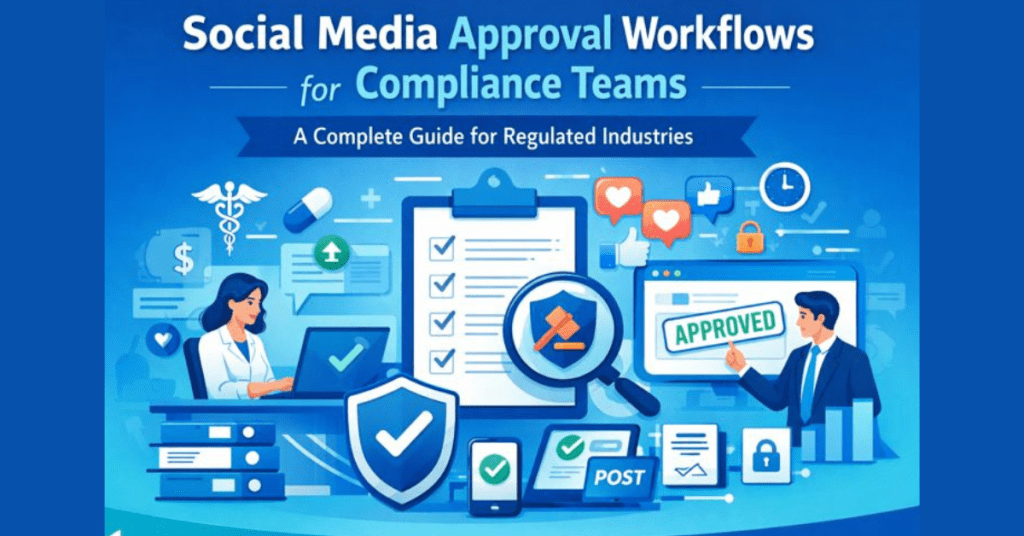
A Complete Guide for Regulated Industries
Social media is now a core communication channel for regulated industries such as pharmaceuticals, biotechnology, healthcare, medical devices, and financial services. It is used to educate audiences, support brand visibility, engage professionals, and amplify approved messaging at scale. However, unlike websites, brochures, or static campaigns, social media operates in real time—while regulatory oversight does not.
This fundamental mismatch has made social media approval workflows for compliance teams a critical operational requirement.
For compliance, legal, medical, and risk teams, social media is no longer just a marketing channel. It is a regulated publishing environment where every post, comment, and shared asset can carry legal, reputational, and regulatory consequences. Without structured approval workflows, organizations expose themselves to unnecessary risk, delayed campaigns, inconsistent messaging, and audit challenges.
This guide explains how compliance teams can design, implement, and scale effective social media approval workflows that enable faster publishing without sacrificing governance.
What Are Social Media Approval Workflows for Compliance Teams?
A social media approval workflow is a structured process that governs how content is created, reviewed, approved, published, and archived before it becomes publicly visible. For compliance teams, this workflow ensures that every piece of social content adheres to internal policies, brand guidelines, and external regulations.
Unlike basic marketing approvals, compliance-grade workflows must account for:
-
Regulatory requirements
-
Legal review and disclosures
-
Medical or risk validation
-
Regional and jurisdictional differences
-
Audit readiness
In regulated industries, social media approval workflows are not optional safeguards. They are the backbone of compliant digital execution.
Why Traditional Approval Models Fail in Regulated Social Media
Many organizations still rely on approval processes designed for static marketing assets such as brochures, PDFs, or website pages. These models typically involve email chains, document attachments, and manual sign-offs.
While this approach may work for long-form assets with extended timelines, it breaks down completely in social media environments.
Key reasons traditional approval models fail include:
Mismatch Between Speed and Governance
Social media operates in hours or minutes, while email-based approvals operate in days. This leads to missed opportunities or pressure to bypass compliance steps.
Lack of Version Control
Multiple versions of the same post circulate across email threads, making it unclear which version was approved and which one was published.
No Central Audit Trail
When approvals are scattered across inboxes, compliance teams cannot easily prove who approved what, when, or under which conditions.
Poor Cross-Team Visibility
Marketing, legal, and compliance teams often operate in silos, leading to misalignment and last-minute escalations.
Increased Risk During Paid and Amplified Campaigns
Paid social, boosted posts, and employee advocacy introduce new approval requirements that traditional workflows were never designed to handle.
These challenges make it clear that social media approval workflows for compliance teams must be purpose-built, not adapted from outdated processes.
The Role of Compliance Teams in Social Media Governance
Compliance teams play a central role in social media governance, even if they are not involved in daily publishing activities.
Their responsibilities include:
-
Defining what content is allowed or restricted
-
Ensuring disclosures, disclaimers, and fair balance where required
-
Monitoring regulatory obligations across regions
-
Preparing for audits, inspections, or legal inquiries
-
Reducing reputational and legal risk
A strong approval workflow allows compliance teams to fulfill these responsibilities without becoming bottlenecks.
Instead of reacting to issues after publication, compliance teams can proactively shape how content is created and approved.
Key Benefits of Social Media Approval Workflows for Compliance Teams
Well-designed approval workflows deliver measurable value across the organization.
Reduced Compliance Risk
Every post is reviewed against predefined rules, reducing the likelihood of violations, misleading claims, or unauthorized messaging.
Stronger Brand Consistency
Approval workflows ensure consistent tone, messaging, and positioning across all regions, teams, and platforms.
Faster Time to Publish
Contrary to common belief, structured workflows often increase speed by eliminating confusion, rework, and last-minute escalations.
Improved Collaboration
Marketing, legal, and compliance teams collaborate within a shared system rather than relying on disconnected tools.
Audit Readiness
Complete approval histories, timestamps, and version records simplify regulatory inspections and internal audits.
Common Types of Social Media Approval Workflows
There is no single approval model that works for every organization. Compliance teams should select workflows based on organizational size, content volume, and regulatory complexity.
Centralized Approval Workflow
In a centralized workflow, a single team or authority—often marketing combined with compliance—reviews and approves all content.
This model provides strong control and consistency but may struggle at scale.
Best suited for:
-
Small to mid-sized regulated organizations
-
Low to moderate content volume
Hierarchical Approval Workflow
Hierarchical workflows route content through multiple approval levels, often across regions or business units.
This model supports complex organizational structures but can introduce delays if not well designed.
Best suited for:
-
Large enterprises
-
Multi-region or multi-brand organizations
Collaborative Approval Workflow
Collaborative workflows allow marketing, legal, and compliance teams to review content simultaneously rather than sequentially.
This approach improves quality and alignment but requires clear ownership to avoid decision paralysis.
Best suited for:
-
Cross-functional teams
-
High-stakes or sensitive content
Automated Approval Workflow
Automated workflows rely on predefined rules, templates, and permissions to reduce manual review.
Low-risk or pre-approved content can move faster, while higher-risk posts trigger deeper review.
Best suited for:
-
High-volume publishing environments
-
Mature compliance programs
User-Generated Content and Employee Advocacy Workflow
This workflow governs how employee-shared or community-generated content is reviewed before amplification.
It is critical for organizations that use employee advocacy while maintaining regulatory control.
Best suited for:
-
Organizations with active employee advocacy programs
Designing an Approval Workflow That Works for Compliance Teams
Creating an effective workflow requires more than mapping steps. It requires alignment between compliance, marketing, and leadership.
Step 1: Define Roles and Responsibilities
Clearly document who is responsible for:
-
Compliance and legal review
-
Final approval
-
Publishing
-
Post-publication monitoring
Role clarity reduces delays and accountability gaps.
Step 2: Establish Clear Approval Guidelines
Compliance teams should document:
-
Brand voice and messaging rules
-
Regulatory and disclosure requirements
-
Prohibited content categories
-
Crisis escalation procedures
These guidelines form the foundation of all approvals.
Step 3: Centralize the Approval Process
Approvals should happen inside a single system rather than across email, chat tools, and shared drives.
Centralization improves visibility, traceability, and accountability.
Step 4: Align the Workflow With Content Planning
Approval workflows should integrate with content calendars so compliance teams have visibility into upcoming campaigns and posts well in advance.
This reduces last-minute approvals and reactive decision-making.
Step 5: Introduce Automation Strategically
Automation should support compliance, not bypass it.
Examples include:
-
Auto-approving pre-approved templates
-
Routing high-risk content to senior reviewers
-
Enforcing mandatory disclosures
Step 6: Measure and Optimize
Compliance teams should track metrics such as:
-
Average approval time
-
Rejection reasons
-
Workflow bottlenecks
-
Revisions per post
Continuous optimization ensures workflows remain effective as content volume grows.
Approval Workflows Across Different Regulated Industries
Pharmaceuticals and Life Sciences
Pharma workflows often require medical, legal, and regulatory (MLR) review. Approval timelines must align with fast-moving social campaigns while maintaining strict compliance.
Key considerations include fair balance, claims substantiation, and adverse event monitoring.
Healthcare and Medical Devices
Healthcare organizations must ensure patient privacy, accurate information, and ethical communication.
Approval workflows help prevent HIPAA violations and misleading health claims.
Financial Services
Financial firms must comply with regulations related to disclosures, recordkeeping, and advertising standards.
Approval workflows ensure all social content meets regulatory obligations and remains archived for audit purposes.
Why Tools Matter in Compliance-Grade Approval Workflows
Manual workflows quickly become unmanageable as content volume grows.
While generic project management tools can support basic approvals, they often lack:
-
Role-based compliance controls
-
Audit-ready approval records
-
Regulated publishing features
This is where purpose-built platforms become essential.
MarketBeam is designed specifically to support social media approval workflows for compliance teams in regulated industries.
By combining structured approvals, version control, governed employee advocacy, and compliance-ready audit trails, MarketBeam enables organizations to publish confidently without slowing down marketing execution.
The Shift From Approval to Governance
Modern compliance teams are moving beyond reactive approvals toward proactive governance.
Instead of reviewing every post manually, they:
-
Define rules upfront
-
Enable safe automation
-
Monitor compliance continuously
-
Intervene only when necessary
Approval workflows are the mechanism that enables this shift.
Final Thoughts
Social media is not slowing down. Regulations are not loosening.
For regulated industries, the only sustainable path forward is to treat social media as a governed publishing environment.
Social media approval workflows for compliance teams are no longer a support function. They are compliance infrastructure.
Organizations that invest in structured, scalable workflows gain:
-
Faster execution
-
Lower risk
-
Stronger brand control
-
Audit confidence
Those that rely on outdated approval methods will continue to face delays, risk, and regulatory exposure.
With MarketBeam, MedTech companies can manage influencer content, track engagement, and automate compliance—all within one secure platform.
👉 Learn more about Social Media Compliance for MedTech