Introduction: Compliance at a Crossroads
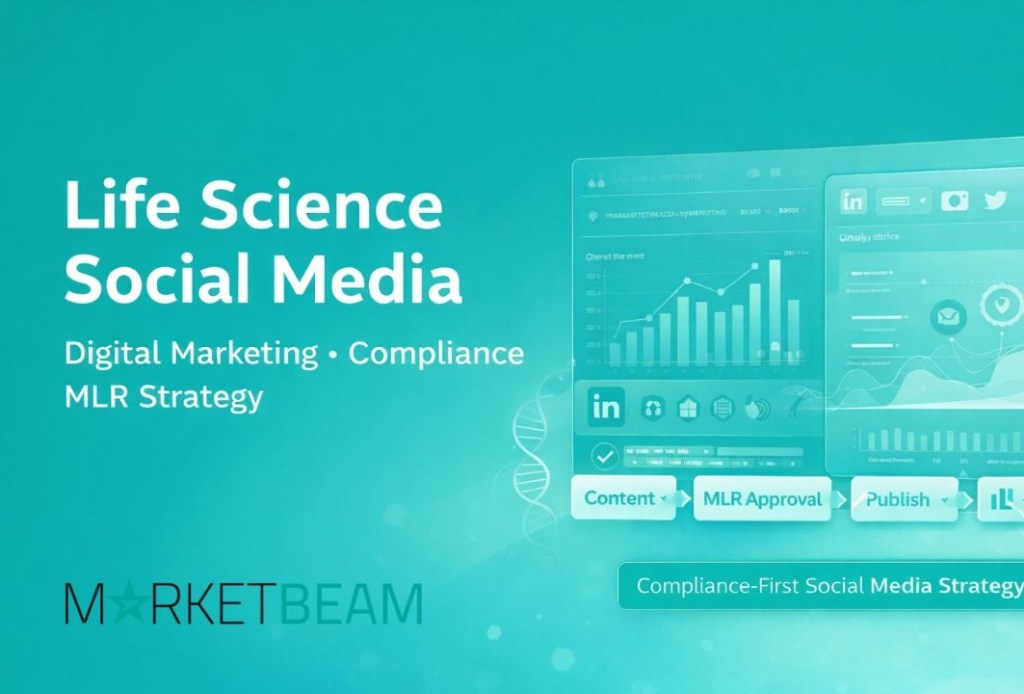
The explosion of omnichannel engagement, real-world evidence (RWE) studies, and influencer partnerships has made social media an indispensable channel for pharma, biotech, and med-tech brands. Yet every tweet, infographic, or 15-second reel is a potential regulatory filing and the scrutiny is only intensifying. As we move toward 2030, digital content compliance in life sciences will define competitive advantage as much as science itself. Companies that can accelerate review cycles, preserve scientific accuracy, and prove audit-readiness will win mindshare and market share. MarketBeam’s mission is to help them do exactly that by embedding automated review, Veeva social media publishing, and AI-driven monitoring directly into day-to-day workflows.
1. A New Regulatory Era (2025-2030)
Recent policy shifts confirm that regulators expect the same rigor online as in product labeling:
-
FDA “Internet & Social Media” Final Guidance (January 2025). The Office of Prescription Drug Promotion (OPDP) expanded its 2014 draft to mandate balanced risk language in any short-form social post. (fda.gov)
-
FDA TV/Radio Ad Rules (effective Nov 20 2024) now outlaw distracting visuals or sound effects when listing risks signaling broader intolerance for gimmicky claims across channels. (apnews.com)
-
EU AI Act (August 2024) introduces a risk-based framework; “high-risk” medical marketing algorithms must log decision logic and bias tests. (sciencedirect.com, pubmed.ncbi.nlm.nih.gov)
Collectively, these moves elevate digital content compliance in life sciences from an operational burden to a board-level priority.
2. Forces Driving Change
Several converging trends accelerate the need for agile governance:
-
Generative AI content surges. Large-language-model tools create drafts in seconds, but also hallucinate or misinterpret labeling.
-
Hyper-segmented advertising. First-party data strategies, recommended by Veeva’s 2025 commercial outlook, demand flawless consent management. (veeva.com)
-
Global transparency acts. From Canada’s VANDA to Australia’s MISB, new rules echo the EU’s disclosure mindset.
The result: more content, more channels, and exponentially more touchpoints where digital content compliance in life sciences can break down.
3. Technology Enablers: From Rule-Based to Intelligent
Tomorrow’s compliance stack will marry deterministic logic with probabilistic AI:
Capability |
2022 State |
2025-2030 Trajectory |
Keyword flagging |
Static term lists |
NLP models discerning context & claim substantiation |
Audit trails |
PDF exports |
Immutable, blockchain-anchored ledgers |
Risk scoring |
Manual |
Predictive AI assigning probability of regulator action |
MarketBeam already embeds machine-learning “MLR Pre-Check,” catching off-label implications before human review. When combined with NLP frameworks tuned to FDA and EMA lexicons, the system slashes re-work hours a glimpse of how digital content compliance in life sciences will look in 2030.
4. Integrated Ecosystems: Veeva, MarketBeam & Real-Time Publishing
Siloed platforms once forced marketers to copy-paste assets from Veeva Vault into social tools, risking version drift. Native connectors now change the game:
-
Veeva social media publishing APIs let MarketBeam pull the final PromoMats-approved asset title, body copy, references, and risk statements directly into the post composer.
-
Status sync flows two ways: as soon as medical/legal rejects a revision in Vault, MarketBeam pauses scheduled posts, eliminating accidental breaches.
This tight loop not only guarantees compliance but also shrinks cycle time, a critical KPI as digital content compliance in life sciences becomes a speed race.
5. Data Governance & Privacy by Design
Regulators increasingly link content compliance with data ethics. Expect:
-
Mandatory explainability for any AI that personalizes copy.
-
Event-level consent logs for HCP targeting.
-
Convergence of GMP (Good Manufacturing Practice) and GVP (Good Pharmacovigilance Practice) records with social publishing metadata.
MarketBeam encrypts every post payload, stores logs for 10 years, and maps user roles to Vault permissions, ensuring digital content compliance in life sciences from molecule to message.
6. Predictive Monitoring & Real-Time Intervention
Static compliance checks end once the post goes live; future systems will “listen forward”:
-
AI sentiment engines flag patterns that hint at Adverse Events.
-
Computer vision scans creative for imagery that could contradict risk language after new safety findings.
-
Real-time benchmarks compare engagement spikes to historical MLR approvals, alerting teams if a post behaves anomalously.
These capabilities transform digital content compliance in life sciences from detective work into preventive medicine.
7. Human Skills & Cross-Functional Collaboration
As automation handles rote checks, talent priorities shift:
Role |
Evolving Skillset |
Medical reviewers |
Prompt engineering, AI audit interpretability |
Marketers |
Data storytelling, risk-aware creative ideation |
Compliance officers |
Algorithmic bias analysis, global signal harmonization |
Unified dashboards like MarketBeam’s “Compliance Cockpit” provide a single source of truth, fostering shared accountability for digital content compliance in life sciences.
8. Future Scenarios (2027-2030)
Scenario 1: Zero-Click Approval
Regulators accept AI-generated attestations, and pre-approved content moves from concept to publish with no manual gatekeeping.
Scenario 2: Federated Review Networks
Pharma alliances share anonymized compliance data via blockchain, raising baseline standards and reducing redundant reviews.
Scenario 3: Personalized Risk Scores
Every HCP profile carries a real-time risk tolerance; content auto-tailors safety emphasis accordingly.
Under every scenario, integrated platforms like MarketBeam reinforced by Veeva social media publishing workflows serve as the nervous system that keeps content compliant at scale.
9. MarketBeam in Action: Faster Time-to-Yes
A top-20 pharma client integrated MarketBeam with Veeva PromoMats:
-
44 % faster MLR cycle
-
90 % reduction in post-launch edits
-
Single-click audit exports during a surprise FDA 483 inspection
10. Your 6-Step Roadmap to 2030
-
Audit your current stack. Identify duplicate workflows between social tools, DAMs, and Veeva Vault.
-
Adopt first-party data capture. Future privacy rules favor owned data over cookies.
-
Embed AI pre-checks. Start with low-risk assets to build trust.
-
Cross-train teams. Upskill reviewers on prompt engineering and bias detection.
-
Simulate future regulation. Run tabletop exercises for EU AI Act audits or FDA digital inspections.
-
Choose trusted vendors. MarketBeam’s certified Veeva connector and audit-ready logs future-proof programs today.
Conclusion: Compliance as Competitive Advantage
The next five years will see an unprecedented convergence of regulation, technology, and consumer expectation. Companies that treat digital content compliance in life sciences as a growth driver not a checkbox will unlock faster launches, deeper engagement, and defensible market positions. With MarketBeam’s AI engine, immutable audit trails, and seamless Veeva social media publishing integration, your brand is ready for whatever 2030 brings. Now is the moment to modernize workflows, retrain teams, and make compliance the catalyst of innovation.
Ready to future-proof your social publishing? Book a demo today and experience end-to-end compliance in action.