A New Era for MedTech: UK and US Join Forces on AI and Regulatory Reform
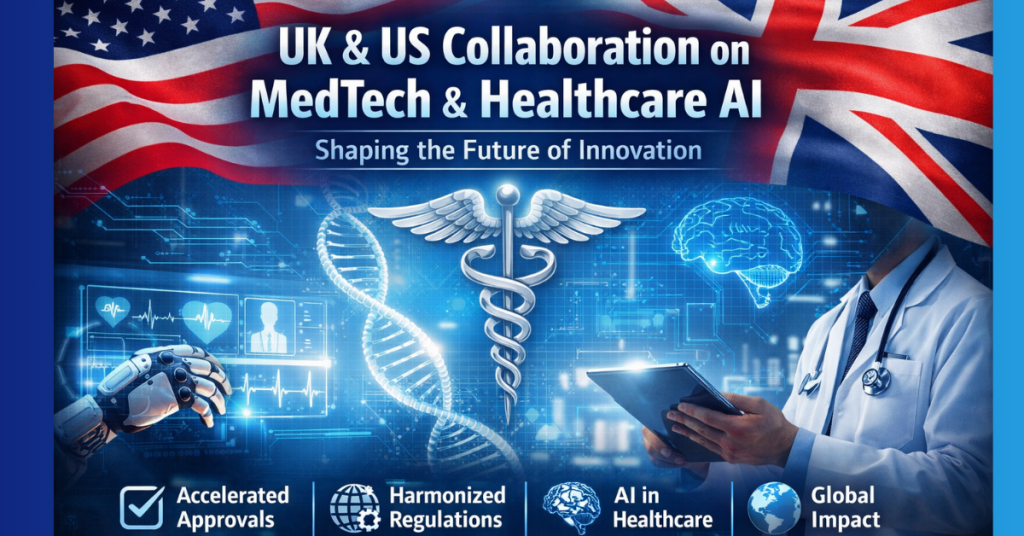
In a landmark announcement, the UK’s Medicines and Healthcare products Regulatory Agency (MHRA) confirmed a major new partnership with the U.S. Food and Drug Administration (FDA).
This collaboration aims to accelerate safe access to innovative medical technologies and AI-driven healthcare solutions by aligning regulatory pathways across both nations.
This is a major step toward creating a globally connected health innovation ecosystem.

🔹 Key Announcements at a Glance
| Initiative | What It Means |
|---|---|
| UK–US MedTech Collaboration | Closer alignment + shared regulatory initiatives |
| Launch of National AI Commission | New body guiding safe AI in healthcare |
| Faster UK Market Access for FDA-approved devices | Accelerated pathways to launch in Britain |
| New Legislation in 2026 | MedTech reform infrastructure |
| NHS Access & Scaling Advantage | Real-world data + national testing ground |
🧭 Why This is a Significant Moment
This is the first time two of the world’s most influential health regulators have formally aligned on:
-
medical device oversight
-
AI in healthcare governance
-
safety accelerators
-
international reliance frameworks
This signals a future where innovation can cross borders more easily.
🧠 National AI Commission: Who is Involved?
The newly launched commission includes leaders from:
-
Microsoft
-
Google
-
Center for AI Innovation in Healthcare
-
Coalition for Health AI (CHAI)
-
UK universities
-
NHS organizations
-
public health commissioners
-
regulatory science leaders
🌍 Faster Approval Through “International Reliance Routes”
What does this mean?
If a medical device is already approved by the FDA (US), it will soon be able to access the UK market faster — without repeating the entire approval process.
Eligible U.S. approvals:
| FDA Pathway | Description |
|---|---|
| 510(k) | Substantial equivalence pathway |
| De Novo | New, low-to-moderate risk innovations |
| PMA | Highest regulatory standard |
This cuts YEARS off approval cycles.
🏥 The Role of the NHS in Innovation
The NHS is uniquely positioned globally:
-
65 million patients
-
unified healthcare system
-
integrated clinical dataset
-
real-world monitoring ability
This allows the UK to become a test-bed for global innovation.

🚀 Industry Impact Overview
Who Benefits Most
| Beneficiary | Advantages |
|---|---|
| Patients | Earlier access to safer innovations |
| MedTech Startups | Faster commercialization pathways |
| Investors | Reduced regulatory uncertainty |
| Health Systems | Better access to advanced care tools |
| AI Innovators | Clearer regulatory standards |
🔍 Strategic Takeaways for MedTech Leaders
This shift signals:
➡ A unified approach to healthcare AI
➡ Reduced approval redundancy
➡ Stronger post-market monitoring
➡ Global evidence-sharing
➡ A patient-safety-first innovation model
This is a framework to accelerate—while safeguarding.
📊 High-Level Timeline
| Year | Update |
|---|---|
| 2025 | Announcement + AI Commission launched |
| 2026 | Reform enters legislation |
| 2027 | International reliance routes open |
📣 Conclusion
The expanded MHRA–FDA collaboration is a watershed moment for global medical innovation.
By aligning regulatory frameworks, enabling faster access to cutting-edge technologies, and promoting trustworthy AI in healthcare, this partnership sets the stage for transformation across the entire healthcare ecosystem.
This is not just regulatory alignment —
this is the next chapter in accelerated, safer, global medtech innovation.