Understanding the Life Sciences Software Market
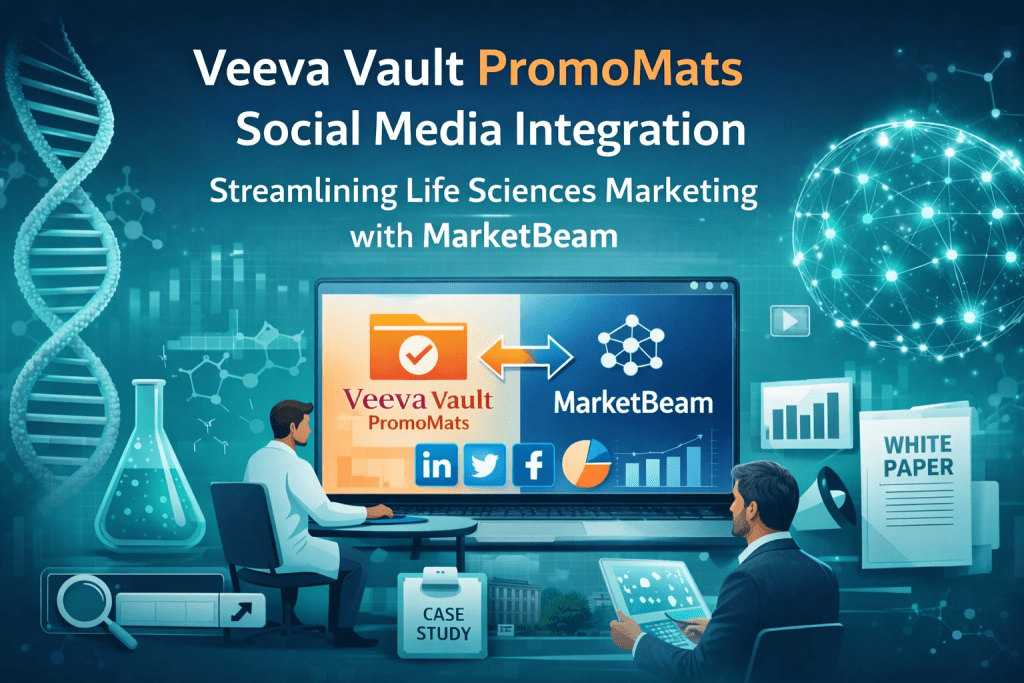
The life science software market is evolving rapidly, and Veeva Vault PromoMats social media integration is becoming a critical requirement for regulated marketing teams. Pharmaceutical companies, biotech innovators, and medical device manufacturers depend on compliant systems to manage documentation, approvals, and governance across digital channels.
At the core of many enterprise stacks is Veeva Vault PromoMats, a system built to manage promotional materials through structured medical legal regulatory review processes. It ensures traceability, audit readiness, and documentation continuity across marketing and regulatory teams.
However, while compliance infrastructure is mature, distribution infrastructure often remains disconnected. This disconnect creates operational friction in life sciences marketing. Approved content sits securely within governance systems, yet publishing and analytics tools operate independently.
In an industry where compliance is foundational, fragmentation is not sustainable.This is exactly why Veeva Vault PromoMats social media integration must be built into your publishing workflow. MarketBeam delivers that alignment.
Compliance, MLR Healthcare, and the Reality of Life Sciences Marketing
Life sciences marketing differs fundamentally from most other industries. Every message must pass medical legal regulatory review before public distribution. The MLR healthcare process protects patient safety, ensures scientific accuracy, and reduces regulatory risk.
Unlike digital marketing for fintech companies, where compliance centers on financial disclosures and advertising transparency, digital marketing life sciences initiatives require therapeutic claim validation, adverse event monitoring, and scientific substantiation.
The margin for error is minimal.
When marketing teams export approved assets from PromoMats into standalone scheduling tools, they introduce manual processes that weaken governance continuity. Documentation trails can become fragmented. Version control may suffer. Reporting becomes disconnected from approved assets.
In a regulated environment, this is more than inefficiency. It is exposure.
The Organic Reach Challenge in Digital Marketing Life Sciences
Organic reach is essential in modern life sciences marketing. LinkedIn thought leadership, executive branding, and scientific education campaigns have become central to pharmaceutical visibility.
Marketing leaders often rely on tools such as a linkedin reach calculator to estimate impressions and engagement potential. While these forecasts provide directional insight, reach alone does not define success in regulated industries.
Organic reach must coexist with compliance.Without integration, growth increases risk. With MarketBeam, growth remains governed.
Without structural integration between approval workflows and publishing platforms, scaling visibility increases complexity. Teams must manually ensure that published posts match previously approved documentation. This slows campaign velocity and increases compliance pressure.
MarketBeam addresses this by enabling organic reach expansion within governed workflows. Approved assets remain connected to their review history while moving seamlessly into distribution channels. This continuity ensures that digital marketing strategy for pharmaceutical companies remains compliant while still achieving measurable growth.
Why Generic Tools Fail in the Life Sciences Software Market
The broader life sciences software ecosystem emphasizes integration. Clinical systems connect with regulatory databases. Quality management platforms align with manufacturing oversight. CRM tools integrate with commercial operations.
Marketing technology should operate within this same framework.
Generic publishing tools are built for speed and convenience, not for regulated promotional environments. They are optimized for industries where medical legal regulatory review is not a structural requirement.
As a result, they create parallel processes for PromoMats users. Approved content must be exported. Documentation must be duplicated. Analytics systems remain disconnected from compliance infrastructure.
This fragmentation undermines operational precision in life science content marketing.
For organizations operating within PromoMats, the logical solution is not adding another isolated tool. It is extending compliance architecture into distribution workflows.
To understand the structural difference clearly, compare fragmented marketing stacks with an integrated, compliance-first model.
Fragmented vs Integrated Model in the Life Sciences Software Market
| Area | Fragmented Tools | MarketBeam Model |
|---|---|---|
| Medical Legal Regulatory Review | Manual export, audit gaps | Direct approval continuity |
| MLR Healthcare | Re-approvals required | Approval history preserved |
| Organic Reach | Compliance handled separately | Governed reach scaling |
| LinkedIn Campaigns | Reach estimate only | Reach + compliance linkage |
| Life Science Content Marketing | Content disconnected from MLR | Unified content + governance |
| Digital Marketing Life Sciences Analytics | Split reporting tools | Centralized performance view |
| Digital Marketing Strategy for Pharmaceutical Companies | Parallel compliance + publishing | Integrated growth framework |
| Risk Level | Higher exposure | Reduced compliance risk |
| Life Science Software Market Fit | Not built for regulated use | Designed for regulated marketing |
The difference is structural. Fragmented tools add complexity. MarketBeam removes it.
Why Veeva Vault PromoMats Social Media Integration Requires MarketBeam
MarketBeam is purpose-built for regulated industries that require structured publishing environments. Unlike conventional platforms, it aligns directly with compliance-driven ecosystems.
For PromoMats users, MarketBeam provides structural continuity. Approved content remains anchored to its medical legal regulatory review history as it moves into social publishing. This eliminates redundant approval steps and reduces manual risk.
Within the life science software market, integration defines competitive advantage. MarketBeam does not attempt to replace regulated systems. It extends them into digital channels.
This approach supports life sciences marketing objectives while preserving governance discipline. Marketing teams can accelerate campaigns without bypassing compliance safeguards. Regulatory teams maintain visibility into published content. Executive leadership gains access to unified reporting that connects approved assets with performance metrics.
In practical terms, this means faster execution, stronger audit readiness, and measurable digital impact.
Measuring ROI in Life Science Content Marketing
Modern life sciences marketing must demonstrate measurable outcomes. Organic reach, engagement growth, lead generation, and pipeline contribution all factor into executive evaluation.
However, measurement must remain tied to governed assets. If performance analytics operate separately from approval systems, reporting loses structural integrity.
MarketBeam connects digital marketing life sciences performance metrics with compliance documentation. Campaign results can be traced back to approved content, creating transparency across teams.
This alignment strengthens life science content marketing strategies by ensuring that visibility, engagement, and compliance operate within a unified ecosystem.
As the life science software market continues to mature, executive leaders increasingly demand this level of integration.
Digital Marketing Strategy for Pharmaceutical Companies in a Regulated Era
A successful digital marketing strategy for pharmaceutical companies must integrate governance with growth. It must enable organic reach expansion while protecting the integrity of medical legal regulatory review.
Disconnected tools create operational silos. Integrated systems create structural resilience.
MarketBeam enables pharmaceutical marketers to scale campaigns without increasing compliance exposure. In a landscape where scrutiny intensifies alongside digital expansion, this balance becomes critical.
Companies that align approval workflows, publishing infrastructure, and analytics systems will outperform those relying on fragmented solutions.
Conclusion
The life science software market is moving toward connected ecosystems. Regulatory platforms, CRM systems, and analytics tools are increasingly interoperable. Marketing cannot remain an exception.
For organizations using Veeva Vault PromoMats, the path forward is clear. Social publishing must operate within the same governance framework that controls promotional approvals.
MarketBeam stands as the only logical choice because it aligns organic reach, life science content marketing, and digital marketing life sciences initiatives with medical legal regulatory review standards.
Growth without compliance creates risk. Compliance without scalable distribution limits impact.
MarketBeam delivers both.
If your organization operates within PromoMats and seeks a compliant-first digital marketing strategy for pharmaceutical companies, now is the time to evaluate integration.
Schedule a demo with MarketBeam and transform how your life sciences marketing operates within the regulated digital era.