Generic scheduling tools were built for marketers who can post freely. In regulated industries, that freedom can become a risk. Life sciences organizations operate in environments where every piece of public communication may require regulatory oversight.
The most effective pharma and biotech teams today are turning compliance into a competitive advantage by integrating regulatory workflows directly into their social media publishing systems.
The Problem: The Hidden Cost of Using the Wrong Tool
When a pharmaceutical company’s marketing team schedules a post through tools like Hootsuite or Buffer, there is an invisible assumption built into the process — that the content has already passed every compliance review required.
In many industries, that assumption is harmless. In life sciences, it can create serious regulatory exposure. A single non-compliant post could trigger regulatory scrutiny, warning letters, or long-term reputational damage.
The issue is not that traditional social media tools are poorly designed. Platforms such as Sprout Social, Hootsuite, and Buffer are excellent products for general marketing teams that operate in non-regulated environments. Their primary purpose is to help marketers publish content faster and manage multiple channels efficiently.
However, they were never built for industries where every post related to a drug, medical device, or financial product must pass Medical, Legal, and Regulatory (MLR) review before publication.
Using a generic social media tool in a regulated environment is similar to using a consumer navigation app to guide an aircraft. It may appear to work initially, but the risk is embedded in the system itself.
Typical Impact of Legacy Social Media Workflows
-
$10K+ – Average cost per compliant post when using fragmented workflows
-
8–10 tools – Separate systems often required to publish one compliant post
-
40× potential increase – Engagement potential when employee advocacy is implemented correctly
The Compliance Gap: What “Scheduling” Misses in Regulated Industries
A typical MLR workflow in a pharmaceutical company often involves multiple disconnected systems:
-
Content creation tools
-
Email threads for feedback
-
SharePoint or Google Drive for version control
-
PDF markup tools for annotations
-
Social media scheduling platforms for publishing
These tools rarely communicate with each other. As a result, compliance teams spend a large portion of their time managing files and tracking revisions rather than reviewing content itself.
More importantly, most scheduling tools have no built-in awareness of regulatory approval status. This means the platform cannot prevent a post from going live before it has been approved.
In regulated industries, this creates a structural risk.
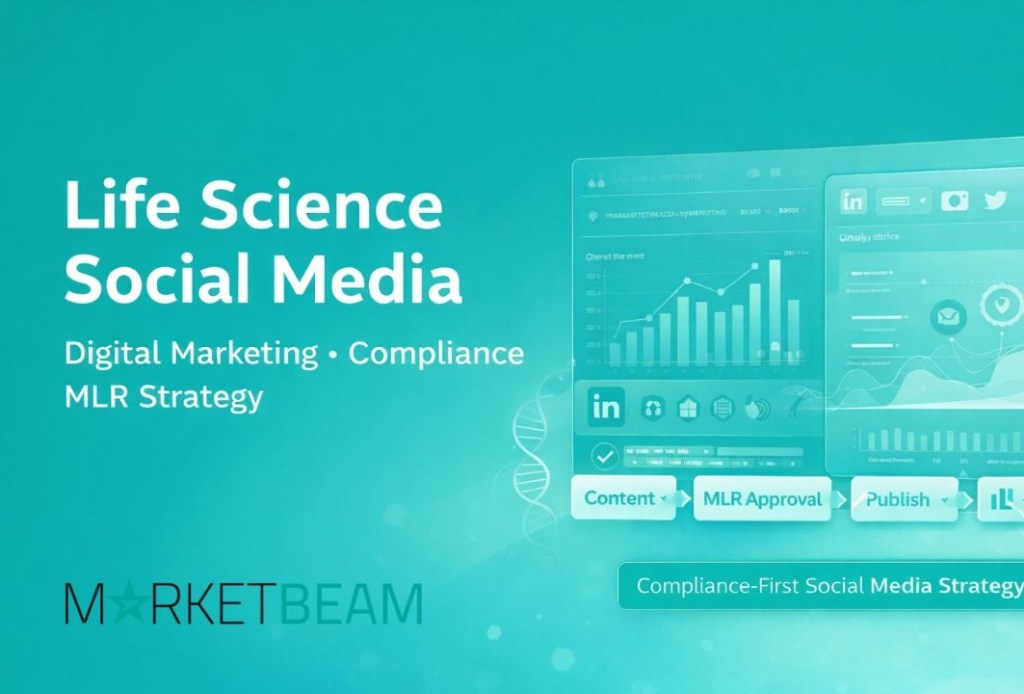
What companies truly need is a system where MLR review and publishing exist within the same workflow. Once a piece of content is approved by medical, legal, and regulatory reviewers, it becomes eligible for scheduling automatically — and not before.
This kind of structure cannot be added as a simple feature. It requires a platform designed from the beginning for regulated environments.
“The real question isn’t whether your team can post compliantly — it’s whether your tool is designed to make non-compliance structurally impossible.”
The Opportunity: Employee Advocacy in Life Sciences
Despite regulatory restrictions, employee advocacy represents one of the most powerful and underutilized communication channels in the pharmaceutical industry.
Consider a company with 500 employees. That organization effectively has 500 potential voices on professional networks like LinkedIn — including scientists, clinical experts, regulatory specialists, and commercial leaders.
These individuals often carry far more credibility with healthcare professionals than corporate brand accounts.
Research consistently shows that content shared by employees receives significantly higher engagement than the same content posted by company pages.
However, many pharma companies hesitate to launch employee advocacy programs for one key reason: compliance visibility.
Without a system that ensures only pre-approved content is shared, compliance teams cannot confidently allow employees to represent the organization online.
Ironically, the very compliance requirements that appear to limit employee advocacy are actually what make structured advocacy platforms extremely valuable.
Features such as:
-
Pre-approved content libraries
-
One-click employee sharing
-
Automated audit logs
turn compliance from a barrier into the infrastructure that enables scalable advocacy.
The Solution: What a Compliance-Native Platform Looks Like
The difference between generic social media tools and compliance-native platforms becomes clear when examining the content lifecycle.
1. Content Creation
Modern platforms assist teams during the drafting stage by identifying potential compliance issues before content reaches reviewers.
AI-assisted drafting tools can flag:
-
Missing disclaimers
-
Off-label product claims
-
Non-compliant messaging tone
This reduces the number of review cycles required during MLR approval.
2. Approval Workflow
Instead of relying on scattered email chains and document folders, compliance-native systems integrate the entire approval process into one environment.
Medical, legal, and regulatory reviewers can:
-
Comment
-
Annotate
-
Request edits
-
Approve content
within the same system where publishing will occur.
3. Distribution and Audit Trails
Once approved, the same platform manages publishing and employee distribution.
Every action — including shares, edits, comments, and reposts — is automatically logged. This creates the type of audit trail regulators expect during compliance reviews.
Integration with Industry Systems
Many life sciences organizations already rely on content management systems designed specifically for regulated industries.
For example, Veeva PromoMats is widely used for managing promotional materials and MLR workflows.
When a social media platform integrates directly with PromoMats:
-
Marketing teams can submit social content for MLR review directly from the publishing environment
-
Approved content automatically becomes eligible for scheduling
-
The manual step between “approved” and “published” disappears
This integration removes one of the most dangerous points in legacy workflows — the manual transfer of content between approval systems and publishing tools.
Generic Tools vs Compliance-Native Platforms
Generic social media platforms are designed primarily to manage marketing workflows.
Their approval systems typically function as internal management tools — for example, allowing a marketing manager to approve a junior employee’s post.
These workflows are not designed to enforce regulatory compliance.
There is no built-in mechanism preventing users from scheduling content before MLR approval because the platform itself does not recognize MLR status.
Compliance-native platforms operate differently.
In these systems:
-
Approval status becomes a hard gate
-
Unapproved content cannot be scheduled
-
Employee shares originate from pre-approved libraries
-
Every activity is logged for audit purposes
This changes the compliance model from assumed compliance to provable compliance.
How to Evaluate Your Current Social Media Setup
Companies can quickly determine whether their current social media tools introduce compliance risk by asking three simple questions.
1. Can someone schedule a post before regulatory review?
If any team member can publish content that has not gone through formal MLR approval, there is a compliance exposure.
2. Can you produce a complete approval history for all posts?
If a regulator asked for the approval history of every post published in the past two years, could your organization generate it from a single system?
If not, the audit trail is fragmented.
3. Do employees share from a pre-approved content library?
If employees compose their own posts when sharing company information, the organization has limited visibility into how its messaging appears in public.
The Takeaway: Compliance Is the Architecture
The most successful life sciences organizations on social media in 2025 are not the ones that bypass compliance requirements.
They are the ones that build their entire social strategy on top of compliance infrastructure.
When:
-
every piece of content is pre-approved
-
every employee share is tracked
-
every audit trail is automatically stored
compliance stops being a barrier and becomes the system that allows teams to move faster with confidence.
Employee advocacy at scale in regulated industries becomes possible only when the compliance layer is also the publishing layer.
This architectural shift is what separates platforms designed for regulated industries from those originally built for general marketing use.
And it is why the most effective pharma, biotech, and financial services teams are no longer relying on the same social media tools used by consumer brands.