Innovation is the foundation of biotechnology. However, innovation alone does not guarantee visibility, credibility, or commercial success. In today’s highly regulated environment, biotech companies must balance scientific advancement with compliant, scalable marketing strategies.
A well-defined biotech marketing strategy helps organizations communicate complex science, attract investors, build trust with stakeholders, and scale growth—without compromising regulatory requirements.
This guide explains how biotech companies can scale innovation through strategic, compliant digital marketing, and what frameworks work best in regulated industries.
Why Biotech Marketing Is Fundamentally Different
Unlike consumer or SaaS marketing, biotech marketing operates under strict regulatory oversight. Messaging must be accurate, non-promotional, and supported by evidence. Claims must withstand scrutiny from regulators, investors, partners, and healthcare stakeholders.
Key challenges include:
-
Complex scientific concepts that are difficult to simplify
-
Long sales and adoption cycles
-
High compliance and approval requirements
-
Multiple stakeholders, including investors, HCPs, regulators, and partners
As a result, biotech marketing is not about volume—it is about precision, credibility, and trust.
| Aspect | Biotech Marketing Strategy | Traditional Marketing |
|---|---|---|
| Industry Regulation | Highly regulated (FDA, FTC, EMA) | Minimal or none |
| Messaging Style | Evidence-based, educational | Promotional and persuasive |
| Audience | Investors, HCPs, regulators, partners | Consumers or end users |
| Content Approval | Mandatory review (MLR / legal) | Rarely required |
| Sales Cycle | Long and complex | Short to medium |
| Marketing Goal | Trust, credibility, adoption | Immediate conversion |
| Risk Sensitivity | Very high | Moderate to low |
The Role of Marketing in Scaling Biotech Innovation
Scaling innovation does not mean overselling scientific breakthroughs. It means clearly communicating value, impact, and potential across the right channels.
An effective biotech marketing strategy helps to:
-
Translate research into understandable value propositions
-
Build brand authority and credibility
-
Attract funding and strategic partnerships
-
Educate stakeholders without regulatory risk
-
Support long-term commercialization goals
Marketing becomes the bridge between scientific discovery and real-world impact.
Core Pillars of a Scalable Biotech Marketing Strategy
1. Clear Positioning and Scientific Storytelling
Strong biotech marketing starts with positioning. Companies must articulate:
-
What problem their innovation solves
-
Why it matters in a clinical, economic, or societal context
-
How it is differentiated from existing solutions
Scientific storytelling focuses on evidence-based narratives, not promotional language. Whitepapers, explainer content, and educational blogs help position the brand as an authority rather than a seller.
2. Content Marketing Built for Education and Trust
Content marketing plays a central role in biotech marketing strategy. Educational content supports awareness, credibility, and stakeholder confidence.
Effective biotech content formats include:
-
Research-driven blog articles
-
Thought leadership from scientists and leadership teams
-
Whitepapers and technical briefs
-
Webinars and conference recaps
-
Case studies and validation data
Each piece of content should be reviewed for compliance and aligned with approved messaging.
3. Digital Marketing Channels That Support Regulated Growth
Biotech companies increasingly rely on digital channels to reach global audiences. However, channel selection must align with regulatory realities.
Common digital channels include:
-
LinkedIn for investor relations, employer branding, and partnerships
-
SEO to capture high-intent scientific and investment queries
-
Email marketing for controlled, permission-based communication
-
Website content hubs for compliant education and resource sharing
The focus should be on quality engagement, not aggressive promotion.
4. Social Media Marketing Without Compliance Risk
Social media is often underutilized in biotech due to perceived compliance risks. However, when managed correctly, it can significantly increase brand visibility and credibility.
A compliant social media strategy includes:
-
Pre-approved content workflows
-
Controlled publishing and access management
-
Clear disclaimers and moderation policies
-
Audit-ready content history
Social media should be treated as an extension of scientific communication, not a promotional channel.
5. Marketing Compliance as a Strategic Advantage
In regulated industries, compliance is not a limitation—it is a differentiator.
A scalable biotech marketing strategy integrates compliance into every stage:
-
Content creation
-
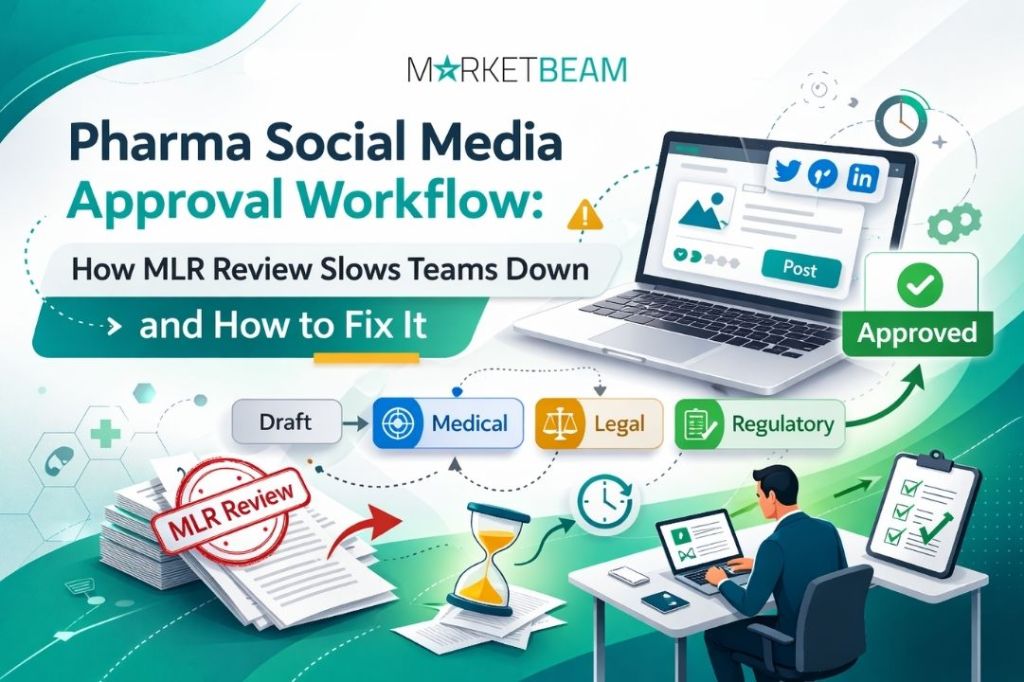
Review and approval (MLR or equivalent)
-
Publishing and amplification
-
Monitoring and reporting
When compliance workflows are streamlined using the right tools, marketing teams move faster with less risk.
How to Align Marketing with Investor Expectations
Investor audiences expect clarity, credibility, and data—not hype.
A strong biotech marketing strategy supports investor relations by:
-
Presenting consistent messaging across all digital touchpoints
-
Demonstrating market understanding and commercial readiness
-
Highlighting milestones, partnerships, and regulatory progress
-
Supporting valuation narratives with data and metrics
Marketing teams play a critical role in shaping perception long before formal investor discussions begin.
Using Data and Analytics to Scale Biotech Marketing
Data-driven decision-making is essential in biotech marketing. Analytics help teams understand what content resonates, which channels perform best, and how stakeholders engage over time.
Key metrics include:
-
Content engagement and reach
-
Website traffic by stakeholder segment
-
Campaign performance and lead quality
-
Social media visibility and employee amplification impact
Analytics provide the insights needed to refine strategy while maintaining compliance.
The Role of Marketing Platforms in Biotech Growth
As biotech companies scale, manual marketing processes become inefficient and risky. Centralized marketing platforms help teams manage complexity.
The right platform enables:
-
Controlled publishing and access governance
-
Built-in compliance workflows
-
Cross-channel analytics and reporting
-
Employee advocacy with audit trails
Technology allows biotech marketing teams to scale without increasing compliance exposure.
Common Mistakes in Biotech Marketing Strategy
Many biotech companies struggle with marketing due to avoidable mistakes:
-
Overly technical messaging without context
-
Inconsistent positioning across channels
-
Lack of compliance integration
-
Reliance on agencies without internal control
-
Poor measurement of marketing impact
Avoiding these pitfalls requires a structured, long-term approach.
Future Trends in Biotech Marketing
Biotech marketing continues to evolve as digital and regulatory environments change.
Key trends shaping the future include:
-
Greater use of compliant automation tools
-
Increased focus on thought leadership and education
-
Data-driven personalization within regulatory boundaries
-
Employee advocacy as a trusted amplification channel
-
Stronger alignment between marketing, compliance, and leadership teams
Companies that invest early in these capabilities gain a competitive advantage.
Conclusion: Scaling Innovation with the Right Biotech Marketing Strategy
Scaling innovation in biotech is not about louder marketing—it is about smarter, compliant communication.
A successful biotech marketing strategy:
-
Educates rather than promotes
-
Builds trust with investors and stakeholders
-
Integrates compliance into workflows
-
Uses data to guide decisions
-
Leverages technology to scale efficiently
By adopting a structured, compliant, and data-driven approach, biotech companies can amplify innovation, accelerate growth, and attract long-term investment—without regulatory risk.
With MarketBeam, MedTech companies can manage influencer content, track engagement, and automate compliance—all within one secure platform.
👉 Learn more about Social Media Compliance for MedTech
💼 Connect with Us on LinkedIn!
What is a biotech marketing strategy?
A biotech marketing strategy is a structured approach to promoting biotechnology innovations while complying with regulatory requirements. It focuses on education, credibility, investor communication, and long-term growth rather than direct promotion.
Why is biotech marketing considered a regulated activity?
Biotech marketing involves scientific claims, clinical data, and health-related information. Regulatory bodies such as the FDA and FTC require that all public communication is accurate, non-misleading, and supported by evidence.
How can biotech companies scale marketing without increasing compliance risk?
Biotech companies can scale marketing by using compliant marketing platforms, implementing structured content approval workflows, and relying on data-driven decision-making instead of manual processes.
Which digital marketing channels work best for biotech companies?
Websites, LinkedIn, email marketing, webinars, and compliant social media platforms work best for biotech companies. These channels support education, stakeholder engagement, and controlled communication.
Is social media safe for biotech marketing?
Yes, social media can be used safely in biotech marketing when content is pre-approved, publishing access is controlled, and audit trails are maintained for regulatory compliance.
How does marketing help attract biotech investors?
Marketing helps attract biotech investors by clearly communicating innovation value, market potential, regulatory progress, and long-term vision through consistent and credible digital messaging.
What metrics should biotech marketing teams track?
Key metrics include content engagement, website traffic, lead quality, social media reach, and investor inquiries. These metrics help demonstrate marketing ROI while maintaining compliance.
Why do biotech companies need marketing platforms instead of agencies?
Marketing platforms provide better control, built-in compliance workflows, transparency, and scalability. This is critical for biotech companies operating in regulated environments.