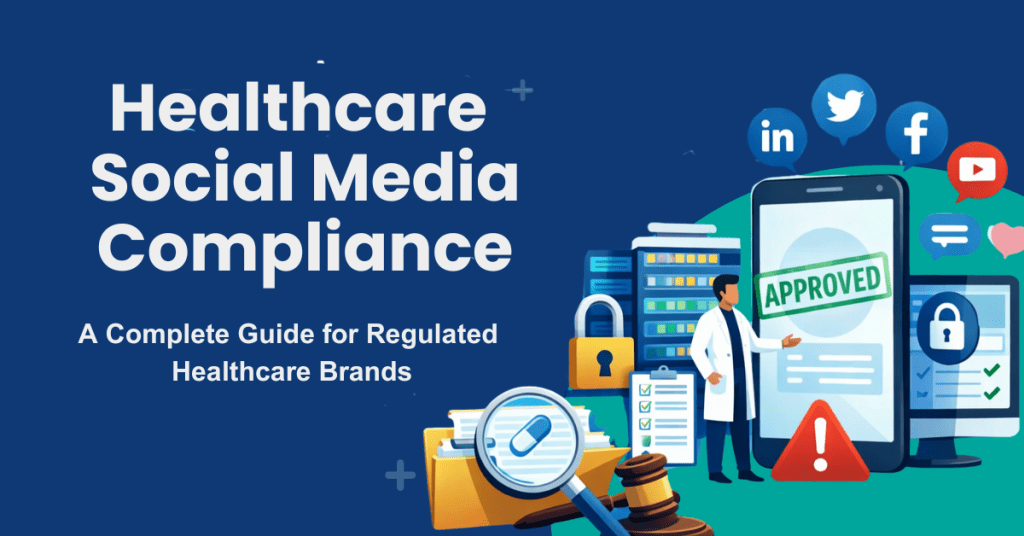
Social media has transformed how healthcare organizations communicate. Hospitals, pharmaceutical brands, biotech companies, medical device manufacturers, clinics, physicians, and healthcare startups all use platforms such as LinkedIn, X (Twitter), Facebook, Instagram, and YouTube to educate patients, promote innovation, recruit talent, and build trust.
However, healthcare is not a normal marketing industry. Every post, comment, image, testimonial, or employee interaction is governed by strict regulatory frameworks designed to protect patients, ensure truthful medical communication, and prevent harm. This is why Healthcare Social Media Compliance has become one of the most critical challenges facing modern healthcare organizations.
Unlike retail or consumer brands, healthcare companies operate under regulations such as HIPAA, FDA promotional rules, FTC advertising standards, state medical board guidelines, and pharmacovigilance obligations. Failing to manage social media in a compliant way can lead to severe financial penalties, lawsuits, regulatory action, brand damage, and loss of patient trust.
In this guide, we will explore what healthcare social media compliance really means, why it is so complex, where organizations fail, and how platforms like MarketBeam help healthcare brands scale social media safely and compliantly.
What Is Healthcare Social Media Compliance?
Healthcare social media compliance refers to the policies, controls, workflows, and technologies that ensure all social media activity meets legal, regulatory, ethical, and medical standards.
It governs:
-
What content can be published
-
Who can approve it
-
How it is reviewed
-
Where it is posted
-
How it is monitored
-
How long it is stored
-
How regulators can audit it
Healthcare social media compliance exists to protect:
-
Patient privacy
-
Patient safety
-
Medical accuracy
-
Fair advertising practices
-
Corporate liability
In simple terms, it ensures that healthcare brands do not use social media in a way that harms patients, misleads the public, or violates healthcare laws.
Why Healthcare Social Media Is So High-Risk
Social media platforms were designed for casual conversation, not regulated medical communication. Healthcare organizations face unique risks that most industries never encounter.
1. HIPAA and Patient Privacy Risks
The Health Insurance Portability and Accountability Act (HIPAA) protects all personally identifiable health information. A single social media post, comment, reply, photo, or testimonial can expose protected patient data.
Even well-intentioned posts like:
-
Thanking a patient
-
Sharing a recovery story
-
Responding to a comment
-
Posting photos from a clinic
can accidentally reveal private medical information. This makes social media one of the biggest HIPAA risk zones for healthcare organizations.
2. FDA and Promotional Compliance
Healthcare companies, pharmaceutical brands, and medical device manufacturers must follow FDA rules when promoting products or therapies.
On social media, this means:
-
No off-label promotion
-
No unapproved claims
-
Balanced risk and benefit information
-
No misleading testimonials
-
No selective data presentation
A single tweet, LinkedIn post, or influencer video that violates these rules can be considered illegal advertising.
3. Adverse Event Reporting
If a patient comments on a post saying a drug caused side effects, complications, or harm, that becomes a reportable adverse event.
Healthcare companies are legally required to:
-
Detect adverse events
-
Capture them
-
Submit them to regulators within strict timelines
Missing or ignoring these signals on social media can result in serious regulatory penalties.
4. Employee and HCP Social Media Activity
Doctors, nurses, medical reps, and healthcare employees are active on social platforms. Without controls, they may:
-
Share unapproved content
-
Discuss patients
-
Make medical claims
-
Promote products incorrectly
This creates huge compliance exposure for healthcare organizations.
Why Traditional Social Media Tools Fail in Healthcare
Most healthcare organizations use tools designed for marketing teams, not compliance teams.
Generic platforms like Hootsuite, Buffer, or Sprout Social focus on:
-
Scheduling
-
Engagement
-
Publishing
They do not provide:
-
Medical-legal review
-
Audit trails
-
Content approvals
-
Adverse event detection
-
Employee governance
As a result, healthcare organizations end up relying on:
-
Email approvals
-
Spreadsheets
-
PDF policies
-
Manual tracking
These systems break down under regulatory scrutiny.
The Medical-Legal-Regulatory (MLR) Requirement
Healthcare social media content must be reviewed by:
-
Medical
-
Legal
-
Regulatory
This process is called MLR review.
MLR ensures:
-
Clinical accuracy
-
Regulatory compliance
-
Ethical communication
-
Patient safety
Social media posts, images, videos, captions, and replies must all go through MLR before being published.
Without proper software, MLR becomes slow, inconsistent, and risky.
What a Compliant Healthcare Social Media Workflow Looks Like
A truly compliant system follows this lifecycle:
-
Content is created
-
It is submitted for MLR review
-
Medical, legal, and compliance teams review it
-
Approved content is stored in a controlled library
-
Only approved content can be published
-
Posts are monitored in real time
-
Adverse events are detected and routed
-
All actions are logged for audits
This is the operational foundation of Healthcare Social Media Compliance.
Regulatory Frameworks Governing Healthcare Social Media
Healthcare brands must comply with multiple overlapping regulations.
HIPAA
Protects patient privacy and health information.
FDA
Controls promotional communication for drugs, devices, and therapies.
FTC
Regulates advertising and consumer protection.
State Medical Boards
Set ethical and professional standards for HCPs.
Pharmacovigilance Rules
Require reporting of adverse events.
Social media touches all of these simultaneously.
What Happens When Healthcare Social Media Is Not Compliant
The risks are not theoretical. Organizations face:
-
HIPAA fines
-
FDA warning letters
-
FTC penalties
-
Product recalls
-
Litigation
-
Brand damage
-
Loss of physician trust
-
Loss of patient trust
A single viral post can undo years of reputation building.
How MarketBeam Enables Healthcare Social Media Compliance
MarketBeam is built specifically for regulated industries such as healthcare, life sciences, and financial services. It embeds compliance into every step of social media management.
MarketBeam provides:
MLR Approval Workflows
Every post must be approved before it goes live. Medical, legal, and compliance teams collaborate in one system.
Veeva Vault & PromoMats Integration
Approved content can be pulled directly from compliant repositories used by pharma and healthcare brands.
AI Compliance Pre-Checks
MarketBeam uses artificial intelligence to flag potential compliance issues before reviewers even see the content.
Adverse Event Detection
Social comments, messages, and replies are monitored to identify patient safety signals.
Employee Advocacy Controls
Doctors, reps, and staff can only share pre-approved content.
Audit Trails
Every action is logged for inspections, litigation, and regulatory audits.
Why Compliance and Growth Must Co-Exist
Healthcare brands are under pressure to:
-
Educate patients
-
Compete digitally
-
Attract talent
-
Build trust
But they cannot do this by risking compliance.
MarketBeam allows organizations to:
-
Publish faster
-
Reduce legal risk
-
Maintain brand control
-
Enable employees
-
Prove compliance
This is how healthcare companies grow safely in the digital age.
Healthcare Social Media Compliance Checklist
Use this to assess your readiness:
-
Do all posts go through MLR?
-
Can you prove who approved what?
-
Can you detect adverse events?
-
Can employees only share approved content?
-
Can regulators audit your social media?
-
Can you archive everything for 7 years?
If not, you are not fully compliant.
Future of Healthcare Social Media Compliance
Regulators are increasing scrutiny of digital channels. AI-powered monitoring, audit trails, and integrated compliance platforms will soon become mandatory.
Healthcare organizations that invest now will gain:
-
Faster marketing
-
Lower risk
-
Better governance
-
Competitive advantage
Final Thoughts
Social media is now a core channel for healthcare communication. But without strong compliance systems, it becomes a serious liability.
Healthcare Social Media Compliance is no longer optional. It is a legal, ethical, and business requirement.
With platforms like MarketBeam, healthcare organizations can turn social media into a safe, scalable, compliant growth engine.
Healthcare Social Media Compliance – FAQs
What is healthcare social media compliance?
Healthcare social media compliance is the process of ensuring that all social media activity follows healthcare regulations such as HIPAA, FDA promotional rules, FTC advertising guidelines, and patient-safety requirements. It controls how healthcare organizations create, approve, publish, monitor, and archive social media content to protect patient privacy and prevent regulatory violations.
Why is social media risky for healthcare organizations?
Social media is risky for healthcare organizations because it allows rapid, uncontrolled communication that can expose patient information, promote unapproved medical claims, or miss adverse event reporting. Even a single comment or post can lead to HIPAA violations, FDA enforcement, lawsuits, or reputational damage.
What are the main regulations governing healthcare social media?
Healthcare social media is governed by multiple regulations, including HIPAA for patient privacy, FDA rules for drug and device promotion, FTC standards for advertising accuracy, state medical board guidelines for physician conduct, and pharmacovigilance requirements for adverse event reporting.
What is MLR review in healthcare social media?
MLR stands for Medical, Legal, and Regulatory review. It is the process by which healthcare content is reviewed by clinical, legal, and compliance teams before being published. In social media, every post, image, video, or message must pass MLR to ensure medical accuracy, legal safety, and regulatory compliance.
What is an adverse event on social media?
An adverse event occurs when a patient reports a negative reaction, side effect, or harm related to a medical product or treatment. If this is posted on social media, healthcare companies are legally required to detect it, capture it, and report it to regulators within specific timeframes.
Can doctors and healthcare staff post freely on social media?
No. Healthcare professionals must follow strict ethical, legal, and privacy rules. Without governance and approved content libraries, employee social media activity can expose organizations to HIPAA violations, misinformation, and regulatory penalties.
Why are generic social media tools not compliant for healthcare?
Generic social media tools are designed for marketing, not regulation. They do not provide MLR approval workflows, audit trails, adverse event monitoring, or controlled employee sharing. This makes them unsafe for regulated healthcare environments.
How does MarketBeam support healthcare social media compliance?
MarketBeam provides MLR-based approval workflows, AI-powered compliance checks, Veeva Vault and PromoMats integration, adverse event detection, employee advocacy controls, and full audit trails. This allows healthcare organizations to manage social media safely and compliantly at scale.
Is social media allowed for healthcare organizations?
Yes, but only when managed through compliant workflows. Healthcare organizations can use social media for education, engagement, and brand building as long as all activity follows HIPAA, FDA, and patient safety regulations.
How can healthcare organizations stay compliant while growing online?
By using a regulated social media platform like MarketBeam, healthcare organizations can automate approvals, monitor compliance, control employee activity, and maintain audit-ready records—allowing them to grow digitally without increasing regulatory risk.
With MarketBeam, MedTech companies can manage influencer content, track engagement, and automate compliance—all within one secure platform.
👉 Learn more about Social Media Compliance for MedTech