Top 10 Life Sciences Software Vendors, Market Size and Best Life Sciences Software
The life sciences industry is evolving rapidly with the help of powerful software platforms. From life sciences SaaS to pharma marketing automation, the need for specialized tools is growing. In this blog, we rank the top life sciences software vendors shaping digital transformation in healthcare. Whether you’re evaluating Veeva Systems, Oracle, or other life sciences cloud platforms, this guide will help you stay ahead of the curve.
Among these tools, life sciences marketing software stands out as a game-changer, offering enhanced efficiency, precision, and effectiveness in marketing operations. By leveraging advanced features such as automation, multichannel marketing, and customer segmentation, these platforms empower life sciences companies to maintain a competitive edge in a fast-paced market.
This blog explores the top 10 life sciences software vendors, delves into the market size and trends, and highlights the best software solutions tailored to meet the industry’s unique needs. Whether you’re looking for tools to support compliance, campaign planning, or digital engagement, this guide will help you navigate the evolving landscape of life sciences software.
The life sciences software market is experiencing significant growth, driven by technological advancements and the industry’s increasing reliance on digital solutions. In 2023, the global life sciences software market was valued at approximately USD 14.70 billion and is projected to reach USD 36.25 billion by 2032, exhibiting a Compound Annual Growth Rate (CAGR) of 10.7% during the forecast period.

Key Drivers of Market Growth:
- Adoption of Marketing Automation in Life Sciences: Life sciences companies are increasingly implementing marketing automation tools to streamline operations, enhance customer engagement, and improve marketing efficiency. These tools enable personalized communication, lead nurturing, and data-driven decision-making, contributing to the market’s expansion.
- Increasing Need for Regulatory-Compliant Solutions: The stringent regulatory environment in the life sciences sector necessitates software solutions that ensure compliance with industry standards. Companies are investing in platforms that facilitate adherence to regulations, thereby mitigating risks and maintaining market credibility.
- Role of Life Sciences Campaign Planning Tools in Driving Digital Transformation: Campaign planning tools tailored for the life sciences industry are pivotal in orchestrating effective marketing strategies. These tools support digital transformation by enabling efficient resource allocation, real-time analytics, and multichannel marketing approaches, leading to enhanced operational agility and market responsiveness.
The convergence of these factors underscores the critical role of specialized software in advancing the life sciences industry’s capabilities and market reach.
Life Sciences SaaS Market Overview & Trends (2026)
The life sciences industry relies on specialized software vendors to enhance research, development, and operational efficiency. Below is an Top Life Sciences Software Vendors Ranked:
MarketBeam also offers powerful life sciences marketing tools that integrate seamlessly with CRMs and help manage compliant content distribution.
- Veeva Systems – Top Life Sciences CRM & Compliance Tool
- Specialization: Cloud-based solutions for the global life sciences industry.
- Key Products: Veeva Vault (content management), Veeva CRM (customer relationship management), and Veeva Network (master data management).
- Notable Clients: Pfizer, AstraZeneca, and Novartis.
- IQVIA – Analytics-Driven Life Sciences SaaS Vendor
- Specialization: Advanced analytics, technology solutions, and contract research services.
- Key Products: Orchestrated Customer Engagement (OCE) and IQVIA Technologies suite.
- Notable Clients: Johnson & Johnson, Merck, and Roche.
- Medidata Solutions
- Specialization: Cloud-based solutions for clinical trials and drug development.
- Key Products: Medidata Rave (clinical data management) and Medidata CTMS (clinical trial management).
- Notable Clients: Bristol-Myers Squibb, GlaxoSmithKline, and Sanofi.
- Oracle Life Sciences – Cloud Platform for Pharma & Biotech
- Specialization: Comprehensive suite of applications for clinical development and safety.
- Key Products: Oracle Health Sciences Clinical One and Oracle Argus Safety.
- Notable Clients: Eli Lilly, Bayer, and AbbVie.
- SAP Life Sciences
- Specialization: Enterprise resource planning (ERP) and supply chain management solutions.
- Key Products: SAP S/4HANA and SAP Integrated Business Planning.
- Notable Clients: Roche, Boehringer Ingelheim, and Teva Pharmaceuticals.
- Thermo Fisher Scientific
- Specialization: Laboratory information management systems (LIMS) and scientific data management.
- Key Products: SampleManager LIMS and Watson LIMS.
- Notable Clients: Pfizer, Amgen, and Gilead Sciences.
- Dassault Systèmes
- Specialization: 3D design, simulation, and product lifecycle management (PLM) solutions.
- Key Products: BIOVIA (scientific informatics) and ENOVIA (collaborative innovation).
- Notable Clients: Johnson & Johnson, Medtronic, and Abbott Laboratories.
- PerkinElmer Informatics
- Specialization: Data analytics and electronic laboratory notebooks (ELN).
- Key Products: Signals Notebook and TIBCO Spotfire.
- Notable Clients: Novartis, Merck, and Pfizer.
- LabWare
- Specialization: Laboratory information management systems (LIMS) and electronic laboratory notebooks (ELN).
- Key Products: LabWare LIMS and LabWare ELN.
- Notable Clients: GlaxoSmithKline, AstraZeneca, and Eli Lilly.
- PRA Health Sciences
- Specialization: Contract research organization (CRO) services and technology solutions for clinical trials.
- Key Products: PRA’s Symphony suite and mobile health platforms.
- Notable Clients: Biogen, Bristol-Myers Squibb, and Pfizer.
These vendors offer a range of solutions tailored to the unique needs of the life sciences sector, supporting advancements in research, development, and commercialization.
Key Features to Look for in Life Sciences Marketing Software
Choosing the right life sciences marketing software is crucial for companies aiming to optimize their marketing strategies while navigating the complexities of a highly regulated industry. Here are the essential features to prioritize:
1. Regulatory Compliance for Marketing Campaigns
- Life sciences companies operate under strict regulatory frameworks, making compliance non-negotiable.
- Marketing software should:
- Enable content approval workflows compliant with industry standards, such as FDA or EMA regulations.
- Integrate tools like MLR (Medical, Legal, and Regulatory) review systems to ensure all campaigns meet legal and ethical guidelines.
- Provide audit trails to track approvals and changes for transparency.
2. Automation Tools for Campaign Planning and Execution
- Automation is key to scaling marketing efforts efficiently.
- Essential automation features include:
- Scheduling tools for multichannel campaigns, ensuring timely delivery across platforms.
- Auto-response systems for immediate engagement with potential leads.
- Pre-built templates and workflows to reduce manual effort while maintaining consistency.
3. Integration with Multichannel Marketing Software and CRMs
- Effective software integrates seamlessly with existing tools to create a cohesive marketing ecosystem.
- Look for:
- Compatibility with popular CRMs like Salesforce, HubSpot, or Veeva CRM for streamlined customer data management.
- Multichannel functionality that allows marketers to manage email, social media, and mobile campaigns from a single platform.
- Real-time data synchronization to eliminate silos and improve decision-making.
4. Enhanced Customer Segmentation and Real-Time Analytics
- Understanding and targeting the right audience is critical for success.
- Key capabilities include:
- Advanced customer segmentation tools powered by AI to create personalized marketing campaigns.
- Real-time analytics dashboards that track campaign performance, identify trends, and measure ROI.
- Lead tracking features that connect marketing efforts to sales outcomes, ensuring alignment across teams.
By prioritizing these features, life sciences companies can effectively manage their marketing strategies, ensuring compliance, scalability, and measurable success. Whether you’re automating campaigns or analyzing customer behavior, the right software will be a cornerstone of your digital marketing success.
MarketBeam: A Leading Life Sciences Marketing Software Solution
In the realm of life sciences marketing software, MarketBeam stands out as a powerful platform designed to address the unique challenges of regulated industries. Tailored specifically for life sciences, biotech, and pharmaceutical companies, MarketBeam empowers organizations to streamline their marketing efforts while maintaining compliance with strict industry regulations.
Overview of MarketBeam
MarketBeam is a cloud-based social media marketing platform built to simplify and enhance digital marketing for regulated industries. With its specialized features, it bridges the gap between compliance requirements and marketing efficiency, making it an ideal choice for companies looking to scale their marketing operations without compromising on regulatory standards.
Key Features of MarketBeam
- MLR-Compliant Social Media Publishing
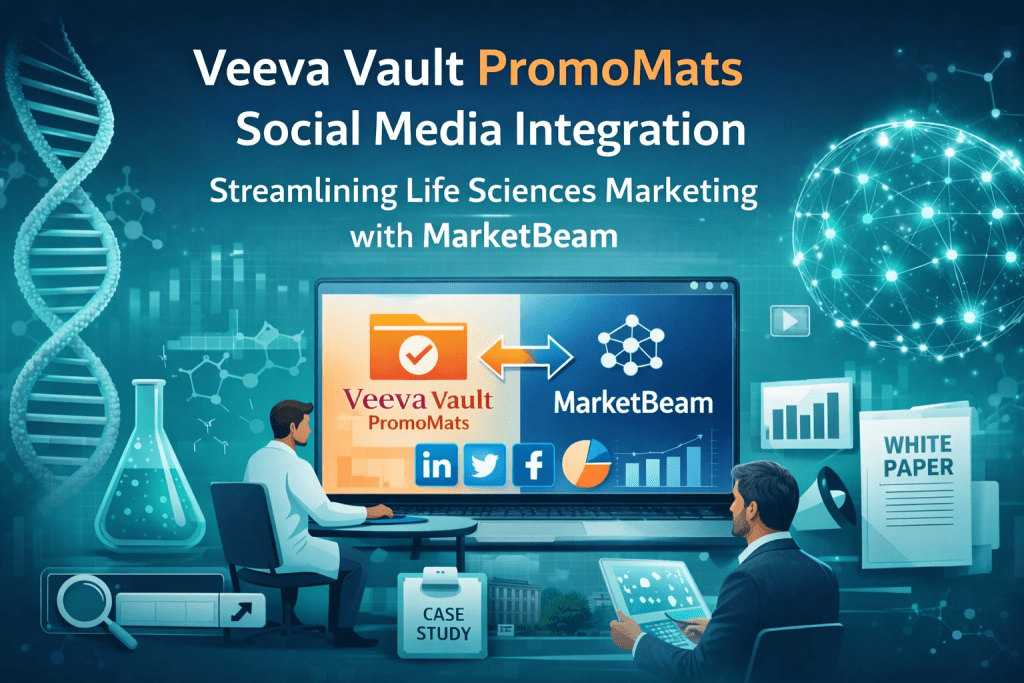
- MarketBeam integrates seamlessly with platforms like Veeva Vault PromoMats, ensuring all social media content undergoes Medical-Legal-Regulatory (MLR) review and approval before publication.
- This compliance-first approach reduces risk and ensures adherence to FDA, EMA, and other regulatory guidelines.
- Employee Advocacy Tools
- MarketBeam enables organizations to amplify their social media reach by leveraging employee networks.
- Its intuitive tools allow employees to share pre-approved content with just one click, expanding the brand’s visibility and engagement organically.
- Advanced Analytics
- The platform offers real-time insights into campaign performance, audience engagement, and lead conversions.
- Analytics dashboards provide actionable data to optimize future campaigns and improve ROI.
- Seamless Integration with Popular Platforms
- MarketBeam integrates with leading CRMs like Veeva CRM and HubSpot, as well as marketing tools, enabling streamlined workflows and enhanced data management.
- This interoperability ensures marketing teams can connect their efforts across platforms without losing valuable data.
Benefits of MarketBeam
- Streamlined Regulatory Compliance
- Automates the compliance process, making it easy to publish content that adheres to stringent industry standards.
- Enhanced Digital Reach Through Employee Advocacy
- By utilizing employee networks, MarketBeam significantly expands the company’s reach and engagement on social media platforms.
- Data-Driven Decision-Making
- With robust analytics and lead tracking capabilities, MarketBeam provides marketers with the insights they need to refine strategies and maximize their impact.
Why Choose MarketBeam?
For life sciences companies navigating the complexities of marketing in a regulated environment, MarketBeam offers a comprehensive solution that prioritizes compliance, efficiency, and scalability. Its user-friendly interface and advanced features make it an indispensable tool for companies aiming to enhance their digital presence and drive measurable results.
Discover how MarketBeam can transform your marketing strategy today.
Benefits of Using Life Sciences Marketing Software
Adopting specialized life sciences marketing software offers transformative benefits for companies operating in regulated industries. These tools not only streamline complex processes but also empower organizations to maintain compliance while achieving measurable marketing success. Below are the key advantages of leveraging life sciences digital marketing services:
1. Streamlined Campaign Planning and Execution
- Marketing software simplifies the process of planning, launching, and managing campaigns across multiple channels.
- Automation tools allow life sciences companies to:
- Schedule campaigns efficiently.
- Track progress in real-time.
- Allocate resources effectively for optimal impact.
- The result is reduced time-to-market for marketing initiatives and improved coordination among teams.
2. Improved Customer Segmentation and Targeting
- Advanced customer segmentation tools enable marketers to identify and target specific audiences with precision.
- With AI and analytics-driven insights, companies can:
- Personalize messaging based on customer preferences and behavior.
- Deliver relevant content to key stakeholders, such as healthcare providers or patients.
- Increase engagement rates and conversion potential by tailoring campaigns to specific segments.
3. Compliance with Regulatory Standards
- Life sciences marketing software is designed to meet the stringent regulatory requirements of the industry.
- Key compliance benefits include:
- Automated MLR (Medical, Legal, Regulatory) review workflows to ensure all marketing materials are approved before release.
- Detailed audit trails for tracking approvals and revisions, providing transparency and accountability.
- Integration with compliance-focused platforms like Veeva Vault PromoMats to streamline regulatory adherence.
4. Cost and Resource Efficiency
- Marketing software reduces the need for manual processes, freeing up valuable time and resources.
- By automating routine tasks such as campaign scheduling and reporting, companies can:
- Lower operational costs.
- Allocate resources more effectively to strategic initiatives.
- Scale marketing efforts without a proportional increase in team size.
By leveraging the advantages of life sciences digital marketing software, companies can enhance their marketing operations, ensure compliance, and achieve better ROI. The combination of efficiency, precision, and regulatory assurance makes these tools indispensable in today’s competitive and fast-evolving market.
Trends in Life Sciences Marketing Software
The landscape of life sciences marketing software is rapidly evolving, driven by technological advancements and changing market dynamics. Emerging innovations are transforming how companies engage with their audiences, optimize campaigns, and stay compliant. Here are the top trends shaping the future of life sciences marketing software:
1. AI-Powered Customer Segmentation Tools
- Artificial Intelligence (AI) is revolutionizing customer segmentation by analyzing vast datasets to identify patterns and preferences.
- Benefits include:
- Creation of hyper-targeted marketing campaigns based on audience behavior.
- Prediction of customer needs to deliver personalized content at the right time.
- Enhanced lead scoring to prioritize high-potential prospects.
Example: AI tools can segment healthcare professionals (HCPs) based on specialty, prescribing habits, or engagement history, enabling tailored outreach.
2. Enhanced Integration with Mobile Marketing Solutions
- With the growing reliance on mobile devices, marketing software now integrates seamlessly with mobile marketing solutions.
- Features include:
- Mobile-responsive content and ads for better user experience.
- Push notifications and SMS campaigns for timely communication.
- Analytics to track mobile user engagement and campaign performance.
Example: Pharmaceutical companies can use mobile marketing to provide real-time updates to HCPs about new drug launches or clinical trials.
3. Growing Focus on LinkedIn Advertising for Life Sciences
- LinkedIn has emerged as a critical platform for engaging healthcare professionals, researchers, and decision-makers in the life sciences industry.
- Marketing software now incorporates tools to optimize LinkedIn campaigns by:
- Delivering targeted ads based on professional roles and interests.
- Enhancing B2B lead generation strategies.
- Providing insights into engagement metrics specific to LinkedIn audiences.
Example: Companies use LinkedIn advertising to promote whitepapers, webinars, or product launches to their target audience.
4. Adoption of Life Sciences Inbound Marketing Strategies
- Inbound marketing, which focuses on attracting and engaging prospects through valuable content, is gaining traction in life sciences.
- Key tools and strategies include:
- Blogs, whitepapers, and webinars designed to educate and inform.
- Automated workflows to nurture leads through the buyer’s journey.
- Analytics to measure the success of inbound efforts and refine strategies.
Example: A biotech company could create an educational blog series on breakthrough therapies, using inbound marketing to attract researchers and investors.
The integration of AI, mobile solutions, LinkedIn advertising, and inbound strategies reflects the dynamic evolution of life sciences marketing software. By adopting these trends, companies can not only stay ahead in a competitive market but also create meaningful, data-driven engagement with their audience. These innovations are redefining the capabilities and potential of marketing software in the life sciences sector.
H2: Choosing the Best Software for Your Needs
Selecting the right life sciences marketing software is critical for optimizing marketing efforts, maintaining compliance, and driving measurable results. With various options available, here’s how to ensure the software aligns with your organization’s goals and requirements:
1. Assess Your Organization’s Size and Needs
- Start by understanding your organization’s unique challenges and marketing objectives.
- Key considerations include:
- The volume and complexity of campaigns you manage.
- Whether your team requires features like automation, CRM integration, or advanced analytics.
- The level of support needed for compliance processes.
Example: A smaller organization might prioritize ease of use and cost-efficiency, while larger enterprises may require advanced features like MLR-compliant workflows and multi-department collaboration tools.
2. Evaluate Integration Capabilities with Existing Systems
- Ensure the software integrates seamlessly with your current tools and platforms, such as:
- CRM systems (e.g., Salesforce, Veeva CRM, or HubSpot).
- Content management systems (CMS) or regulatory platforms.
- Analytics tools for tracking and optimizing campaign performance.
- Strong integration capabilities prevent data silos and enhance overall efficiency.
Tip: Choose software that offers APIs and pre-built connectors for easy integration.
3. Consider Scalability, Compliance Features, and Ease of Use
- Scalability: Ensure the platform can grow with your business, accommodating increased marketing activities and user access.
- Compliance Features: Look for tools with built-in regulatory workflows, like MLR approval processes, to reduce the risk of non-compliance.
- Ease of Use: A user-friendly interface is essential, especially for non-technical users, ensuring efficient onboarding and productivity.
Example: Tools like MarketBeam provide intuitive interfaces designed for life sciences professionals, making compliance and campaign execution simpler.
4. Brief Comparison of MarketBeam with Other Platforms
MarketBeam is a standout choice for life sciences companies, offering unique features tailored to the industry’s needs. Here’s how it compares with other platforms:
| Feature | MarketBeam | Other Platforms |
| Compliance Support | MLR-compliant workflows with Veeva integration | Limited or requires manual processes |
| Employee Advocacy | Integrated advocacy tools for wider reach | Often missing or offered as a separate add-on |
| Ease of Use | User-friendly, even for non-technical users | Steeper learning curve |
| Integration | Seamless with Veeva, HubSpot, and CRMs | May require additional customization efforts |
| Analytics | Real-time insights with lead attribution | Basic reporting with limited customization |
By assessing your needs, evaluating integration capabilities, and considering key features like scalability and compliance, you can select the best life sciences marketing software for your organization. Platforms like MarketBeam offer a unique combination of user-friendly design, regulatory compliance, and advanced analytics, making them an ideal choice for life sciences companies looking to elevate their marketing strategies.
Conclusion
In the fast-evolving life sciences industry, selecting the right marketing software is essential to stay competitive. The right software can help companies streamline campaign planning, enhance customer engagement, ensure compliance with regulatory standards, and drive data-informed decisions. By investing in robust tools, life sciences organizations can navigate complex marketing landscapes while achieving measurable results.
Among the many options available, MarketBeam stands out as a top choice. Its unique combination of compliance-first features, employee advocacy tools, and advanced analytics makes it an ideal solution for life sciences companies looking to scale their marketing efforts efficiently. Additionally, its seamless integrations with platforms like Veeva and HubSpot further simplify workflows and ensure marketing teams are equipped with everything they need to succeed.
Choosing the Right Life Sciences Software Vendor for Your Needs. If your organization is seeking a compliant, scalable, and user-friendly platform to transform its marketing strategy, MarketBeam is the solution you need.
Explore how MarketBeam can enhance your marketing efforts and drive results for your life sciences company. Schedule a demo today to find the perfect fit for your business needs. Transform your marketing strategy with the power of technology!