
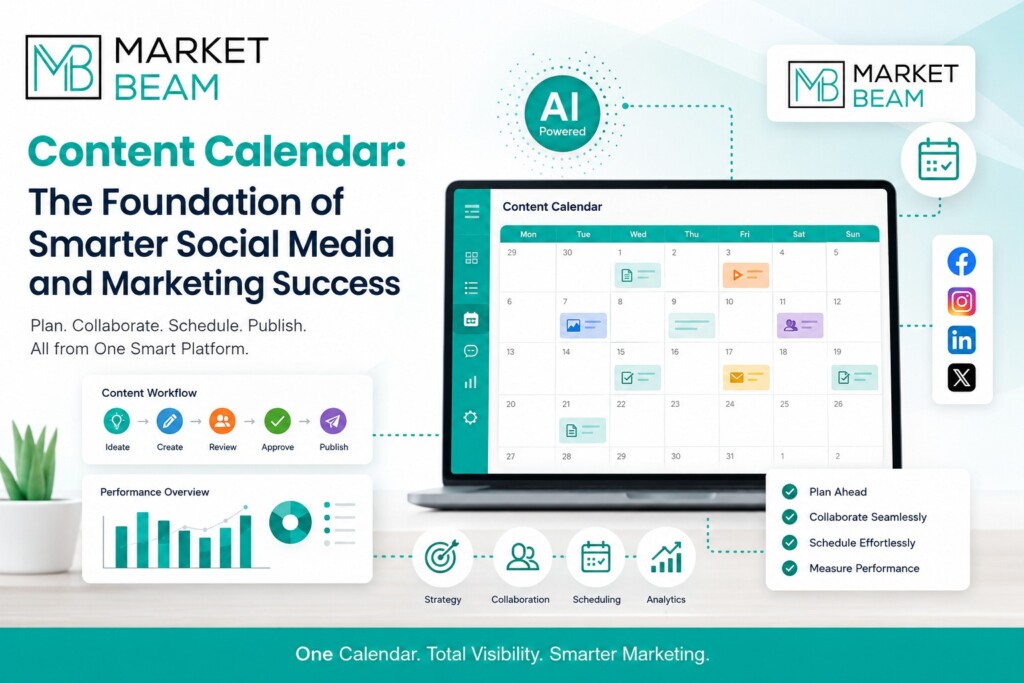
Creating great content is only one part of a successful marketing strategy. The real challenge is publishing the right content at the right time while keeping every campaign organized across multiple platforms. As businesses expand their digital presence, managing blogs, social media posts, product launches, events, and promotional campaigns manually becomes increasingly difficult. This is why every modern organization needs a well-structured Content Calendar.
A Content Calendar helps marketing teams organize ideas, schedule campaigns, coordinate content across departments, and maintain a consistent publishing schedule. Instead of reacting to daily posting requirements, businesses can plan weeks or months in advance, ensuring every piece of content aligns with business objectives and audience expectations.
MarketBeam provides enterprise organizations with intelligent tools that simplify content planning, collaboration, approvals, publishing, and performance tracking from a single platform. By combining AI-powered automation with enterprise workflows, businesses can transform how they manage their marketing operations.
What Is a Content Calendar?
A Content Calendar is a centralized planning system that organizes upcoming content across various marketing channels. It provides a clear schedule of what content will be published, when it will go live, where it will appear, and who is responsible for creating and approving it.
Unlike a simple spreadsheet, modern content calendar software integrates planning, scheduling, approvals, collaboration, publishing, and analytics into one platform. This allows marketing teams to maintain complete visibility over campaigns while reducing manual coordination.
Whether managing blog articles, videos, newsletters, webinars, or social media campaigns, a well-designed Content Calendar ensures every marketing activity supports broader business goals.
Why Every Business Needs a Content Calendar
Consistency is one of the biggest factors influencing marketing success. Customers expect brands to communicate regularly with valuable and relevant content. Without proper planning, organizations often publish inconsistently, miss important dates, or duplicate content across campaigns.
A structured Content Calendar helps eliminate these challenges by providing a roadmap for future content. Marketing teams can coordinate seasonal campaigns, product launches, industry events, and promotional activities long before publishing deadlines arrive.
Businesses also gain greater flexibility when unexpected opportunities arise. Because the overall schedule is already organized, teams can adjust priorities without disrupting ongoing campaigns.
An effective marketing content calendar improves visibility into campaign timelines while helping leadership understand upcoming initiatives and resource requirements.
The Challenges of Managing Content Without a Calendar
Many organizations still rely on disconnected spreadsheets, emails, and messaging platforms to coordinate content creation. As marketing operations grow, this fragmented process becomes increasingly difficult to manage.
Content creators may not know campaign priorities. Designers often receive last-minute requests. Marketing managers struggle to track approval status, while executives have limited visibility into upcoming campaigns.
Without a centralized planning system, businesses frequently experience missed publishing deadlines, inconsistent messaging, duplicated work, and delayed approvals.
These issues become even more significant when multiple departments contribute to content creation or when organizations operate across different regions.
Using a professional content planning tool helps eliminate confusion by giving every stakeholder access to a single, organized publishing schedule.
The Role of AI in Modern Content Planning
Artificial intelligence is transforming how marketing teams create and manage content. Instead of manually planning every campaign, businesses now use an AI content calendar to automate repetitive tasks, identify publishing opportunities, and optimize content schedules.
AI analyzes historical engagement, audience behavior, seasonal trends, and campaign performance to recommend the best publishing times and content distribution strategies.
Marketing teams can also use AI to generate content ideas, organize editorial schedules, and identify gaps within existing campaigns. Rather than replacing creativity, AI enables marketers to spend more time developing impactful campaigns while automation handles routine planning activities.
Organizations adopting AI-driven planning often experience greater productivity, faster campaign execution, and improved content consistency.
Manual Content Planning vs. AI-Powered Content Calendar
| Feature | Manual Planning | AI-Powered Content Calendar |
| Campaign Organization | Multiple spreadsheets | Centralized dashboard |
| Scheduling | Manual updates | Automated scheduling |
| Team Collaboration | Email-based coordination | Real-time collaboration |
| Publishing Workflow | Separate tools | Integrated workflow |
| Content Recommendations | Manual decisions | AI-powered suggestions |
| Performance Tracking | Limited visibility | Centralized analytics |
| Scalability | Difficult for large teams | Enterprise-ready planning |
Social Media Content Planning Made Simple
Managing multiple social platforms requires more than simply creating posts. Businesses must coordinate campaigns, maintain consistent messaging, adapt content for different audiences, and publish at the right time across every channel.
A social media content calendar provides a structured view of all upcoming campaigns, making it easier to balance promotional content, educational posts, customer stories, and industry updates.
With effective social media content planning, teams can visualize upcoming campaigns weeks in advance, ensuring content supports product launches, events, and business initiatives.
Planning content ahead of time also improves audience engagement because marketers have more time to optimize messaging, creative assets, and publishing schedules.
Why Editorial Planning Is Essential
Content marketing extends beyond social media. Organizations publish blogs, whitepapers, case studies, newsletters, webinars, and videos throughout the year.
Managing these assets requires an organized editorial calendar software solution that coordinates every stage of the content lifecycle.
Editorial planning helps teams identify publishing gaps, maintain consistent messaging, and ensure content aligns with business goals. Writers, editors, designers, and marketing managers all work from the same schedule, reducing delays and improving collaboration.
As organizations scale their marketing efforts, editorial planning becomes essential for maintaining quality while increasing publishing frequency.
Content Scheduling That Supports Business Growth
Publishing content consistently is easier when scheduling is integrated directly into the planning process.
A modern content scheduling platform allows businesses to create campaigns, assign responsibilities, schedule publishing dates, and monitor progress without relying on disconnected tools.
Instead of reacting to daily marketing demands, teams build long-term strategies supported by organized workflows and intelligent scheduling.
This proactive approach improves campaign execution while reducing last-minute content creation and publishing errors.
A well-managed Content Calendar ultimately becomes more than a schedule—it serves as the operational foundation for successful marketing, enabling businesses to maintain consistency, improve collaboration, and achieve measurable growth.
Content Workflow Management for Faster Campaign Execution
Creating content is rarely the responsibility of one person. A typical marketing campaign involves content writers, designers, social media managers, legal reviewers, compliance teams, and decision-makers. Without a structured process, projects can quickly become delayed, leading to missed publishing opportunities and inconsistent messaging.
This is where content workflow management becomes essential. A well-defined workflow ensures every task moves smoothly from content creation and editing to approvals, scheduling, publishing, and performance analysis.
An organized Content Calendar provides visibility into every stage of the workflow, making it easy for team members to track responsibilities, review deadlines, and collaborate efficiently. Instead of relying on lengthy email chains or disconnected spreadsheets, everyone works from a centralized platform where updates are visible in real time.
For enterprise organizations, streamlined workflow management reduces bottlenecks, improves accountability, and helps marketing teams deliver campaigns on schedule.
Collaborative Content Planning Improves Team Productivity
Marketing success depends on teamwork. Campaigns often involve multiple departments working together to create content that aligns with business objectives and customer expectations.
Collaborative content planning enables teams to brainstorm ideas, assign responsibilities, review content, and approve campaigns without unnecessary delays. Marketing managers gain complete visibility into project progress, while writers and designers receive clear deadlines and priorities.
A centralized Content Calendar also reduces duplicate work by ensuring every stakeholder can see planned campaigns before new content is created. This improves communication, minimizes confusion, and helps teams maintain consistent messaging across every marketing channel.
As businesses continue to scale, collaboration becomes increasingly important. A shared planning environment allows distributed teams to work together effectively regardless of location or department.
Why Businesses Need an Enterprise Content Scheduling Platform
Marketing operations have become more complex than ever. Businesses manage blogs, social media posts, email campaigns, webinars, product launches, and promotional events simultaneously. Coordinating these activities manually is inefficient and increases the risk of missed opportunities.
A modern content scheduling platform brings every campaign into one organized system. Teams can create content, assign ownership, request approvals, schedule publishing dates, and monitor campaign progress without switching between multiple applications.
Enterprise scheduling platforms also provide reporting and analytics, helping organizations measure campaign performance and refine future strategies.
When combined with an intelligent Content Calendar, businesses gain greater control over their entire marketing process while improving operational efficiency.
Benefits of an Enterprise Content Calendar
| Business Challenge | How a Content Calendar Helps |
| Missed publishing deadlines | Centralized scheduling and reminders |
| Poor team communication | Supports collaborative content planning |
| Manual campaign management | Automates content workflow management |
| Inconsistent social media posting | Improves social media content planning |
| Multiple marketing channels | Organizes campaigns in one dashboard |
| Content approval delays | Streamlines review workflows |
| Limited campaign visibility | Provides complete marketing calendar oversight |
| Scaling enterprise marketing | Supports AI-powered planning and automation |
Why MarketBeam Is the Ideal Content Calendar Solution
Today’s enterprises require more than a basic scheduling tool. They need an intelligent platform that supports planning, collaboration, publishing, analytics, and governance from a single interface.
MarketBeam delivers these capabilities through an enterprise-grade Content Calendar designed for modern marketing teams. Its advanced content calendar software enables organizations to organize campaigns, coordinate cross-functional teams, and maintain complete visibility over publishing schedules.
The platform also serves as a powerful content planning tool, allowing marketers to plan campaigns weeks or months ahead while aligning content with strategic business goals. Through intelligent automation and an AI content calendar, MarketBeam helps optimize publishing schedules, reduce manual effort, and improve campaign performance.
Its integrated social media content calendar simplifies social media content planning across multiple platforms, making it easier to maintain consistent engagement with audiences. Combined with robust content workflow management, businesses can streamline approvals, improve collaboration, and ensure every campaign meets internal standards before publication.
MarketBeam also supports collaborative content planning, enabling marketing teams, designers, executives, and compliance departments to work together efficiently from a centralized dashboard. This collaborative environment improves productivity while reducing communication gaps and project delays.
For organizations seeking a scalable marketing content calendar that combines AI, automation, publishing, and enterprise collaboration, MarketBeam provides a complete solution for managing the entire content lifecycle.
Conclusion
Successful marketing starts with effective planning. Without a structured process, businesses struggle to maintain consistency, coordinate teams, and deliver campaigns on time. A well-designed Content Calendar solves these challenges by providing a centralized framework for organizing, scheduling, approving, and publishing content across every marketing channel.
Modern organizations benefit even more when their planning system includes content calendar software, AI content calendar capabilities, social media content planning, content workflow management, and collaborative content planning. These features help teams work more efficiently while improving campaign quality and overall marketing performance.
MarketBeam combines all these capabilities into one enterprise-ready platform, empowering organizations to simplify content operations, strengthen collaboration, and execute smarter marketing strategies. Whether managing daily social media posts or large-scale enterprise campaigns, MarketBeam helps businesses stay organized, productive, and prepared for long-term growth.
Connect with Us
Ready to simplify your content planning and improve marketing efficiency with an intelligent Content Calendar?
Sales: sales@marketbeam.io
Tech Support: support@marketbeam.io
Discover how MarketBeam can help your team plan smarter, collaborate better, and publish content with confidence.
Frequently Asked Questions (FAQs)
1. What is a Content Calendar?
A Content Calendar is a planning system that helps businesses organize, schedule, and manage content across blogs, social media, email campaigns, and other marketing channels. It improves consistency, collaboration, and campaign execution.
2. Why is content calendar software important?
Content calendar software centralizes planning, scheduling, approvals, and publishing into one platform. It helps marketing teams stay organized, reduce manual work, and improve campaign visibility.
3. How does an AI content calendar improve marketing?
An AI content calendar analyzes audience behavior, engagement trends, and campaign performance to recommend publishing schedules, content ideas, and workflow improvements, helping businesses achieve better results.
4. What are the benefits of social media content planning?
Social media content planning ensures consistent publishing, aligns campaigns with business goals, reduces last-minute work, and improves audience engagement across multiple platforms.
5. How does collaborative content planning help teams?
Collaborative content planning allows writers, designers, marketers, and managers to work together within a centralized system, improving communication, reducing delays, and ensuring campaigns are completed efficiently.
6. Why should businesses choose MarketBeam for content planning?
MarketBeam provides enterprise-grade content calendar software with AI-powered planning, social media scheduling, workflow management, collaboration tools, analytics, and publishing capabilities. It helps organizations streamline their entire content lifecycle while improving productivity and marketing performance.