Organizations in regulated industries rely on social media to engage customers, educate stakeholders, strengthen brand visibility, and communicate important business updates. Whether operating in healthcare, pharmaceuticals, financial services, manufacturing, or technology, enterprises must balance marketing effectiveness with strict regulatory and operational requirements. A well-defined social media governance framework provides the structure needed to manage digital communications consistently while reducing compliance risks.
As organizations expand across regions, departments, and business units, social media management becomes increasingly complex. Multiple teams may create content, manage campaigns, or interact with customers simultaneously. Without standardized governance, businesses risk inconsistent messaging, unauthorized publishing, security vulnerabilities, and regulatory violations.
A comprehensive social media governance framework helps organizations establish clear responsibilities, standardized approval processes, enterprise controls, and documented workflows that support compliant social media operations. Combined with the right technology, governance enables enterprises to scale digital communications confidently while maintaining accountability.
MarketBeam helps regulated organizations streamline governance through centralized collaboration, workflow automation, approval management, and enterprise social media controls that improve both compliance and operational efficiency.
What Is a Social Media Governance Framework?
A social media governance framework is a structured system of policies, processes, technologies, and organizational responsibilities that guide how an enterprise manages its social media activities. Rather than focusing only on publishing content, the framework establishes standards for planning, approvals, security, monitoring, compliance, and ongoing governance.
An effective social media governance framework ensures that every social media account operates according to documented procedures while supporting consistent communication across departments and regions.
The framework also provides leadership teams with greater visibility into content creation, campaign execution, user permissions, and compliance activities. By standardizing operations, organizations improve collaboration while reducing operational and regulatory risks.
Unlike a simple marketing strategy, governance creates an enterprise-wide operating model that supports long-term scalability and organizational control.
Why Regulated Companies Need a Social Media Governance Framework
Organizations operating in regulated industries face additional responsibilities when managing digital communications.
Marketing campaigns often require review from legal, compliance, medical, regulatory, or executive stakeholders before publication. Customer interactions may involve sensitive information, regulatory disclosures, or reporting obligations that demand structured oversight.
Implementing a social media governance framework helps regulated companies establish consistent processes that reduce human error while strengthening accountability across multiple teams.
The framework also supports audit readiness by documenting approvals, maintaining publishing histories, and recording governance decisions throughout the content lifecycle.
For enterprises managing numerous brands, products, or regional accounts, governance becomes essential for maintaining operational consistency and protecting organizational reputation.
Building a Strong Governance Model
Every successful social media governance framework begins with a clearly defined governance model.
A governance model outlines how decisions are made, who has approval authority, how responsibilities are assigned, and how compliance is maintained across the organization.
Leadership teams should identify governance objectives before designing workflows. Common objectives include protecting brand reputation, improving regulatory compliance, increasing operational efficiency, strengthening collaboration, and reducing organizational risk.
The governance model should also define performance metrics that measure governance effectiveness. Examples include approval turnaround times, publishing accuracy, compliance incidents, security events, and policy adherence.
As organizations grow, the governance model should remain flexible enough to support new business units, additional social media platforms, and evolving regulatory expectations.
Understanding the RACI Matrix
One of the most effective tools for implementing a social media governance framework is the RACI matrix.
A RACI matrix helps organizations define who is Responsible, Accountable, Consulted, and Informed during each stage of the content lifecycle.
For example, marketing teams may be responsible for creating content, compliance teams may be consulted during review, department leaders may approve publication, and executive stakeholders may be informed of campaign performance.
Clearly documented responsibilities reduce confusion while improving accountability across departments.
Using a RACI matrix also minimizes duplicated effort, accelerates decision-making, and ensures that every campaign follows consistent governance procedures.
As enterprise marketing operations expand, structured responsibility mapping becomes increasingly valuable for maintaining efficiency.
Designing an Effective Approval Workflow
Every social media governance framework depends on a structured approval workflow.
Approval workflows define how content progresses from planning and creation through review, revisions, approvals, publishing, and post-publication monitoring.
Marketing teams typically prepare campaign content before routing it to legal, compliance, regulatory, or executive reviewers based on organizational requirements.
Documented approval workflow procedures reduce publishing errors while ensuring that only approved content reaches public audiences.
Automation further improves workflow efficiency by routing content through predefined review stages, tracking revisions, and maintaining complete approval histories.
Organizations that standardize approval processes experience fewer operational delays while improving governance consistency.
Core Components of a Social Media Governance Framework
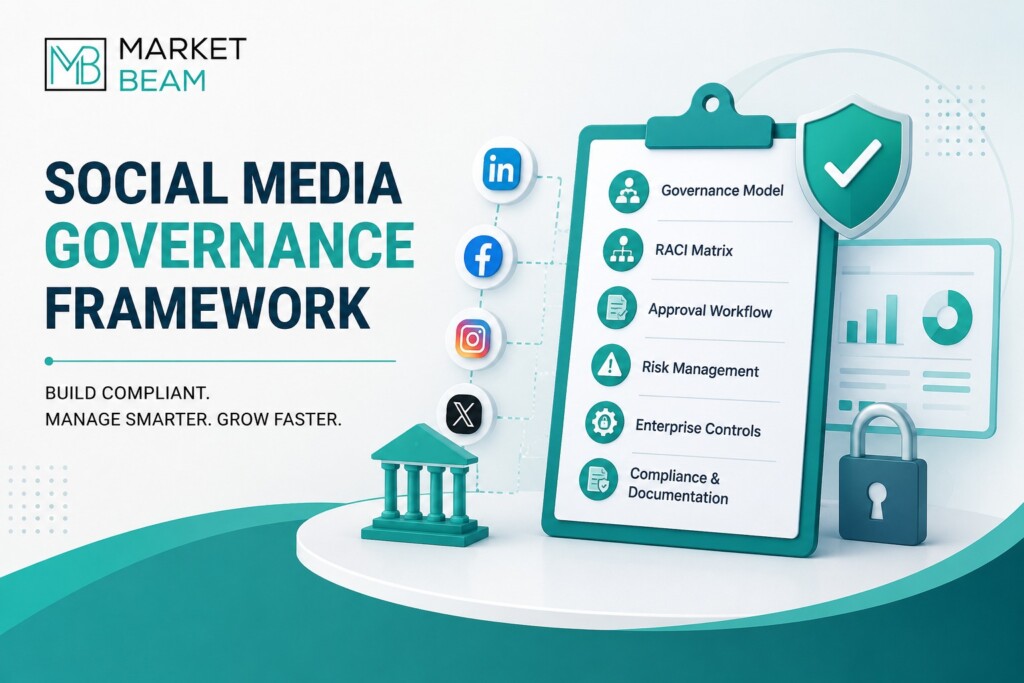
| Governance Component | Primary Purpose |
| Governance Model | Defines organizational decision-making structure |
| RACI Matrix | Clarifies responsibilities and accountability |
| Approval Workflow | Standardizes content review and publishing |
| Risk Management | Identifies and reduces operational risks |
| Enterprise Controls | Protects accounts and governance processes |
| Compliance Documentation | Supports audits and regulatory oversight |
Common Governance Challenges
Many organizations recognize the importance of governance but struggle to implement an effective social media governance framework.
One common challenge involves inconsistent approval procedures. Different departments may follow separate workflows, resulting in delays, duplicated effort, and inconsistent messaging.
Another challenge is unclear ownership. Without a documented governance model or RACI matrix, employees may be uncertain about who is responsible for content creation, approvals, compliance reviews, or publishing decisions.
Organizations also encounter difficulties maintaining governance across multiple brands, geographic regions, and business units. As marketing operations scale, inconsistent processes create operational inefficiencies and increase compliance risks.
Technology limitations can further complicate governance when teams rely on spreadsheets, email chains, or disconnected systems to coordinate approvals and maintain documentation.
Implementing a structured social media governance framework, supported by centralized collaboration and workflow automation, helps organizations overcome these challenges while improving accountability, compliance, and enterprise-wide operational consistency.
Strengthening Risk Management
An effective social media governance framework must include a structured approach to risk management. Every social media activity carries potential operational, legal, security, and reputational risks. Without a proactive governance strategy, organizations may experience inconsistent messaging, unauthorized publishing, regulatory issues, or data security incidents.
A strong risk management program begins with identifying the organization’s primary areas of exposure. These may include compliance violations, brand misuse, account compromise, misinformation, customer complaints, or accidental disclosure of confidential information.
Once risks have been identified, organizations should establish documented mitigation procedures that include approval requirements, monitoring activities, incident response plans, and regular governance reviews.
Continuous monitoring also plays a critical role. Organizations should evaluate campaign performance, publishing activities, account access, and compliance metrics on an ongoing basis to identify issues before they become significant business problems.
Integrating risk management into the social media governance framework enables organizations to improve operational resilience while protecting long-term brand reputation.
Implementing Enterprise Controls
As organizations scale their digital presence, strong enterprise controls become essential for maintaining security, accountability, and governance consistency.
Enterprise controls include role-based permissions, multi-factor authentication, centralized account management, audit logging, content approval requirements, and standardized publishing procedures. These controls help ensure that only authorized personnel can access enterprise social media accounts or publish content.
Organizations should also maintain centralized documentation that records account ownership, user permissions, approval histories, and governance decisions. Regular reviews help identify inactive accounts, outdated permissions, and opportunities to strengthen security.
Well-designed enterprise controls reduce operational risks while supporting compliance with internal policies and industry regulations.
For regulated organizations, these controls also improve audit readiness by providing complete visibility into governance activities across every social media channel.
Continuous Improvement and Governance Reviews
Governance should never remain static. Business priorities, regulatory expectations, and social media platforms continue to evolve, requiring organizations to update governance processes regularly.
A mature social media governance framework includes scheduled reviews that evaluate policy effectiveness, workflow performance, security practices, and compliance outcomes.
Leadership teams should assess governance metrics such as approval turnaround times, publishing accuracy, policy adherence, user access reviews, and incident response performance.
Feedback from marketing, compliance, legal, communications, and executive stakeholders also helps identify opportunities for operational improvement.
Continuous evaluation ensures that the governance framework remains aligned with organizational objectives while supporting sustainable growth.
Best Practices for a Social Media Governance Framework
| Best Practice | Business Benefit |
| Develop a documented governance model | Creates consistent organizational oversight |
| Use a RACI matrix | Improves accountability across departments |
| Standardize approval workflow | Reduces publishing delays and errors |
| Integrate risk management | Minimizes compliance and operational risks |
| Implement enterprise controls | Strengthens security and governance |
| Conduct governance reviews | Supports continuous improvement |
| Maintain centralized documentation | Improves audit readiness and reporting |
How MarketBeam Supports Social Media Governance Frameworks
Managing enterprise social media across multiple departments, brands, and regulated environments requires more than publishing tools. Organizations need a centralized platform that supports governance, collaboration, workflow automation, and compliance.
MarketBeam provides an enterprise solution that helps organizations implement a scalable social media governance framework while improving operational efficiency. Marketing, communications, legal, compliance, and executive teams can collaborate within a centralized environment that supports transparent decision-making and consistent governance.
The platform enables organizations to configure approval processes that align with their governance model, ensuring content follows standardized review procedures before publication. Teams can define responsibilities using structured workflows that complement a RACI matrix, helping eliminate ambiguity and improve accountability.
MarketBeam also strengthens risk management through centralized content governance, approval tracking, audit-ready documentation, and collaborative review processes. Organizations gain greater visibility into publishing activities while reducing operational and compliance risks.
Role-based permissions, centralized account management, and workflow automation further reinforce enterprise controls, enabling businesses to scale social media operations confidently while maintaining security and regulatory oversight.
By combining intelligent automation with enterprise governance capabilities, MarketBeam helps regulated organizations create consistent, compliant, and efficient social media operations.
Conclusion
A well-designed social media governance framework provides the structure organizations need to manage enterprise social media with confidence. By implementing a scalable governance model, defining responsibilities through a RACI matrix, standardizing approval workflow processes, strengthening risk management, and maintaining effective enterprise controls, businesses can improve operational efficiency while reducing compliance risks.
As enterprise social media continues to grow in complexity, governance becomes a strategic business capability rather than simply an operational requirement.
MarketBeam empowers organizations with centralized collaboration, workflow automation, governance tools, and enterprise social media management capabilities that simplify implementation while supporting secure, compliant, and scalable digital communications.
Connect With Us
Ready to strengthen your social media governance framework?
Sales: sales@marketbeam.io
Tech Support: support@marketbeam.io
Learn how MarketBeam helps regulated organizations build scalable governance frameworks, streamline approvals, improve collaboration, and maintain compliant enterprise social media operations.
Frequently Asked Questions
1. What is a social media governance framework?
A social media governance framework is a structured system of policies, processes, responsibilities, and technologies that helps organizations manage social media consistently while supporting compliance, security, and operational efficiency.
2. What is a governance model?
A governance model defines how decisions are made, who approves content, how responsibilities are assigned, and how governance activities are managed across an organization.
3. How does a RACI matrix support governance?
A RACI matrix clarifies who is Responsible, Accountable, Consulted, and Informed during each stage of the social media content lifecycle, improving accountability and collaboration.
4. Why is an approval workflow important?
A standardized approval workflow ensures content is reviewed by appropriate stakeholders before publication, reducing errors, improving compliance, and maintaining consistent messaging.
5. How does risk management improve social media governance?
Risk management helps organizations identify, evaluate, and mitigate operational, compliance, security, and reputational risks associated with enterprise social media activities.
6. How does MarketBeam support social media governance?
MarketBeam provides centralized collaboration, workflow automation, configurable approvals, role-based permissions, audit-ready documentation, governance controls, and enterprise social media management that help organizations implement and maintain an effective social media governance framework.