
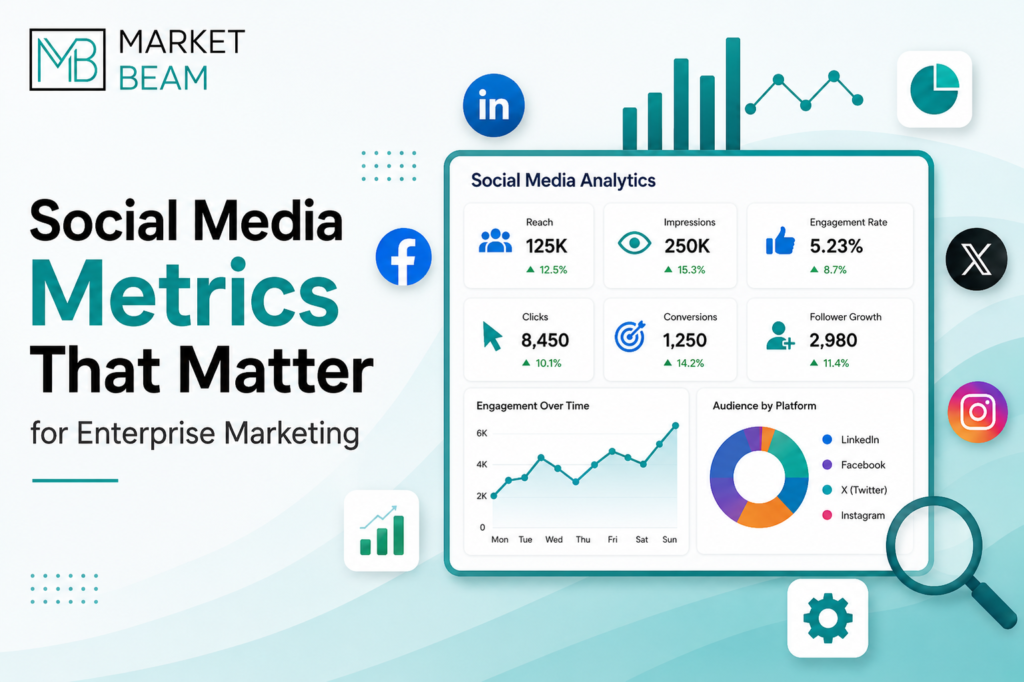
Enterprise marketing teams generate large amounts of social media data every day. Likes, comments, shares, views, clicks, followers, and conversions can all provide useful information, but collecting numbers is not the same as understanding performance. Businesses need to identify which measurements actually support their marketing objectives and use them to make better decisions. This is why understanding social media metrics is essential for modern enterprise marketing.
For large organizations, measurement becomes more complex because campaigns may run across multiple platforms, brands, regions, and business units. A metric that matters to a brand awareness campaign may be less useful for a lead generation campaign. Similarly, regulated organizations may need to evaluate performance while maintaining governance, approval, and compliance requirements.
A structured approach to social media metrics helps teams move beyond vanity numbers and focus on measurable business outcomes. MarketBeam provides enterprise social media management and analytics capabilities that help organizations centralize performance information, improve reporting, and connect social activity with broader marketing operations.
What Are Social Media Metrics?
Social media metrics are measurable data points used to evaluate the performance of social media content, campaigns, accounts, and audience interactions. They help organizations understand what is working, what needs improvement, and whether social activity is contributing to business objectives.
Common measurements include engagement, reach, impressions, clicks, follower growth, video views, leads, and conversions. Each metric provides a different perspective on performance.
The challenge for enterprise teams is deciding which metrics deserve attention. Tracking every available number can make reporting complicated without improving decision-making.
A better approach is to connect social media metrics with specific marketing goals. Awareness campaigns may focus on reach and impressions, engagement campaigns may prioritize interactions, and lead-generation programs may focus on clicks and conversions.
This goal-based approach makes social reporting more meaningful and allows marketing leaders to evaluate performance using metrics that reflect actual business priorities.
Why Social Media Metrics Matter for Enterprise Marketing
Enterprise organizations need measurable evidence that marketing investments are delivering value. Social media metrics provide the data needed to evaluate campaign effectiveness, identify audience behavior, and optimize future strategies.
For marketing managers, metrics help determine which content formats and platforms perform best. For executives, they provide a high-level view of marketing efficiency and campaign progress. For content teams, performance information can reveal which topics generate stronger audience responses.
Metrics can also improve budget allocation. When organizations compare results across campaigns and channels, they can identify where additional resources are likely to create greater impact.
For regulated industries, measurement can also be connected with governance. Teams may need to understand not only whether content performed well, but also which approved campaigns generated the results and how performance changed across markets or business units.
Ultimately, effective social media metrics turn social activity into measurable intelligence that supports better marketing decisions.
Understanding Engagement Rate
Engagement rate is one of the most widely used social media metrics because it measures how actively audiences interact with content.
Depending on the platform and reporting method, engagement can include likes, comments, shares, saves, clicks, reactions, and other interactions. Engagement rate typically compares these interactions with a relevant denominator such as reach, impressions, or followers.
A high engagement rate can indicate that content is resonating with its intended audience, but context is important. A campaign may receive many interactions because it generated controversy rather than positive interest.
Enterprise teams should therefore evaluate engagement alongside sentiment, reach, content type, and campaign objectives.
For example, an educational post may have a lower engagement rate than an entertainment-focused post but still create more meaningful interactions with a target professional audience.
Engagement rate is most useful when tracked over time and compared across similar campaigns rather than evaluated as an isolated number.
Reach: How Many People See Your Content?
Reach measures the number of unique users who are exposed to content. It is an important awareness indicator because it provides insight into how widely a message has distributed across an audience.
For enterprise marketers, reach can help evaluate the scale of a campaign across multiple platforms. It can also help determine whether a brand is expanding its visibility among target audiences.
However, higher reach does not automatically mean better marketing performance. A campaign can reach a large audience without generating meaningful engagement or conversions.
This is why reach should be evaluated alongside other social media metrics. Comparing reach with engagement rate, clicks, and conversions can help organizations understand whether visibility is translating into meaningful actions.
Impressions: Measuring Content Visibility
Impressions represent the number of times content is displayed. Unlike reach, the same user can generate multiple impressions.
This makes impressions useful for evaluating content visibility and frequency. For example, if a campaign receives 100,000 impressions and a reach of 40,000 people, marketers can see that the content was displayed multiple times to some users.
Enterprise teams can use impressions to compare campaign visibility, understand distribution patterns, and evaluate how frequently audiences encounter content.
However, impressions should not be interpreted as proof of engagement or business impact. Like other social media metrics, their value depends on the objective being measured.
Clicks and Click-Through Performance
Clicks indicate that a user took an action by selecting a link, button, or other clickable element. For campaigns designed to drive traffic, clicks can be more meaningful than simple reactions.
Marketing teams often use click-through rate to evaluate how effectively content encourages users to take the next step.
A campaign may receive a high number of impressions but very few clicks, suggesting that visibility is strong while the message or call to action may need improvement.
Analyzing clicks alongside reach, impressions, engagement, and landing-page performance provides a more complete understanding of campaign effectiveness.
Core Social Media Metrics
| Metric | What It Measures | Primary Use |
| Engagement Rate | Audience interactions with content | Engagement analysis |
| Reach | Unique users exposed to content | Brand awareness |
| Impressions | Total content displays | Visibility and frequency |
| Clicks | User actions on links or CTAs | Traffic generation |
| Conversions | Completion of a desired action | Business outcomes |
| Follower Growth | Change in audience size | Community development |
Common Measurement Challenges
Enterprise teams often struggle with inconsistent definitions and fragmented reporting. Different platforms may calculate similar social media metrics differently, making direct comparisons difficult.
Another challenge is metric overload. Teams can spend significant time reviewing dashboards without identifying which measurements actually influence strategic decisions.
Attribution is another concern. A customer may discover a brand through social media but convert later through another channel. This makes it difficult to assign value to social activity without a broader measurement framework.
The solution is to establish standardized definitions, connect metrics with business objectives, and use consistent reporting practices across campaigns and regions.
A centralized analytics platform can further simplify measurement by bringing performance information together and reducing the need for manual data collection.
Measuring Conversions and Business Outcomes
While reach, impressions, engagement, and clicks help explain how audiences interact with content, conversions connect social activity with business outcomes. A conversion can be a form submission, registration, purchase, demo request, download, or another action that supports a defined marketing objective.
For enterprise teams, tracking conversions helps determine whether campaigns are producing meaningful results rather than simply generating visibility. A campaign with high engagement but few conversions may require changes to its messaging, targeting, landing page, or call to action.
Conversion data should also be interpreted within the customer journey. Social media may introduce a prospect to a brand without being the final channel responsible for the conversion. Using attribution models alongside other social media metrics can provide a more balanced understanding of contribution.
Choosing Metrics Based on Marketing Goals
The most effective measurement programs do not track the same metrics for every campaign. The right social media metrics depend on the objective.
For brand awareness, teams may prioritize reach, impressions, video views, and audience growth. For engagement objectives, engagement rate, comments, shares, and saves may be more relevant. Traffic campaigns can focus on clicks and click-through rate, while lead-generation campaigns should emphasize conversions and qualified leads.
This goal-based approach prevents teams from becoming distracted by metrics that do not directly support the campaign objective.
Enterprise organizations can also create standardized reporting frameworks that define the primary and secondary metrics for different campaign types. This makes comparisons easier across brands and regions while improving consistency in executive reporting.
Social Media Metrics for Regulated Industries
Regulated organizations need a measurement framework that considers more than marketing performance. Healthcare, pharmaceutical, financial, and other regulated businesses often need stronger governance around how content is created, approved, published, and analyzed.
For these organizations, social media metrics can be evaluated alongside campaign type, approval status, region, business unit, and governance requirements. This provides greater context when reviewing performance.
For example, a campaign may demonstrate strong engagement but require additional review if audience comments raise compliance concerns. Similarly, teams may want to compare the performance of approved content categories while maintaining records of the workflows associated with each campaign.
MarketBeam positions analytics alongside compliance, publishing, engagement, and social media management, which can help regulated teams maintain greater visibility across their social operations.
Building an Enterprise Measurement Workflow
A reliable analytics process begins with clearly defined objectives. Marketing teams should establish what the campaign is intended to achieve and select the most relevant social media metrics before publishing begins.
Once the campaign is active, performance should be monitored against predefined targets. Teams can compare reach, impressions, engagement rate, clicks, and conversions to understand where performance is strong or where optimization is required.
The next step is analysis. Marketers should look for meaningful patterns across platforms, content formats, audiences, and campaigns rather than evaluating individual posts in isolation.
Insights should then be shared with the appropriate stakeholders. Marketing managers may adjust content strategy, executives may revise budget allocation, and creative teams may use performance findings to improve future campaigns.
The final step is continuous optimization. Results from one campaign should inform the next campaign, creating a measurement cycle that steadily improves performance.
Metrics by Enterprise Marketing Objective
| Marketing Objective | Primary Metrics | What the Team Should Learn |
| Brand Awareness | Reach, Impressions, Video Views | How effectively the campaign expands visibility |
| Engagement | Engagement Rate, Comments, Shares, Saves | Whether content resonates with audiences |
| Traffic | Clicks, Click-Through Rate | How effectively content drives visits |
| Lead Generation | Conversions, Lead Rate | Whether campaigns generate desired actions |
| Community Growth | Follower Growth, Engagement | Whether the audience is expanding and participating |
| Campaign Optimization | Combined KPI Set | Which content and channels perform best |
How MarketBeam Supports Social Media Metrics
MarketBeam provides enterprise social media management capabilities that combine publishing, engagement, analytics, social listening, governance, and reporting. This makes it possible for organizations to evaluate social media metrics as part of a broader social media workflow rather than as isolated numbers.
Marketing teams can use centralized analytics to compare campaign performance, identify trends, and understand which content generates stronger audience responses. A unified reporting environment can also reduce the need to manually collect data from multiple social platforms.
For regulated organizations, the broader platform approach is particularly useful because performance analysis can operate alongside approval workflows, compliance processes, and governance controls. MarketBeam describes analytics and reporting capabilities designed for enterprise and regulated social media operations.
By connecting measurement with publishing and governance, organizations can move from simply tracking numbers to using data as a continuous input for marketing optimization and strategic decision-making.
Conclusion
The most valuable social media metrics are not necessarily the ones with the largest numbers. Their value comes from how effectively they answer business questions.
Reach and impressions help measure visibility. Engagement rate shows how audiences interact with content. Clicks indicate traffic intent, while conversions connect social campaigns to measurable business outcomes.
For enterprise marketing teams, the strongest approach is to define metrics around campaign objectives, establish standardized reporting, and continuously use insights to improve strategy.
MarketBeam combines social media analytics with publishing, listening, engagement, governance, and compliance capabilities, helping organizations build a more connected approach to social performance measurement.
Connect With Us
Ready to improve how your enterprise measures social performance?
Sales: sales@marketbeam.io
Tech Support: support@marketbeam.io
Connect with MarketBeam to explore enterprise social media analytics, reporting, governance, and workflow capabilities.
Frequently Asked Questions
1. What are social media metrics?
Social media metrics are measurable data points used to evaluate the performance of social media content, campaigns, accounts, and audience interactions. Common examples include reach, impressions, engagement rate, clicks, follower growth, and conversions.
2. Which social media metrics matter most for enterprise marketing?
The most important social media metrics depend on the campaign objective. Awareness campaigns may prioritize reach and impressions, while engagement campaigns focus on engagement rate. Traffic campaigns typically measure clicks, and lead-generation campaigns emphasize conversions.
3. What is engagement rate in social media?
Engagement rate measures how actively audiences interact with social media content. Depending on the platform, it can include likes, comments, shares, saves, clicks, and other interactions relative to reach, impressions, or audience size.
4. What is the difference between reach and impressions?
Reach represents the number of unique users exposed to content, while impressions represent the total number of times the content was displayed. One user can generate multiple impressions, so impressions are generally higher than reach.
5. Why are clicks and conversions important?
Clicks indicate that users are taking an action on social content, while conversions show whether those actions lead to a desired business outcome, such as a registration, purchase, lead, or demo request. Together, they help connect social activity with business results.
6. How does MarketBeam help businesses track social media metrics?
MarketBeam combines analytics and reporting with social publishing, engagement, listening, governance, and compliance capabilities. This helps enterprise teams monitor social media metrics, compare campaign performance, and use insights to improve social media strategy and decision-making.