How Social Listening Software Turns Online Conversations into Business Insights
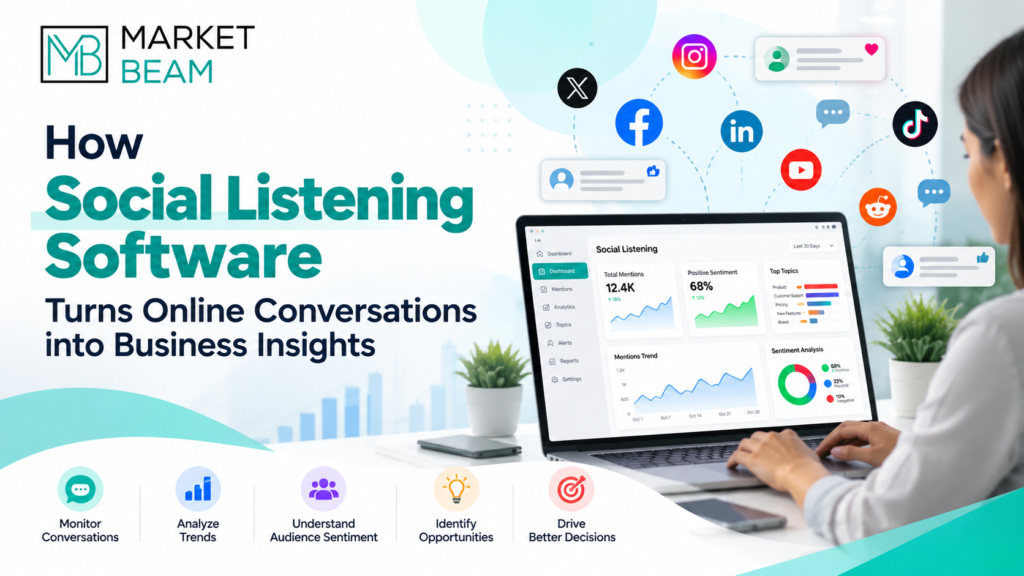
This is where social listening software becomes valuable. It helps organizations analyze conversations, identify trends, understand audience sentiment, and turn social data into useful business insights. Instead of focusing only on likes, comments, and shares, teams can explore what people discuss, why certain topics gain attention, and how public opinions change over time.
For enterprise marketing teams, choosing the right platform requires more than comparing dashboards. Companies must evaluate data sources, analytics, alerting, integrations, reporting, and data governance. Regulated organizations also need to consider privacy, oversight, escalation procedures, and the handling of sensitive conversations.
This guide explains the essential features, practical use cases, and selection criteria that help businesses choose social listening software that fits their needs.
What Is Social Listening Software?
Social listening software helps businesses collect and analyze online conversations about their brand, products, competitors, industry, and relevant topics. Depending on the platform, these conversations may come from social networks, public forums, blogs, news sites, review platforms, and other supported sources.
The primary goal is to understand the meaning behind online discussions. Traditional social media monitoring often focuses on direct mentions, comments, and messages that require a response. Social listening goes further by looking for broader patterns, recurring questions, changing sentiment, and emerging topics.
For example, a company may notice that customers repeatedly discuss the same product issue across different online communities. A listening platform can help the team identify the pattern, review relevant conversations, and share the findings with customer support or product management.
Social listening software can also help marketing teams study campaign reactions, compare brand conversations with competitor activity, and discover topics that matter to their target audience. However, the quality of these insights depends on source coverage, data accuracy, query design, and human interpretation.
How Does Social Listening Software Work?
Most platforms follow a process that turns online conversations into organized insights.
First, users define the topics they want to track. These may include brand names, product names, campaign hashtags, competitor names, industry phrases, or customer concerns. Next, the platform collects available public data from its supported sources and organizes relevant results.
The platform then applies filters and analytical methods to help users identify trends, recurring themes, sentiment patterns, and sudden changes in discussion volume. Alerts can notify the relevant team when activity matches specific conditions.
Finally, users review the findings and decide what action to take. They may adjust campaign messaging, investigate complaints, brief leadership, or share recurring product feedback with another department.
A strong workflow does not end with collecting data. Social listening software should help teams move from discovery to interpretation, reporting, and appropriate action.

Essential Features of Social Listening Software
The best platform for an organization depends on its goals, industry, data needs, and workflows. Nevertheless, several features deserve close attention during evaluation.
1. Broad Data Source Coverage
A useful platform should cover the sources that matter to your audience. Depending on your requirements, these may include supported social networks, public discussions, news websites, blogs, forums, or review sites.
Before selecting social listening software, confirm which sources it actually supports. Access can vary by platform, account permissions, API availability, region, and data provider. A vendor’s claim of broad coverage does not necessarily mean that every post or conversation is accessible.
2. Listening Queries and Search Filters
Search configuration affects the quality of your insights. A query that is too broad may collect irrelevant discussions, while a narrow query may miss important conversations.
Look for keyword combinations, phrase matching, exclusion terms, language filters, location filters where available, and tools for refining queries. For example, a product name that is also a common word may require exclusions to reduce unrelated results.
Social listening software should make it possible to refine searches as teams learn more about the language customers use.
3. Sentiment and Topic Analysis
Sentiment analysis attempts to classify conversations as positive, negative, or neutral. Topic analysis groups related discussions so teams can identify common concerns and emerging themes.
These features can help marketers understand how audiences respond to a campaign or compare recurring customer concerns over time. However, automated analysis is not always accurate. Sarcasm, industry terminology, mixed opinions, and local language differences can affect results.
For important business decisions, teams should review representative examples instead of relying only on summary scores.
4. Monitoring Dashboards and Analytics
A monitoring dashboard should present useful information without overwhelming users. Teams may need conversation volume, sentiment trends, frequently discussed topics, brand mentions, competitor comparisons, and campaign-related activity.
Customizable dashboards help different departments focus on relevant information. Marketing may need campaign insights, while customer experience teams may care more about recurring complaints and service issues.

5. Real-Time or Rule-Based Alerting
Alerts help teams identify meaningful changes without constantly watching a dashboard. Depending on the platform, users may configure notifications for sudden increases in mentions, selected keywords, negative conversation patterns, or other defined conditions.
Before purchasing social listening software, test how alerts behave with real queries. Too many false alarms can cause alert fatigue, while poorly configured rules may miss useful signals. Important alerts should have a clear owner and an established response process.
6. Reporting, Collaboration, and Integrations
Social insights are more valuable when teams can share them with the people who need to act. Look for clear reports, export options, collaboration features, and integrations with relevant business systems.
Enterprise teams may also require access controls, documented workflows, and records of how insights were reviewed and escalated. In regulated organizations, these capabilities should align with established policies and applicable requirements.
Social Listening Software Feature Comparison
| Feature | What to evaluate | Business value |
|---|---|---|
| Data sources | Network coverage and available data | Broader, more relevant insights |
| Search and filters | Query control and irrelevant-result handling | Better data quality |
| Sentiment analysis | Classification quality and context handling | Clearer understanding of audience reactions |
| Monitoring dashboard | Custom views and useful metrics | Faster interpretation |
| Alerting | Rule flexibility, timing, and noise control | Earlier awareness of important changes |
| Reporting | Exports, sharing, and trend comparisons | Better decisions across departments |
| Access and governance | Permissions, records, and escalation support | More controlled enterprise workflows |
Practical Use Cases of Social Listening Software
Social listening software serves several business functions. The most useful applications connect conversations to a clear question, such as what customers need, how a campaign performs, or where a potential issue is emerging.
1. Brand Reputation Management
Marketing teams can track brand mentions, identify changes in audience sentiment, and understand recurring praise or criticism. This information can help teams prioritize customer concerns and improve communication.
Social listening software is especially useful when conversations occur across several channels. However, teams should distinguish meaningful changes from normal fluctuations before making decisions.
2. Customer Feedback and Product Insights
Customers often discuss product experiences, common frustrations, and feature requests in public online spaces. Analyzing these discussions can help product and customer experience teams identify recurring needs that may not appear in formal surveys.
Teams can categorize feedback by theme and share the most relevant findings with product managers. These insights should complement, rather than replace, direct customer research.
3. Competitor and Industry Analysis
Social listening software can help teams understand the public conversations surrounding competitors, industry developments, and emerging customer preferences. Companies can compare discussion themes and learn which questions audiences repeatedly ask.
This analysis should focus on identifying useful patterns rather than treating mention volume as a direct measure of competitor success.
4. Campaign Performance and Audience Research
Marketing teams can monitor how people react to a campaign, identify frequently discussed messages, and discover questions that need clarification. These findings can help improve future messaging and audience targeting.
When evaluating campaigns, combine listening insights with relevant engagement, website, and conversion data. That broader view provides more context than conversation volume alone.
5. Risk Detection and Regulated Communications
In regulated industries, social listening software can help teams identify selected keywords, sensitive discussions, complaints, and potential reputational concerns. For pharmaceutical organizations, monitoring may also support the identification of comments that need assessment under established adverse event reporting procedures.
Automated alerts should initiate the appropriate review, not replace it. Qualified teams must assess the context and follow applicable reporting, documentation, and escalation requirements. MarketBeam describes social media monitoring capabilities for regulated organizations, including monitoring interactions and identifying potential compliance concerns. Explore MarketBeam’s monitoring approach.
Social Listening Software Use Cases
| Business function | Example application | Potential outcome |
|---|---|---|
| Marketing | Analyze campaign conversations | Better messaging decisions |
| Customer experience | Identify recurring complaints | More informed service improvements |
| Product management | Group feedback by theme | Better prioritization of customer needs |
| Competitive intelligence | Track competitor discussion themes | Improved market understanding |
| Communications | Identify emerging reputation concerns | Faster investigation |
| Compliance | Flag selected sensitive conversations | Better escalation and review |
How to Choose Social Listening Software
Choosing social listening software requires a clear understanding of your organization’s needs. The most expensive platform is not always the best option, and a large feature list does not guarantee useful insights.
1. Define Your Goals
Start by identifying the questions the platform must answer. Your goals might include tracking brand reputation, understanding customer feedback, comparing competitors, measuring campaign reactions, or supporting regulated monitoring.
Clear objectives make it easier to compare vendors and avoid paying for features your teams will not use.
2. Test Data Coverage and Accuracy
Ask vendors to demonstrate coverage for your priority sources, languages, markets, and topics. Test real queries using known brand mentions and relevant conversations.
Evaluate how well the platform handles duplicate results, ambiguous terms, spam, irrelevant mentions, and missing data. Social listening software should provide enough context for people to judge whether an insight is reliable.
3. Assess Alerts and Analytics
Test the dashboard with realistic scenarios. Can users identify a meaningful trend without searching through excessive data? Can they configure alerts without generating too many unnecessary notifications?
Also assess the quality of sentiment analysis, topic grouping, trend comparisons, and report customization. Ask vendors to explain the limits of automated analysis and how users can correct or validate results.
4. Review Security, Privacy, and Governance
Enterprises should evaluate access permissions, vendor security practices, data handling, retention settings, integrations, and audit requirements. Regulated teams should confirm how the platform supports internal escalation and documentation processes.
Do not assume that every vendor provides the same controls. Validate capabilities during the demonstration and review the contractual terms before adopting a platform.
5. Check Integrations and Usability
The platform should fit the way your teams work. Consider whether it connects to the reporting, collaboration, customer service, or compliance systems your organization already uses.
Also test whether users can build queries, interpret reports, and share insights without extensive technical support. A platform is less valuable when employees struggle to use it consistently.
6. Compare Total Cost and Support
Review pricing alongside source coverage, user limits, data history, integrations, onboarding, training, and support. Ask what happens when your organization adds more users, markets, or monitoring topics.
A structured pilot can reveal practical limitations before a broader rollout.

Common Mistakes When Selecting Social Listening Software
One common mistake is focusing only on the number of features. A platform may offer advanced analytics but still lack the source coverage or alert controls your team needs.
Another mistake is building overly broad searches. These queries can produce large volumes of irrelevant information, making useful patterns harder to identify. Start with focused queries, review results, and refine your terms regularly.
Organizations also risk treating sentiment scores as definitive facts. Automated analysis can miss context, so teams should review examples before acting on important conclusions.
Finally, buying social listening software without assigning owners often leads to unused dashboards and ignored alerts. Establish who reviews insights, who handles escalations, and how findings reach decision-makers.
Measuring the Value of Social Listening Software
Measure value by connecting platform activity to business outcomes. Useful indicators include relevant mention coverage, alert response time, recurring customer themes, reporting time, and the number of actionable insights shared with business teams.
Avoid measuring success only through the number of mentions collected. More data does not automatically mean better decisions.
Instead, review whether social listening software helps teams discover meaningful trends, investigate concerns faster, improve customer understanding, or make better campaign decisions. Establish a baseline during the pilot and evaluate progress over time.
For regulated organizations, also assess whether alerts reach the correct reviewers and whether teams follow documented escalation procedures.
Conclusion
Social listening software helps businesses understand online conversations, identify emerging trends, improve customer research, and make more informed marketing decisions. Its value depends on reliable data sources, relevant queries, useful analytics, well-configured alerts, and clear ownership.
Before selecting a platform, define your goals, test data quality, assess integrations, and review security and governance requirements. For regulated organizations, make sure listening insights connect to the appropriate human review and escalation procedures.
The best solution is one that turns relevant social conversations into actionable insights while fitting your team’s workflow, budget, and business needs.
Connect With MarketBeam
MarketBeam helps enterprise and regulated marketing teams manage social media workflows, monitoring, content approvals, and analytics. For organizations that need social insights alongside publishing and compliance processes, a connected approach can help teams coordinate activity and maintain appropriate oversight.
Sales: sales@marketbeam.io Tech Support: support@marketbeam.io
Frequently Asked Questions
1. What is social listening software used for?
Social listening software helps organizations analyze online conversations about brands, products, competitors, campaigns, and industry topics. Teams use these insights to understand audience sentiment, identify trends, and support business decisions.
2. What is the difference between social listening and social media monitoring?
Social media monitoring often focuses on individual mentions, comments, messages, and responses. Social listening analyzes broader conversation patterns, recurring topics, sentiment, and changes over time. The capabilities can overlap within the same platform.
3. Which features should social listening software include?
Important features may include broad data source coverage, flexible search queries, sentiment analysis, topic identification, customizable dashboards, alerting, reporting, integrations, and suitable access and governance controls.
4. Can social listening software help regulated industries?
Yes. It can help teams identify selected conversations, complaints, and potential risks that need review. However, automated monitoring does not replace required human assessment, formal reporting procedures, or qualified compliance judgment.
5. How do businesses measure social listening success?
Businesses can track the relevance of collected data, response times, customer themes identified, reporting efficiency, actionable insights, and improvements in campaign decisions. Metrics should reflect the organization’s original objectives.
6. How should a company choose social listening software?
Define business goals first, then test source coverage, query accuracy, analytics, alert quality, integrations, usability, privacy controls, and total cost. A pilot using real business scenarios can help validate the platform before adoption.