Healthcare professionals need timely, useful, and credible information to make informed decisions about products, therapies, and treatment options. For pharmaceutical and life sciences companies, reaching this audience requires more than traditional sales activity. Modern HCP marketing combines professional education, digital communication, content, social media, email, events, and other channels to build meaningful relationships with healthcare professionals.
At the same time, life sciences organizations operate in a regulated environment. Promotional claims, product information, scientific content, and digital communications may require careful review before reaching an audience. This means a successful HCP marketing program must balance engagement with compliance, accuracy, and effective measurement.
The best strategies connect audience needs with clear business objectives. They also define which channels to use, what content to provide, how communications are reviewed, and how results are measured.
MarketBeam helps regulated organizations manage social media and digital communications through centralized workflows, compliance processes, publishing, monitoring, governance, and analytics.
What Is HCP Marketing?
HCP marketing is the process of communicating with healthcare professionals through relevant channels to educate, inform, engage, and support awareness of pharmaceutical, biotechnology, medical device, or healthcare products and services.
Healthcare professional audiences can include physicians, pharmacists, nurses, specialists, and other qualified professionals. Each audience may have different information needs, so campaigns should be built around relevance rather than simply increasing message volume.
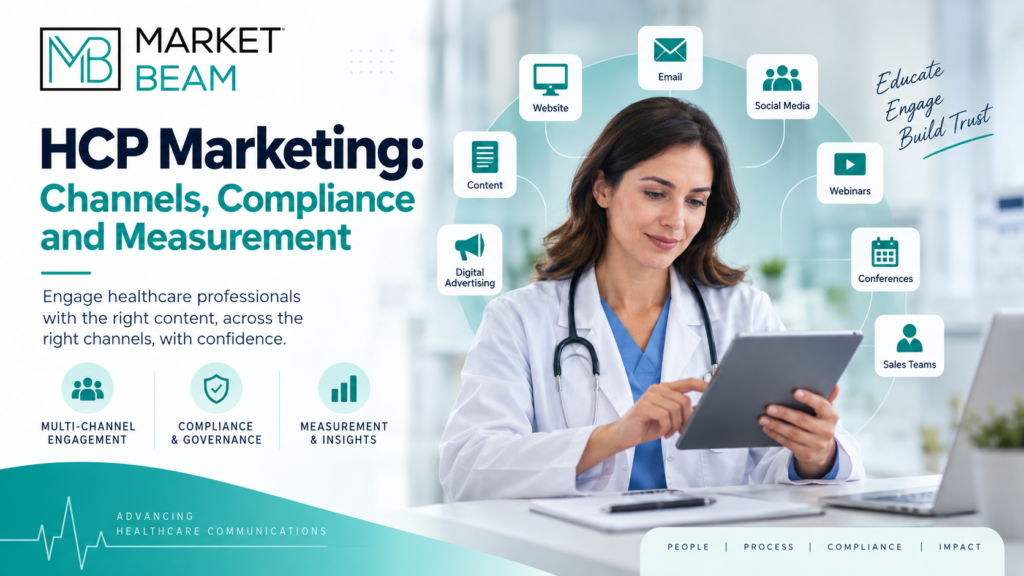
Modern HCP marketing can include professional websites, email, webinars, conferences, sales representatives, digital advertising, professional social networks, and educational content.
The objective is to provide useful information while maintaining appropriate scientific, legal, regulatory, and brand standards.
Why HCP Marketing Matters for Life Sciences
The healthcare landscape has become increasingly digital. Professionals may research products online, attend virtual events, read industry publications, and engage with professional content on social platforms.
This creates more opportunities for HCP marketing, but it also creates a greater need for consistency across channels.
A physician may encounter a company’s social media post, visit its website, receive an email, and later attend a webinar. If the messaging differs significantly between these interactions, the organization can create confusion and weaken trust.
A connected content strategy helps ensure that core messages remain consistent while adapting them to the format and needs of each channel.
Healthcare Professional Marketing and Physician Engagement
Healthcare professional marketing should be based on the needs of the audience. Physicians and other HCPs often value content that is concise, relevant, evidence-based, and easy to access.
Physician engagement can include scientific education, product updates, clinical information, professional resources, and relevant industry insights.
The strongest programs avoid treating every HCP in the same way. A specialist may be interested in detailed scientific information, while another professional may prefer concise educational material.
Audience segmentation helps marketing teams create more relevant experiences. Data from previous interactions can also help identify which topics, formats, and channels generate meaningful engagement.
Key HCP Marketing Channels
Organizations have many options for reaching healthcare professionals. The best channel mix depends on the audience, campaign objective, product lifecycle, and communication requirements.
Professional websites can provide detailed product and scientific resources. Email can support direct communication and ongoing education. Webinars and virtual events can provide deeper engagement and opportunities for discussion.
Professional social media networks can support thought leadership and educational communication. Conferences and field teams remain important for organizations that require direct interaction.
A strong HCP marketing strategy combines channels rather than relying on a single platform. Each channel should have a defined role within the broader customer journey.
Pharma Digital Marketing
Pharma digital marketing has expanded rapidly as healthcare professionals spend more time researching information online. Search, professional social media, email, digital advertising, webinars, and online education now contribute to many life sciences campaigns.
Digital channels make targeting and measurement easier, but they also create content governance challenges. A single campaign may require dozens of assets across multiple platforms.
Marketing teams should establish clear approval processes before launching a campaign. This helps ensure that messaging, claims, visuals, and supporting information remain aligned across all digital touchpoints.
Creating Effective HCP Content
HCP content should provide value rather than simply promote a product. Useful content may include educational resources, scientific information, clinical updates, disease-area information, or product-related materials appropriate for the intended audience.
Content should also be easy to understand and relevant to the professional’s needs. Long technical material may work well in a detailed resource, while a social media post may need a simpler format.
Strong HCP marketing programs maintain a library of approved content, claims, visuals, and references. This makes content creation more efficient and reduces the risk of teams using outdated information.
HCP Marketing Channels and Their Uses
| Channel | Primary Use | Key Consideration |
|---|---|---|
| Professional Website | Detailed education and resources | Accurate, approved information |
| Direct HCP communication | Audience targeting and review | |
| Webinars | Education and deeper engagement | Structured content and speakers |
| Professional Social Media | Awareness and thought leadership | Controlled messaging |
| Digital Advertising | Targeted reach | Review claims and creative |
| Conferences | Direct professional interaction | Consistent campaign messaging |
| Sales Teams | Personalized engagement | Approved materials and guidance |
Common HCP Marketing Challenges
One major challenge is maintaining consistency across channels. Different teams may create social posts, emails, presentations, and website content independently, which can lead to inconsistent messaging.
Another challenge is balancing relevance with compliance. HCP audiences want useful information, but marketing teams must ensure that promotional communications follow applicable requirements and internal review standards.
Content approval can also become a bottleneck. Multiple stakeholders may need to review an asset, particularly for pharmaceutical and regulated products.
Finally, measurement can be fragmented when each channel produces different data. A centralized approach makes it easier to understand overall engagement and campaign performance.
These challenges can be addressed through structured workflows, clear ownership, approved content libraries, and centralized analytics.
Compliant Outreach and Regulatory Considerations
Compliant outreach is a central part of effective HCP marketing. Healthcare professionals expect relevant information, but life sciences organizations must ensure communications follow applicable laws, industry requirements, and internal policies.
Before launching a campaign, teams should identify the audience, purpose, claims, channels, and required review stages. Marketing content may need medical, legal, regulatory, or compliance review depending on its purpose and risk.
A structured approval process helps prevent unsupported claims, inconsistent messaging, and other communication risks. It also creates a clear record of what was reviewed and approved.
For social media and other fast-moving digital channels, the same principles apply. Short posts should not bypass established review controls simply because they contain less text.
Organizations should also monitor interactions after publication. Questions, complaints, or unexpected responses may require escalation to medical, legal, or compliance teams.
Measuring HCP Marketing Performance
An effective HCP marketing strategy needs clear measurement. Tracking performance helps teams understand whether campaigns are reaching the right professionals and producing meaningful engagement.
Useful metrics can include content views, email engagement, webinar registrations, website visits, downloads, professional interactions, and other campaign-specific actions.
However, high activity does not always mean high value. A campaign with many impressions may generate little meaningful engagement, while a smaller campaign may attract a highly relevant professional audience.
Marketing teams should therefore connect HCP marketing metrics with defined campaign goals. Awareness programs may focus on reach and content consumption, while engagement campaigns may prioritize interactions or registrations.
Centralized reporting can also help teams compare performance across channels, audiences, products, and regions.
Building an Effective HCP Marketing Workflow
A structured workflow helps organizations manage HCP marketing from planning through measurement.
The process should begin with campaign objectives and audience segmentation. Teams can then develop content, identify claims and references, and determine which stakeholders must review the material.
Medical reviewers can check scientific accuracy, while legal and regulatory teams assess applicable requirements. Brand teams can confirm consistency before content reaches final approval.
After approval, content can be published through the appropriate channels. Performance data should then be collected and reviewed to determine whether the campaign achieved its objectives.
This workflow creates a continuous cycle: plan, create, review, approve, publish, measure, and improve.
Automation can support the process by routing content, sending reminders, tracking approvals, and maintaining records. Human expertise should remain central to medical, legal, regulatory, and compliance decisions.
Social Media and HCP Engagement
Social media can support physician engagement by providing accessible educational and professional content. Platforms such as LinkedIn can be useful for thought leadership, scientific communication, event promotion, and broader awareness.
However, social media requires careful governance because content is public and interaction can happen immediately.
Organizations should establish clear standards for HCP content, including approved messaging, visual guidelines, review requirements, and escalation procedures. Teams should also monitor comments and responses after publishing.
A strong HCP marketing program treats social media as part of the wider communication strategy rather than as a separate activity.
HCP Marketing Measurement Framework
| Objective | Primary Metrics | Example Insight |
|---|---|---|
| Awareness | Reach, impressions, content views | How widely content is seen |
| Engagement | Engagement rate, interactions | How audiences respond |
| Education | Downloads, webinar registrations | Interest in educational content |
| Website Activity | Visits, page views, time on page | Content consumption |
| Lead Generation | Registrations, qualified leads | Commercial response |
| Social Engagement | Shares, comments, profile visits | Professional interaction |
| Campaign Performance | Combined KPIs | Overall campaign effectiveness |
How MarketBeam Supports HCP Marketing
MarketBeam helps regulated organizations manage social media operations through centralized workflows for content, compliance, approvals, publishing, monitoring, engagement, and analytics.
For HCP marketing teams, this can simplify the process of coordinating content across social channels while maintaining appropriate governance. Marketing teams can prepare campaigns while relevant stakeholders participate in review and approval.
MarketBeam’s platform currently highlights AI-assisted compliance checks, human review workflows, publishing controls, social monitoring, analytics, and governance for regulated organizations.
These capabilities can help teams reduce repetitive administrative work and improve visibility into campaign status. Centralized workflows can also make it easier to maintain consistent processes across products, brands, and regions.
The platform should be configured according to the organization’s own policies and applicable requirements. Technology can support the workflow, but qualified professionals remain responsible for final medical, legal, regulatory, and compliance decisions.
Conclusion
Effective HCP marketing combines relevant healthcare professional communication with strong governance, compliance, and measurement. Organizations need to select the right channels, create useful HCP content, and build workflows that support accurate and consistent communication.
By coordinating healthcare professional marketing, physician engagement, pharma digital marketing, and other digital channels, life sciences organizations can build stronger professional relationships while maintaining appropriate controls.
Clear review procedures, compliant outreach, centralized workflows, and meaningful performance measurement can make campaigns more efficient and easier to manage.
MarketBeam supports regulated teams with social media management, compliance workflows, publishing, monitoring, analytics, engagement, and governance capabilities.
Connect With Us
Ready to improve your HCP marketing strategy?
Sales: sales@marketbeam.io
Tech Support: support@marketbeam.io
Connect with MarketBeam to explore compliant social media management, workflow automation, analytics, publishing, monitoring, and governance for regulated marketing teams.
Frequently Asked Questions
1. What is HCP marketing?
HCP marketing is the process of communicating with healthcare professionals through relevant channels to educate, inform, and engage them around pharmaceutical, biotechnology, medical device, or healthcare products and information.
2. What is healthcare professional marketing?
Healthcare professional marketing focuses on reaching physicians and other qualified healthcare professionals with relevant information through channels such as websites, email, webinars, conferences, digital advertising, and professional social media.
3. How can companies improve physician engagement?
Companies can improve physician engagement by providing relevant, useful, evidence-based content through channels that fit HCP preferences. Audience segmentation and performance data can also help improve future campaigns.
4. What should HCP content include?
HCP content should be relevant to its intended audience and follow the organization’s scientific, legal, regulatory, and brand requirements. Appropriate review should be completed before publication.
5. Why is compliant outreach important?
Compliant outreach helps ensure communications follow applicable requirements and internal policies while reducing risks related to inaccurate claims, inappropriate messaging, or inconsistent content.
6. How does MarketBeam support HCP marketing?
MarketBeam provides social media management, compliance workflows, approvals, publishing, monitoring, engagement, analytics, and governance capabilities that help regulated teams manage HCP marketing more efficiently.