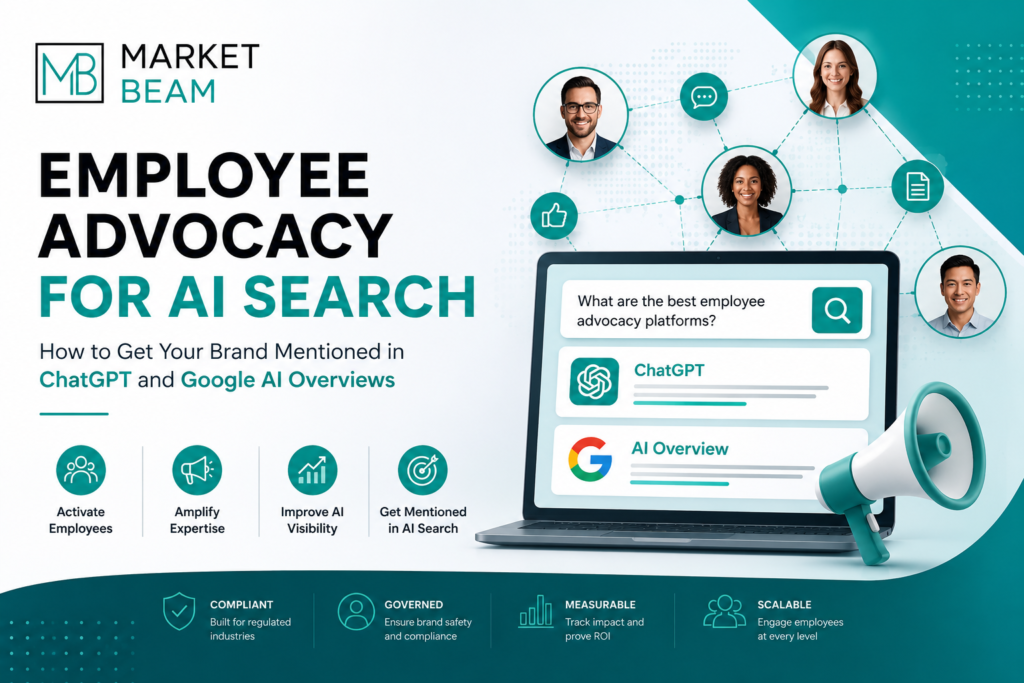
Employee Advocacy for AI Search is becoming one of the most important strategies for brands that want visibility in ChatGPT, Google AI Overviews, and other AI-powered search experiences. Buyers no longer rely only on traditional search engines to discover vendors, solutions, and industry expertise. Instead, they ask AI platforms for recommendations and use generative search tools to evaluate companies before ever visiting a website. As AI search continues to grow, organizations that invest in employee advocacy will gain a significant advantage in building authority and increasing brand visibility.
As a result, enterprise marketers face an important question: how do you ensure your company appears in AI-generated answers?
Increasingly, the answer lies in Employee Advocacy for AI Search.
Traditional SEO focused primarily on optimizing websites. In contrast, Employee Advocacy for AI Search focuses on strengthening your organization’s expertise across the internet through employees, executives, and subject matter experts. Every employee post, LinkedIn article, webinar insight, and expert opinion contributes to the trust signals that AI systems use to determine which brands deserve visibility.
Therefore, organizations that invest in Employee Advocacy for AI Search will gain an advantage over competitors that still rely solely on corporate content strategies.
What Is Employee Advocacy for AI Search?
Employee Advocacy for AI Search is the practice of using employees and executives to create, share, and amplify expertise that improves your company’s visibility in AI-driven search experiences such as ChatGPT and Google AI Overviews.
Traditionally, employee advocacy programs focused on expanding reach and engagement through employee social sharing.
However, the goal of Employee Advocacy for AI Search is different.
The objective is to increase brand authority, improve AI search visibility, strengthen brand recognition, and establish your organization as a trusted source on topics that matter to buyers.
This approach combines employee advocacy strategy with modern concepts such as AI Engine Optimization, Generative Engine Optimization, and SEO across multiple channels.
Rather than depending on a single corporate website to demonstrate expertise, organizations create hundreds or thousands of trust signals across the web through employee-generated content.
Why AI Search Works Differently Than Traditional SEO
Traditional search engines relied heavily on backlinks, keywords, technical SEO, and domain authority.
However, AI search systems evaluate a much broader set of signals.
For example, when someone asks ChatGPT for the best employee advocacy platform or requests recommendations for social media compliance software, AI models consider information from multiple trusted sources.
These signals often include:
- Brand mentions across the web
- Executive thought leadership
- Expert commentary
- Industry citations
- Employee-generated content
- Community discussions
- Media references
- Social engagement patterns
Consequently, AI search visibility depends less on individual pages and more on your overall online presence.
This is exactly why Employee Advocacy for AI Search is becoming a critical growth strategy for B2B organizations.
How Employee Advocacy for AI Search Influences ChatGPT
Many companies want to know how to get their brand mentioned in ChatGPT.
Unfortunately, there is no single ranking factor or optimization trick.
Nevertheless, AI systems tend to recognize brands that consistently demonstrate expertise across multiple channels and sources.
This is where Employee Advocacy for AI Search becomes valuable.
When employees regularly publish content around industry topics, your company becomes associated with those areas of expertise.
For example, if multiple employees discuss employee advocacy software, social media compliance software, AI governance, executive advocacy, and regulated industry marketing, AI systems begin connecting your organization with those subjects.
Over time, this improves the likelihood of employee advocacy for ChatGPT visibility.
The more trusted voices discussing your expertise, the stronger your authority becomes.
Because of this, employee advocacy and AI search are becoming closely connected disciplines.
How Employee Advocacy for AI Search Supports Google AI Overviews
Google AI Overviews operate differently from traditional featured snippets.
Instead of extracting information from a single webpage, Google combines information from multiple trusted sources to generate answers.
As a result, employee advocacy for Google AI Overviews depends heavily on topical authority and strong relationships between your brand and important industry topics.
Organizations that dominate conversations often dominate AI-generated summaries.
When employees, executives, customers, analysts, and partners consistently reference your company within a specific topic area, Google strengthens its understanding of your expertise.
This is one of the biggest advantages of Employee Advocacy for AI Search.
Employees become additional sources of authority that reinforce your messaging and expertise.
Meanwhile, companies relying only on corporate blog content compete against organizations with hundreds of expert voices contributing to industry conversations every day.
Employee Advocacy for AI Search Creates SEO Across Multiple Channels
One of the most important concepts in modern search is SEO across multiple channels.
This approach means your authority is built through many channels rather than through a single website.
LinkedIn posts, webinars, podcast appearances, conference presentations, executive interviews, expert commentary, and employee-generated content all contribute to your online presence.
Therefore, Employee Advocacy for AI Search acts as an SEO strategy designed for the AI era.
Every employee who shares expertise becomes an extension of your SEO program.
Similarly, executive thought leadership creates additional trust signals.
In addition, employee conversations contribute directly to AI search optimization.
This allows companies to scale expertise far beyond what a single marketing team could achieve alone.
Why Employee Content Outperforms Corporate Content
Research consistently shows that audiences trust people more than brands.
Because of this, employees often generate higher engagement than corporate accounts because their content feels more authentic and personal.
AI systems increasingly reflect these same trust patterns.
Employee Advocacy for AI Search works because AI systems identify repeated expertise from multiple trusted voices.
For instance, if twenty employees discuss the same strategic themes, AI models recognize a stronger authority signal than if one corporate account publishes twenty articles on the same topic.
As a result, employee advocacy strategy is quickly becoming an AI visibility strategy.
Organizations that activate employees are creating trust signals at scale.
The Role of Executive Thought Leadership in AI Search Visibility
Executive thought leadership plays an enormous role in AI search visibility.
Senior leaders often attract more engagement, media coverage, and industry citations than corporate accounts.
When executives regularly publish insights around trends, regulations, innovation, and customer challenges, they strengthen the company’s authority profile.
Furthermore, executive thought leadership directly supports Employee Advocacy for AI Search because executives become trusted voices within their industries.
This improves employee advocacy for ChatGPT visibility and increases the likelihood of inclusion in Google AI Overviews.
Organizations that invest in executive activation programs often see benefits that extend far beyond social engagement.
Ultimately, they become recognized industry authorities.
Employee Advocacy for AI Search in Regulated Industries
Regulated industries face unique challenges when implementing employee advocacy programs.
Financial services organizations must comply with FINRA regulations.
Similarly, life sciences organizations must follow MLR review processes.
Healthcare organizations also operate under strict governance requirements.
Because of these challenges, many regulated companies avoid employee advocacy entirely.
However, this creates an opportunity.
Organizations that implement compliant employee advocacy programs can establish authority while maintaining governance and audit requirements.
Employee advocacy for regulated industries allows organizations to improve AI search visibility without increasing compliance risk.
This is particularly valuable for companies operating in life sciences, pharmaceuticals, healthcare, and financial services.
The future of compliant employee advocacy will increasingly involve AI search optimization.
Building an Employee Advocacy for AI Search Strategy
Organizations looking to improve AI visibility should follow a structured approach.
First, identify the topics your company wants to own.
Next, encourage employees to contribute authentic perspectives rather than simply reposting corporate content.
Then, activate executives and subject matter experts.
After that, create consistent publishing habits.
Finally, measure authority growth over time.
An effective employee advocacy platform can simplify this process by providing approved content, compliance workflows, analytics, and distribution tools.
Most importantly, successful employee advocacy strategy focuses on expertise rather than promotion.
AI systems reward organizations that educate markets rather than simply advertise to them.
Measuring Success from Employee Advocacy for AI Search
Traditional employee advocacy programs measured clicks and impressions.
Those metrics still matter.
However, organizations should also monitor indicators that reflect AI search performance.
Important metrics include:
- Growth in branded search volume
- Industry citations
- Executive engagement rates
- Share of voice
- Brand mentions
- AI search visibility
- Inclusion in Google AI Overviews
- Employee advocacy for ChatGPT references
Together, these indicators provide a better understanding of how employee advocacy impacts SEO and long-term authority.
Why Employee Advocacy Software Will Become an AI Visibility Platform
Historically, employee advocacy software focused on content distribution.
However, the next generation of employee advocacy platforms will focus on authority generation.
Organizations will increasingly evaluate solutions based on their ability to improve AI search visibility rather than simply increase social reach.
Features such as executive advocacy programs, compliance workflows, analytics, AI recommendations, and authority tracking will become standard requirements.
As a result, the employee advocacy platform of the future will function as an AI visibility engine.
The Future of Employee Advocacy and AI Search
The future of search is recommendation rather than ranking.
Instead of asking whether your website ranks number one, organizations will ask whether their brand appears in ChatGPT responses and Google AI Overviews.
This shift changes everything.
Companies that invest in Employee Advocacy for AI Search today are building the foundation of expertise that will power visibility tomorrow.
Employee insights strengthen expertise.
Executive perspectives build trust.
Meanwhile, employee-generated content contributes to SEO across multiple channels.
The organizations that embrace employee advocacy and AI search early will become the brands that generative search systems recommend most frequently.
Frequently Asked Questions
Can Employee Advocacy for AI Search guarantee visibility in ChatGPT?
No. No company can guarantee inclusion in AI-generated answers. However, Employee Advocacy for AI Search increases trust signals that improve the likelihood of visibility.
Does employee advocacy help Google AI Overviews?
Yes. Employee advocacy for Google AI Overviews strengthens authority, brand recognition, and topical relevance across multiple channels.
What is AI Engine Optimization?
AI Engine Optimization is the process of improving visibility in AI-driven search experiences such as ChatGPT and Google AI Overviews.
How does employee advocacy impact SEO?
Employee advocacy impacts SEO by increasing brand mentions, trust signals, backlinks, engagement, and SEO performance across multiple channels.
Why is Employee Advocacy for AI Search important for enterprises?
Large organizations often have hundreds or thousands of employees with valuable expertise. Employee Advocacy for AI Search allows companies to scale authority through those voices.
Conclusion
The companies that dominate AI search will not necessarily be the companies with the biggest websites.
Instead, they will be the companies with the strongest trust signals.
These organizations will have active executives, knowledgeable employees, trusted experts, and consistent thought leadership.
That is why Employee Advocacy for AI Search is emerging as one of the most important marketing strategies of the AI era.
Organizations that build authority through employees today will become the brands that ChatGPT, Google AI Overviews, and future AI search engines recommend tomorrow.