Social media has transformed the way pharmaceutical companies communicate with healthcare professionals, patients, caregivers, and the broader public. Platforms like LinkedIn, X, Facebook, Instagram, and YouTube enable organizations to share educational content, product updates, disease awareness campaigns, and corporate announcements at an unprecedented scale. While these channels create valuable engagement opportunities, they also introduce significant regulatory responsibilities. Understanding FDA fair balance is essential for ensuring that every promotional communication presents benefits and risks accurately while complying with FDA regulations.
For pharmaceutical marketers, maintaining FDA fair balance goes beyond adding a brief safety disclaimer. It requires thoughtful planning, consistent governance, and collaboration among marketing, medical, legal, and regulatory (MLR) teams. Every promotional message should help audiences make informed decisions by presenting both the potential benefits and the associated risk information in a balanced manner.
MarketBeam helps regulated organizations streamline compliant digital communications through centralized collaboration, approval workflows, content governance, and enterprise social media management. By combining technology with structured review processes, companies can strengthen compliance while improving operational efficiency.
What Is FDA Fair Balance?
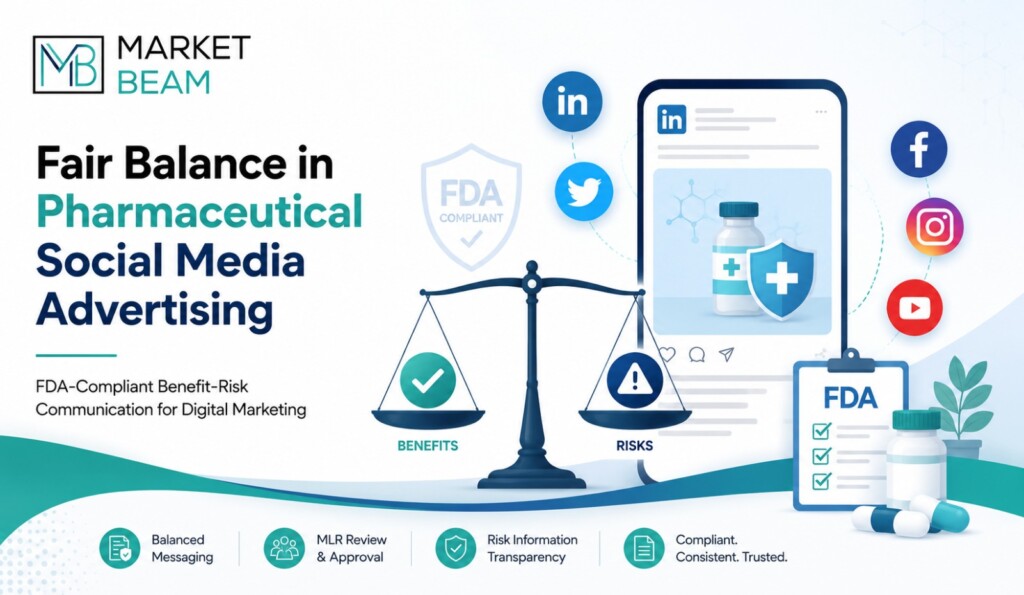
FDA fair balance refers to the FDA’s expectation that prescription drug promotional materials present both the benefits and the risks of a product in a truthful, accurate, and balanced way. Promotional communications should never emphasize positive outcomes while minimizing, obscuring, or omitting important safety information.
Whether the communication appears in a print advertisement, digital campaign, email, webinar, website, or social media post, FDA fair balance requires organizations to provide audiences with enough information to understand both the advantages and potential risks associated with the promoted product.
This principle applies across all forms of pharma advertising, including paid promotions, branded social media content, sponsored campaigns, videos, and other company-controlled communications.
Why FDA Fair Balance Matters
Building trust is one of the most important objectives in healthcare communications. Patients and healthcare professionals rely on pharmaceutical companies to provide accurate and reliable information when evaluating treatment options.
Ignoring FDA fair balance can expose organizations to regulatory scrutiny, warning letters, reputational damage, and reduced public confidence. Promotional materials that overstate benefits or fail to communicate significant safety concerns may be considered misleading.
Strong compliance practices also help organizations improve internal collaboration. Marketing teams can develop engaging campaigns while medical, legal, and regulatory reviewers verify that communications align with FDA compliance expectations before publication.
Organizations that consistently apply FDA fair balance demonstrate a commitment to transparency, responsible communication, and patient safety.
Understanding Fair Balance Requirements
Meeting fair balance requirements involves more than simply listing side effects at the end of an advertisement.
The FDA expects promotional communications to present benefit and risk information with comparable prominence. If product benefits are highlighted using large headlines, compelling visuals, or prominent placement, important risk disclosures should receive similar visibility and readability.
Organizations should avoid presenting benefit claims in a way that overshadows safety information or creates an inaccurate impression of the product’s overall profile.
Following fair balance requirements also means ensuring that promotional materials remain scientifically accurate, consistent with approved prescribing information, and supported by appropriate evidence.
Marketing teams should work closely with medical reviewers to verify that all claims accurately reflect approved labeling before publication.
The Importance of Benefit-Risk Presentation
An effective benefit-risk presentation allows audiences to evaluate both the therapeutic value and the potential risks associated with a pharmaceutical product.
Instead of emphasizing only positive outcomes, organizations should integrate safety information naturally into promotional communications. This balanced approach supports informed decision-making while reducing the likelihood of misleading promotional practices.
A well-structured benefit-risk presentation should clearly explain approved indications, expected clinical benefits, significant warnings, contraindications, and other important safety considerations where appropriate.
As social media content becomes shorter and more visual, maintaining FDA fair balance requires careful planning to ensure that both benefit and risk information remain accessible and understandable.
Communicating Risk Information Effectively
Providing accurate risk information is one of the most critical aspects of compliant pharmaceutical marketing.
Risk information should be presented in language that is clear, understandable, and appropriate for the intended audience. Companies should avoid minimizing important warnings or presenting safety disclosures in a format that is difficult to notice or interpret.
When creating digital content, organizations should consider how graphics, videos, captions, and platform limitations affect the visibility of safety information.
Marketing teams should also ensure that links to additional prescribing information or Important Safety Information (ISI) are used appropriately where permitted, while recognizing that linking alone may not satisfy all regulatory expectations depending on the communication.
Maintaining consistent risk information across websites, advertisements, social media posts, and other promotional channels helps strengthen both compliance and audience trust.
Key Elements of FDA Fair Balance
| Compliance Element | Why It Matters |
| Balanced Benefit Claims | Prevents misleading promotional messaging |
| Clear Risk Information | Supports informed healthcare decisions |
| Comparable Visibility | Ensures risks receive appropriate prominence |
| Accurate Benefit-Risk Presentation | Reflects approved product labeling |
| Medical, Legal, and Regulatory Review | Improves compliance before publication |
| Consistent Messaging | Maintains trust across communication channels |
Common Fair Balance Compliance Challenges
Maintaining FDA fair balance across modern digital marketing channels can be challenging.
Social media platforms often impose character limits, image size restrictions, and formatting constraints that make it difficult to include complete promotional information. Marketing teams may also face pressure to create concise, engaging content that competes for audience attention.
Another challenge involves maintaining consistency across multiple communication channels. A product campaign may include social media posts, landing pages, email communications, webinars, videos, and digital advertisements. Every promotional asset should consistently reflect approved messaging while meeting fair balance requirements.
Organizations also need efficient collaboration between marketing, medical, legal, and regulatory teams. Without structured review processes, inconsistent messaging or incomplete risk information may reach publication, increasing compliance risk.
Technology and standardized governance play an important role in addressing these challenges. Centralized workflows, documented approvals, and collaborative review processes help organizations consistently implement FDA fair balance while improving marketing efficiency.
FDA Compliance Best Practices for Fair Balance
Maintaining FDA fair balance requires a proactive compliance strategy that extends throughout the entire promotional content lifecycle. Rather than reviewing content only before publication, organizations should build compliance into planning, creation, review, publishing, monitoring, and recordkeeping.
A strong governance framework begins with documented policies that define how promotional materials are created and reviewed. Marketing teams should understand when medical, legal, and regulatory (MLR) review is required, while compliance teams should establish standardized approval criteria based on FDA expectations.
Regular employee training also supports long-term FDA compliance by ensuring marketing professionals stay informed about evolving regulations, approved product labeling, and internal review procedures.
Organizations should maintain comprehensive documentation of approvals, revisions, and promotional assets to improve audit readiness and support regulatory inspections.
By embedding FDA fair balance into daily operations, pharmaceutical companies reduce compliance risks while improving efficiency and collaboration.
Building a Fair Balance Workflow for Regulated Marketing Teams
Successful pharmaceutical marketing depends on structured workflows that ensure every promotional communication receives appropriate review before publication.
The process begins with campaign planning, where marketing teams define messaging objectives, target audiences, and communication channels. During content creation, writers and designers develop materials that include both benefit claims and appropriate risk information.
Draft content then moves through Medical, Legal, and Regulatory review. Medical reviewers verify scientific accuracy, legal teams evaluate regulatory obligations, and regulatory specialists ensure compliance with fair balance requirements and approved prescribing information.
Following approval, organizations can schedule promotional content while maintaining complete documentation of review histories and approval records. Continuous monitoring after publication helps identify potential compliance concerns, public inquiries, or misinformation that may require additional action.
A standardized workflow makes it easier to consistently implement benefit-risk presentation principles across every marketing campaign.
Leveraging Technology to Improve Compliance
Modern pharmaceutical marketing generates a large volume of promotional content across websites, email campaigns, webinars, digital advertising, and social media platforms.
Managing these activities manually often creates inefficiencies, inconsistent approvals, and version-control challenges. Enterprise technology helps regulated organizations centralize collaboration while improving visibility throughout the promotional lifecycle.
Workflow automation routes promotional assets through predefined approval stages, reducing manual coordination and accelerating review cycles without compromising compliance quality.
Centralized document management ensures marketing, medical, legal, and regulatory teams always work from the latest approved materials. Audit trails provide complete records of revisions, approvals, and publication history, supporting both internal governance and regulatory inspections.
Technology also strengthens FDA fair balance by helping organizations maintain consistent messaging, accurate risk information, and standardized review processes across every communication channel.
Best Practices for Maintaining FDA Fair Balance
| Best Practice | Compliance Benefit |
| Establish standardized review workflows | Improves consistency across promotional campaigns |
| Include balanced benefit-risk presentation | Supports informed healthcare decisions |
| Present clear risk information | Reduces misleading promotional claims |
| Maintain centralized documentation | Strengthens audit readiness |
| Conduct regular MLR reviews | Improves scientific and regulatory accuracy |
| Monitor published communications | Identifies compliance issues early |
| Train marketing and compliance teams | Builds a strong compliance culture |
How MarketBeam Supports Compliant Pharma Advertising
Managing compliant pharma advertising requires more than publishing content on multiple social platforms. Regulated organizations need centralized governance, structured approvals, and efficient collaboration to maintain consistent compliance.
MarketBeam provides an enterprise platform that helps regulated organizations strengthen FDA fair balance through workflow automation, collaborative review processes, and centralized content management. Marketing, medical, legal, and regulatory teams can work together in one environment, improving communication while maintaining complete approval histories.
The platform supports organized campaign planning, approval workflows, and content governance that align with internal compliance procedures. Teams can coordinate promotional assets, manage revisions, and maintain audit-ready documentation throughout the content lifecycle.
MarketBeam also simplifies enterprise social media management by enabling organizations to schedule approved content, oversee multiple communication channels, and maintain consistent messaging across digital campaigns.
Although regulatory responsibility remains with each organization, MarketBeam helps simplify the internal governance processes that support compliant promotional communications and responsible benefit-risk presentation.
Conclusion
Maintaining FDA fair balance is a fundamental responsibility for every pharmaceutical organization engaged in digital marketing and social media advertising. Presenting balanced benefit claims alongside clear risk information helps healthcare professionals and patients make informed decisions while supporting regulatory compliance.
By following established fair balance requirements, implementing structured review workflows, strengthening benefit-risk presentation, and maintaining ongoing FDA compliance, organizations can reduce regulatory risks while building greater trust with their audiences.
MarketBeam empowers regulated organizations with enterprise collaboration, workflow automation, content governance, and social media management capabilities that simplify compliant pharma advertising. With the right governance framework and technology, pharmaceutical marketers can execute effective campaigns while maintaining confidence in every promotional communication.
Connect With Us
Ready to improve compliant pharmaceutical social media marketing?
Sales: sales@marketbeam.io
Tech Support: support@marketbeam.io
Discover how MarketBeam helps regulated organizations strengthen governance, streamline approvals, and support FDA fair balance across every stage of the promotional content lifecycle.
Frequently Asked Questions
1. What is FDA fair balance?
FDA fair balance is the FDA’s expectation that pharmaceutical promotional materials present product benefits and risk information with equal prominence so audiences receive accurate and balanced information.
2. Why are fair balance requirements important?
Fair balance requirements help ensure promotional communications are truthful, scientifically accurate, and not misleading by presenting both benefits and risks appropriately.
3. What is benefit-risk presentation?
Benefit-risk presentation refers to communicating the therapeutic benefits of a product alongside important safety information, allowing healthcare professionals and patients to make informed treatment decisions.
4. How should risk information be presented on social media?
Risk information should be clear, visible, understandable, and appropriately balanced with promotional claims. Organizations should follow FDA expectations and internal review processes for every communication.
5. How can pharmaceutical companies improve FDA compliance?
Companies can strengthen FDA compliance by implementing standardized MLR review workflows, maintaining centralized documentation, training employees regularly, monitoring published content, and using governance-focused technology platforms.
6. How does MarketBeam support compliant pharma advertising?
MarketBeam provides centralized collaboration, approval workflows, content governance, audit trails, and enterprise social media management that help regulated organizations improve internal compliance processes and execute compliant pharma advertising more efficiently.