The pharmaceutical industry operates under some of the strictest marketing regulations in the world. Every promotional message, whether it appears on a company website, a social media platform, an email campaign, a sales presentation, or a digital advertisement, must be accurate, balanced, scientifically supported, and compliant with regulatory requirements. Unlike many other industries where marketing teams can publish content immediately after internal approval, pharmaceutical organizations must follow a structured MLR Approval Workflow before any promotional material reaches healthcare professionals, patients, or the public.
As digital marketing continues to evolve, the volume of content being produced has increased dramatically. Marketing teams now manage websites, webinars, videos, social media campaigns, employee advocacy programs, email marketing, digital advertising, and educational resources simultaneously. Without a well-defined MLR Approval Workflow, managing this growing content pipeline becomes increasingly difficult, resulting in delayed product launches, inconsistent messaging, compliance risks, and operational inefficiencies.
Modern pharmaceutical organizations are therefore investing in technology and standardized review processes that simplify collaboration between Medical, Legal, and Regulatory teams while reducing review times. An effective MLR Approval Workflow not only protects organizations from compliance risks but also enables marketing teams to launch campaigns faster without compromising quality or regulatory standards.
This guide explains how an MLR Approval Workflow works, why it is essential for pharmaceutical organizations, the challenges companies face, and how modern workflow automation is transforming compliant content creation.
What Is an MLR Approval Workflow?
An MLR Approval Workflow is the structured process pharmaceutical and life sciences organizations use to review, validate, approve, and document promotional content before publication. The acronym MLR stands for Medical, Legal, and Regulatory, representing the three departments responsible for ensuring that marketing materials comply with scientific evidence, legal obligations, and regulatory requirements.
The Medical team verifies that every clinical claim is supported by accurate scientific evidence and approved product information. Their responsibility is to ensure that promotional content reflects current medical knowledge, avoids misleading statements, and presents balanced information regarding product benefits and risks.
The Legal team evaluates whether promotional materials comply with applicable laws, intellectual property requirements, advertising regulations, contractual obligations, and corporate policies. Legal reviewers also help minimize organizational risk by identifying statements that could expose the company to regulatory action or legal disputes.
The Regulatory team ensures that every promotional asset complies with regulations established by authorities such as the U.S. Food and Drug Administration (FDA), the European Medicines Agency (EMA), the Medicines and Healthcare products Regulatory Agency (MHRA), and other regional regulatory bodies. Regulatory reviewers confirm that claims remain within approved product labeling and promotional guidelines.
An effective MLR Approval Workflow brings these three functions together into a structured review process that allows organizations to publish compliant content with confidence while maintaining complete documentation for future audits.
Why an MLR Approval Workflow Is Essential
An efficient MLR Approval Workflow serves as the foundation of compliant pharmaceutical marketing. Every promotional asset distributed without proper review has the potential to expose an organization to regulatory action, financial penalties, reputational damage, and loss of public trust.
The importance of an MLR Approval Workflow has increased significantly as pharmaceutical marketing expands across digital channels. Companies now communicate through websites, LinkedIn, X, Facebook, webinars, podcasts, email campaigns, video platforms, employee advocacy programs, online advertisements, and virtual events. Each of these communication channels presents unique compliance challenges while still requiring the same level of regulatory oversight.
A standardized MLR Approval Workflow creates consistency throughout the organization. Marketing teams understand exactly how content moves from creation to publication, while reviewers know their responsibilities at every stage of the approval process. This structure reduces confusion, minimizes duplicate reviews, and helps eliminate unnecessary delays.
The workflow also improves collaboration between departments. Marketing professionals focus on developing compelling campaigns, Medical reviewers verify scientific accuracy, Legal teams evaluate potential risks, and Regulatory specialists confirm compliance with applicable guidelines. Rather than working independently, every stakeholder contributes within a coordinated review process that produces higher-quality promotional materials.
Equally important is documentation. Every review, revision, approval, and final decision should be recorded as part of the MLR Approval Workflow. Maintaining a complete audit trail demonstrates compliance during inspections while providing transparency across the entire content lifecycle.
How an MLR Approval Workflow Works
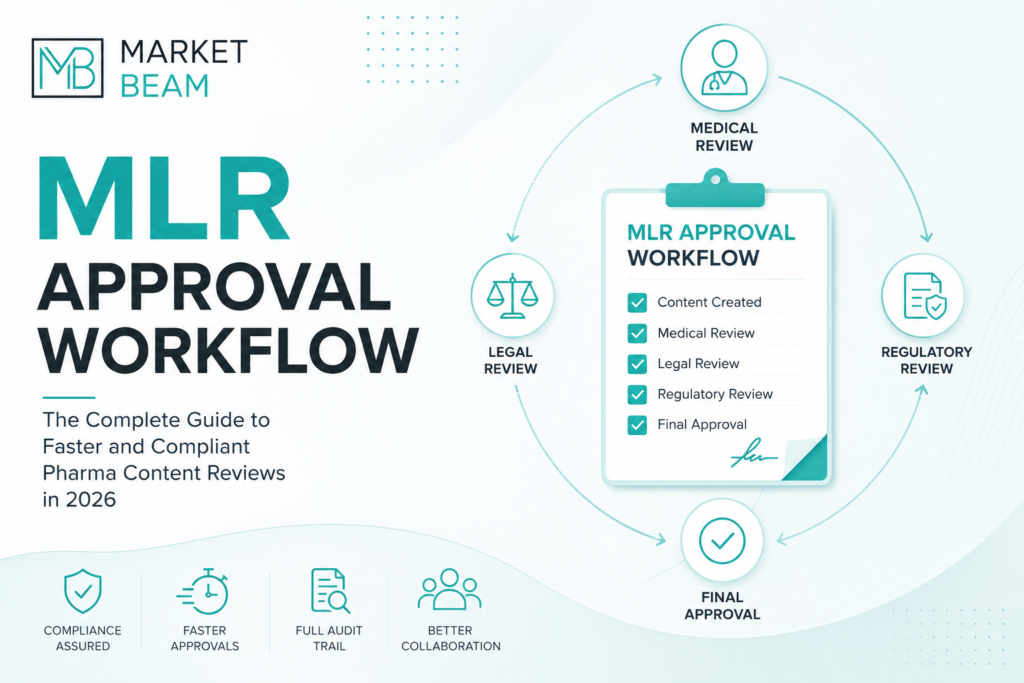
Although every pharmaceutical organization develops its own internal review procedures, most MLR Approval Workflow processes follow a similar sequence designed to ensure both efficiency and compliance.
The process begins when the marketing team creates promotional content based on approved messaging, product information, campaign objectives, and corporate branding guidelines. At this stage, writers, designers, and digital marketers collaborate to produce content that aligns with business goals while referencing approved scientific materials.
Once the initial draft is complete, the content enters the Medical review phase. Medical reviewers examine every clinical statement, efficacy claim, safety reference, dosage recommendation, and scientific citation. Their objective is to ensure that every statement accurately reflects approved clinical evidence and provides balanced information regarding both benefits and potential risks.
After Medical approval, the content progresses to Legal review. Legal specialists evaluate intellectual property considerations, trademark usage, promotional claims, contractual language, copyright compliance, and advertising regulations. They also assess whether the communication introduces unnecessary legal exposure or requires additional disclaimers.
Following Legal review, the content moves to Regulatory review. Regulatory specialists confirm that promotional claims remain consistent with approved prescribing information, product labeling, regional regulations, and internal compliance standards. They verify that mandatory disclosures, safety information, and required references have been included appropriately.
Most organizations experience multiple revision cycles during the MLR Approval Workflow. Marketing teams receive reviewer comments, update the content accordingly, and resubmit revised versions until all reviewers approve the final asset. This iterative process ensures that every concern is resolved before publication.
After receiving final approval, the content becomes eligible for distribution across approved communication channels. Whether published on a corporate website, social media platform, email campaign, or sales enablement portal, the organization retains documentation showing exactly who reviewed the material, what changes were requested, and when final approval occurred.
This structured workflow provides confidence that every promotional asset has undergone appropriate scientific, legal, and regulatory evaluation before reaching its intended audience.
Common Challenges in an MLR Approval Workflow
Despite its importance, many pharmaceutical organizations continue to rely on manual review processes that create unnecessary complexity throughout the MLR Approval Workflow.
One of the most common challenges is fragmented communication. Reviewers frequently exchange comments through email, spreadsheets, PDF documents, and messaging platforms, making it difficult to identify the latest version of a document. As multiple reviewers provide independent feedback, marketing teams often spend considerable time consolidating comments before making revisions.
Version control presents another significant challenge. Without centralized document management, multiple versions of the same promotional material may circulate simultaneously. This increases the likelihood of outdated claims, inconsistent messaging, or previously rejected content being incorporated into the final asset.
Review delays also affect campaign execution. Medical reviewers, Legal teams, Regulatory specialists, and marketing departments typically have competing priorities. When review responsibilities are not clearly defined, content may remain idle for days or even weeks before reaching the next stakeholder. These delays can postpone product launches, awareness campaigns, conference announcements, and educational initiatives.
Visibility is another common issue. Marketing managers often struggle to determine where content is within the MLR Approval Workflow, who is responsible for the next review, and what issues remain unresolved. This lack of transparency creates uncertainty throughout the organization and makes project planning significantly more difficult.
Global pharmaceutical companies face additional complexity because promotional materials frequently require regional adaptations. Different countries operate under different regulatory frameworks, meaning content approved in one market may require substantial modification before publication elsewhere. Coordinating multiple regional reviews while maintaining consistency can become one of the most time-consuming aspects of an international MLR Approval Workflow.
As organizations continue expanding their digital marketing efforts, these manual processes become increasingly difficult to manage. Modern workflow automation, centralized collaboration, and AI-assisted review technologies are therefore becoming essential components of efficient pharmaceutical marketing operations.
Best Practices for Optimizing an MLR Approval Workflow
A successful MLR Approval Workflow is not defined solely by compliance. It should also enable marketing teams to create, review, approve, and publish content efficiently without sacrificing quality or regulatory standards. Organizations that continue relying on manual approvals, scattered email conversations, and disconnected review systems often experience longer review cycles, duplicated effort, and inconsistent documentation.
One of the most effective ways to improve an MLR Approval Workflow is by standardizing the review process across all content types. Every promotional asset should follow the same structured path from content creation through Medical, Legal, Regulatory, and final marketing approval. Standardization eliminates confusion, clarifies responsibilities, and reduces unnecessary back-and-forth communication.
Centralizing collaboration also plays a significant role in improving efficiency. Instead of exchanging multiple document versions through email, organizations benefit from maintaining all comments, revisions, approvals, and supporting references within a single collaborative environment. This approach gives every stakeholder visibility into the current status of each asset while minimizing version-control issues.
Clearly defined reviewer responsibilities are equally important. Medical reviewers should focus on scientific accuracy, Legal reviewers should assess legal and contractual considerations, and Regulatory reviewers should verify compliance with applicable promotional regulations. When each department understands its role within the MLR Approval Workflow, approvals become faster and more consistent.
Maintaining comprehensive documentation throughout the review process is another essential practice. Every revision, approval decision, reviewer comment, and publication record should remain available for future audits. A complete audit trail strengthens regulatory readiness while providing valuable historical information for future campaigns.
Organizations should also establish measurable performance indicators for their MLR Approval Workflow. Monitoring review turnaround times, approval cycle duration, revision frequency, and campaign launch timelines helps identify operational bottlenecks and opportunities for continuous improvement.
As pharmaceutical marketing continues expanding across digital channels, organizations that invest in standardized, transparent, and technology-driven approval workflows will be better positioned to maintain compliance while improving marketing agility.
How Artificial Intelligence Is Transforming the MLR Approval Workflow
Artificial intelligence is changing how pharmaceutical companies manage promotional content, but it is not replacing Medical, Legal, or Regulatory reviewers. Instead, AI serves as an intelligent assistant that helps accelerate the MLR Approval Workflow by reducing repetitive manual tasks and identifying potential compliance issues earlier in the review process.
One of AI’s greatest strengths is assisting content creation. Marketing teams can generate initial drafts, improve readability, maintain brand consistency, and adapt messaging for different communication channels more efficiently than traditional manual processes. Starting with higher-quality content often reduces the number of revision cycles required during review.
AI also supports reviewers by identifying language that may require additional attention. Systems can detect promotional claims that lack supporting references, highlight inconsistent terminology, identify missing safety information, and flag statements that may require Medical or Regulatory verification. Rather than making approval decisions, AI helps reviewers focus their expertise where it adds the greatest value.
Natural language processing can further improve collaboration within an MLR Approval Workflow by organizing reviewer comments, grouping similar feedback, and prioritizing outstanding issues. Marketing teams spend less time interpreting scattered comments and more time implementing meaningful revisions.
Artificial intelligence also improves document management. Automated version tracking, metadata generation, search capabilities, and content classification make it easier to locate approved assets while maintaining complete documentation throughout the review lifecycle.
As AI technology continues to evolve, pharmaceutical organizations will increasingly use intelligent automation to reduce administrative work while preserving the human oversight required for compliant promotional communications.
MLR Approval Workflow for Social Media and Digital Marketing
Social media has become one of the most important communication channels for pharmaceutical companies. Organizations use LinkedIn, X, Facebook, YouTube, webinars, blogs, podcasts, and digital advertising to educate healthcare professionals, share scientific information, and build relationships with key audiences. Despite the speed of digital communication, every promotional message must still follow an appropriate MLR Approval Workflow before publication.
Unlike traditional marketing materials, digital content often requires frequent updates and rapid campaign execution. Marketing teams may publish dozens of social media posts, event announcements, educational articles, employee advocacy campaigns, and promotional videos every month. Managing this volume through manual approval processes can create significant operational challenges.
A modern MLR Approval Workflow for digital marketing should support centralized content creation, structured review routing, version control, approval documentation, and secure publishing. Every approved asset should remain linked to its supporting references, reviewer comments, approval history, and expiration dates where applicable.
Employee advocacy introduces additional considerations. When employees share company-approved content through their personal professional networks, organizations must ensure that only approved messaging is available for distribution. Maintaining governance across employee advocacy programs helps reduce compliance risk while extending organic reach.
Digital campaigns also benefit from post-publication monitoring. Organizations should continuously monitor social conversations, identify potential adverse events, detect compliance concerns, and maintain visibility into published content throughout its lifecycle. Effective governance does not end when content is published; it continues through monitoring, reporting, and ongoing compliance management.
As digital marketing continues to expand, integrating social media into the broader MLR Approval Workflow has become essential for pharmaceutical organizations seeking both regulatory compliance and marketing efficiency.
How MarketBeam Supports the MLR Approval Workflow
Managing an enterprise MLR Approval Workflow requires more than document storage and publishing capabilities. Organizations need a platform that supports collaboration, governance, compliance, analytics, and content distribution within a unified environment.
MarketBeam helps pharmaceutical and life sciences organizations streamline the MLR Approval Workflow by bringing marketing teams, reviewers, and compliance stakeholders together within a centralized platform. Rather than managing approvals across disconnected systems, organizations can coordinate every stage of the review process while maintaining complete visibility into content status.
Configurable approval workflows allow organizations to define review sequences that align with internal governance requirements. Marketing teams can route promotional materials through Medical, Legal, Regulatory, and executive reviewers while maintaining complete documentation throughout the approval lifecycle.
MarketBeam also supports AI-assisted content creation that helps marketing teams develop higher-quality drafts before formal review begins. Although final approval always remains the responsibility of Medical, Legal, and Regulatory experts, AI reduces repetitive editing and improves overall content consistency.
For organizations using Veeva PromoMats, MarketBeam provides native integration that simplifies movement between approved promotional content and social media publishing workflows. This helps reduce manual processes while maintaining regulatory oversight across digital marketing activities.
Employee advocacy capabilities further extend approved content through controlled sharing programs. Organizations can confidently enable employees to distribute compliant content while maintaining governance, reporting, and visibility across advocacy campaigns.
Combined with analytics, social monitoring, approval documentation, and enterprise governance, MarketBeam enables pharmaceutical organizations to manage the complete digital marketing lifecycle while supporting efficient and compliant MLR Approval Workflow processes.
Conclusion
The pharmaceutical industry continues to produce more digital content than ever before, making an efficient MLR Approval Workflow essential for both compliance and business success. As marketing expands across websites, webinars, email campaigns, social media, employee advocacy, and digital advertising, organizations need structured review processes that maintain scientific accuracy while supporting faster campaign execution.
A modern MLR Approval Workflow brings together Medical, Legal, Regulatory, and marketing teams within a standardized framework that improves collaboration, strengthens governance, and reduces compliance risk. Organizations that continue relying on manual review processes often experience delayed product launches, inconsistent documentation, and unnecessary operational complexity.
Technology is transforming this process through workflow automation, centralized collaboration, AI-assisted content creation, and integrated compliance management. These innovations help pharmaceutical organizations reduce review times without compromising regulatory standards.
As digital marketing continues to evolve, organizations that invest in efficient, transparent, and scalable MLR Approval Workflow processes will be better prepared to deliver compliant content quickly while maintaining the trust of healthcare professionals, regulatory authorities, and patients.
Frequently Asked Questions
What is an MLR Approval Workflow?
An MLR Approval Workflow is the structured review process that pharmaceutical companies use to ensure promotional content is reviewed and approved by Medical, Legal, and Regulatory teams before publication.
Why is an MLR Approval Workflow important?
An MLR Approval Workflow helps organizations maintain regulatory compliance, reduce legal risk, improve collaboration, accelerate approvals, and create complete audit trails for promotional materials.
Who participates in an MLR Approval Workflow?
Marketing professionals create promotional content, Medical reviewers verify scientific accuracy, Legal teams evaluate legal considerations, and Regulatory specialists ensure compliance with applicable regulations before granting approval.
Can AI improve an MLR Approval Workflow?
Yes. AI can assist with content generation, identify potential compliance concerns, organize reviewer comments, improve document management, and reduce repetitive manual work. However, final approval should always remain with qualified Medical, Legal, and Regulatory reviewers.
How does MarketBeam support an MLR Approval Workflow?
MarketBeam helps organizations streamline the MLR Approval Workflow through configurable approval workflows, AI-assisted content creation, enterprise governance, social media publishing, employee advocacy, analytics, audit-ready reporting, and native Veeva PromoMats integration.