As organizations expand their digital presence, managing social media responsibly has become a strategic priority. Enterprises today operate across multiple regions, brands, and digital platforms while navigating increasingly complex regulatory requirements. Marketing teams must publish engaging content, legal departments must ensure regulatory alignment, and leadership teams must protect brand reputation. Understanding governance vs compliance is essential for building an effective enterprise social media strategy that balances innovation with operational control.
Although governance and compliance are closely related, they serve different purposes within an organization. Governance establishes the policies, responsibilities, and decision-making structure that guide business operations, while compliance focuses on meeting legal, regulatory, and internal requirements. Together, they create a strong foundation for secure, consistent, and accountable social media management.
For organizations operating in regulated industries such as healthcare, pharmaceuticals, finance, manufacturing, and technology, understanding governance vs compliance helps reduce operational risks, improve collaboration, and strengthen long-term business resilience.
MarketBeam provides enterprise organizations with centralized social media management, workflow automation, governance controls, and approval workflows that simplify both governance and compliance across digital communication channels.
What Is Governance?
Governance refers to the framework that defines how an organization makes decisions, assigns responsibilities, and manages its operations. In enterprise social media, governance establishes the policies, processes, approval workflows, and organizational controls that guide content creation, publishing, monitoring, and reporting.
A strong governance program ensures that every department follows consistent standards while supporting collaboration across marketing, communications, legal, compliance, and executive leadership.
Understanding governance vs compliance begins with recognizing that governance is proactive. It creates the operational structure that helps organizations prevent problems before they occur.
Effective governance also supports scalability by allowing businesses to expand social media operations while maintaining consistency, transparency, and accountability.
What Is Compliance?
Compliance focuses on following applicable laws, regulations, industry standards, and internal organizational policies.
In enterprise social media, regulatory compliance requires organizations to ensure digital communications meet legal obligations, industry requirements, and company policies. This may include advertising regulations, privacy requirements, record retention, security standards, accessibility guidelines, or sector-specific compliance obligations.
Unlike governance, which defines how work should be managed, compliance verifies that work is performed according to established requirements.
Understanding governance vs compliance helps organizations recognize that compliance activities operate within the broader governance framework established by the business.
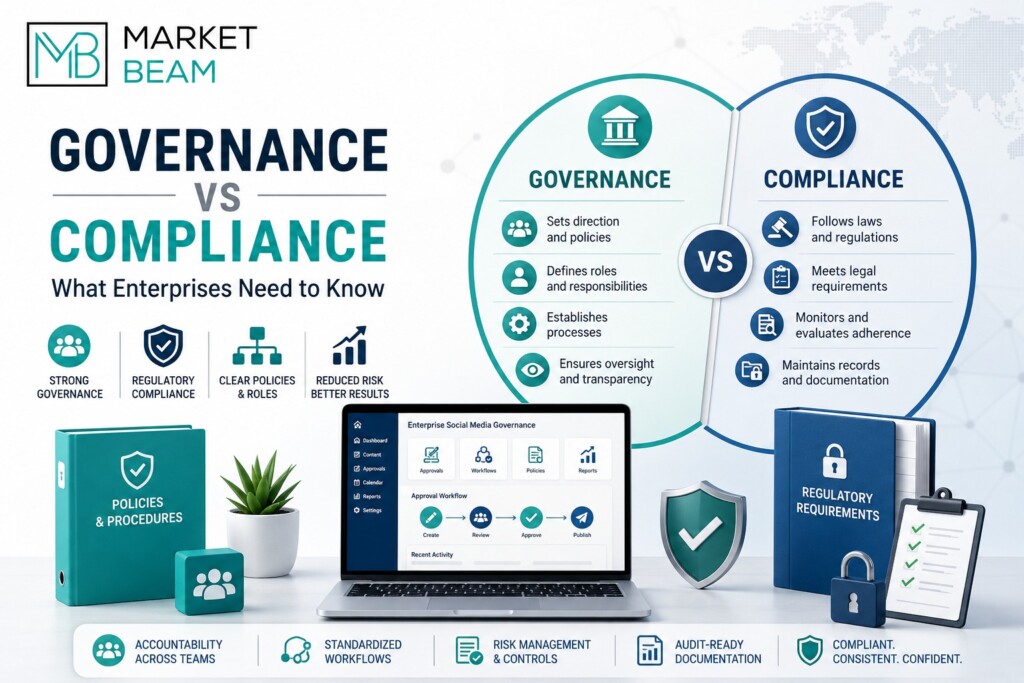
Governance vs Compliance: Understanding the Difference
Although they often work together, governance and compliance are not interchangeable.
When evaluating governance vs compliance, governance answers questions such as:
- Who approves social media content?
- Which departments participate in reviews?
- How are responsibilities assigned?
- What workflows support publishing?
Compliance answers different questions:
- Does the content follow applicable regulations?
- Have legal requirements been satisfied?
- Are required approvals documented?
- Does the communication meet organizational policies?
Governance creates the organizational structure, while compliance ensures activities remain within that structure.
Organizations that understand governance vs compliance are better equipped to design efficient operational processes while maintaining regulatory confidence.
The Role of Corporate Governance
Corporate governance extends beyond social media and influences how organizations establish leadership responsibilities, ethical standards, operational oversight, and strategic decision-making.
Within digital communications, corporate governance ensures leadership defines clear expectations regarding social media use, approval authority, risk management, and employee accountability.
Executive sponsorship is particularly important because governance initiatives require organization-wide participation rather than isolated marketing efforts.
A mature corporate governance program encourages collaboration between executive leadership, marketing, legal, compliance, information security, and communications teams.
This cross-functional approach strengthens organizational consistency while improving strategic alignment across enterprise operations.
Regulatory Compliance in Enterprise Social Media
Modern enterprises face growing regulatory compliance requirements as digital communication expands across multiple channels.
Organizations operating in regulated industries often manage strict advertising regulations, data privacy obligations, financial reporting requirements, healthcare communication standards, or pharmaceutical promotional guidelines.
A successful governance strategy integrates regulatory compliance into every stage of the content lifecycle, from planning and creation to approvals, publishing, monitoring, and documentation.
Marketing teams should collaborate closely with compliance specialists to verify that communications remain accurate, appropriately documented, and aligned with current regulatory expectations.
By integrating compliance into governance processes, organizations reduce operational risk while improving efficiency.
Governance vs Compliance Comparison
| Area | Governance | Compliance |
| Primary Focus | Organizational oversight | Meeting legal and regulatory requirements |
| Objective | Guide decision-making | Ensure adherence to regulations |
| Responsibility | Leadership and governance teams | Compliance, legal, and regulatory teams |
| Approach | Proactive planning | Verification and monitoring |
| Scope | Policies, workflows, accountability | Laws, standards, and internal requirements |
| Business Value | Operational consistency | Reduced legal and regulatory risk |
Common Enterprise Challenges
Many organizations struggle to balance governance vs compliance because both require coordination across multiple departments.
One common challenge involves fragmented responsibilities. Marketing teams may focus on creativity, while compliance teams emphasize regulatory oversight. Without clearly defined roles, approval processes become inconsistent and inefficient.
Another challenge involves outdated documentation. Policies, workflows, and governance procedures should evolve alongside changing regulations, business priorities, and digital platforms.
Organizations also encounter difficulties maintaining visibility across multiple brands, geographic regions, and social media accounts. Inconsistent processes often lead to duplicated work, delayed approvals, and increased operational risk.
Insufficient documentation creates additional challenges. Without standardized policy management, approval records, governance decisions, and compliance evidence become difficult to retrieve during audits or regulatory reviews.
By understanding governance vs compliance, enterprises can design integrated governance programs that improve collaboration, strengthen accountability, and support sustainable digital growth.
Strengthening Policy Management
A successful governance program depends on effective policy management. Policies provide the documented guidance that helps employees understand organizational expectations, approval procedures, communication standards, and compliance responsibilities.
Within the context of governance vs compliance, policy management connects governance objectives with day-to-day operations. Governance establishes what the organization expects, while policies explain how those expectations should be implemented across departments.
Enterprises should maintain policies covering social media usage, content approvals, employee participation, account management, security, crisis communication, and regulatory obligations. Every policy should be reviewed regularly to reflect evolving business priorities, regulatory changes, and platform updates.
Centralized documentation also improves consistency by ensuring employees always access the latest approved versions of organizational policies.
Implementing Effective Risk Controls
Strong risk controls help organizations prevent operational issues before they affect business performance.
Every enterprise faces risks related to unauthorized publishing, inconsistent messaging, security incidents, regulatory violations, and reputational damage. A comprehensive governance strategy identifies these risks and establishes procedures to reduce their impact.
Organizations should implement standardized approval workflows, role-based access controls, account security measures, monitoring processes, and incident response procedures. These risk controls improve operational resilience while supporting long-term governance objectives.
Regular governance reviews further strengthen organizational performance by identifying process improvements and emerging compliance challenges before they become significant issues.
Integrating risk controls into the broader discussion of governance vs compliance helps organizations balance operational efficiency with regulatory responsibility.
Building a Culture of Accountability
Technology and policies alone cannot create successful governance. Enterprises also need a strong culture of accountability.
Every employee involved in digital communications should clearly understand their responsibilities throughout the content lifecycle. Marketing teams create content, communications teams coordinate campaigns, legal and compliance specialists conduct reviews, and leadership provides governance oversight.
Clearly documented responsibilities reduce confusion while improving operational consistency.
Organizations should also establish measurable governance metrics, including approval turnaround times, policy adherence, publishing accuracy, security incidents, and compliance performance. Monitoring these indicators encourages continuous improvement while reinforcing accountability throughout the organization.
Leadership support remains critical because governance initiatives require participation across multiple departments rather than isolated ownership by marketing teams alone.
Table 2: Best Practices for Governance and Compliance
| Best Practice | Business Benefit |
| Establish corporate governance standards | Improves organizational oversight |
| Maintain centralized policy management | Ensures consistent guidance |
| Standardize approval workflows | Improves operational efficiency |
| Strengthen risk controls | Reduces security and compliance risks |
| Define organizational accountability | Improves collaboration and ownership |
| Conduct governance reviews | Supports continuous improvement |
| Document compliance activities | Strengthens audit readiness |
How MarketBeam Supports Governance and Compliance
Managing enterprise social media requires more than publishing content. Organizations need technology that supports governance, compliance, collaboration, and operational efficiency throughout the content lifecycle.
MarketBeam provides an enterprise platform designed to help organizations address both governance vs compliance through centralized workflows, approval management, and enterprise social media governance capabilities.
Marketing, legal, compliance, communications, and executive teams can collaborate within a single environment, improving visibility while maintaining complete approval histories. Configurable workflows support consistent policy management, ensuring content follows standardized review procedures before publication.
The platform also strengthens risk controls by providing role-based permissions, centralized documentation, workflow automation, audit-ready records, and approval tracking. These capabilities help organizations reduce operational risks while improving governance consistency.
MarketBeam reinforces accountability through clearly defined user roles, collaborative review processes, and complete activity histories that support internal governance and regulatory audits.
Whether operating in healthcare, pharmaceuticals, finance, manufacturing, or other regulated industries, organizations can use MarketBeam to simplify enterprise governance while strengthening compliance across digital communication channels.
Conclusion
Understanding governance vs compliance is essential for organizations seeking to build secure, efficient, and compliant enterprise social media operations. While governance establishes the policies, responsibilities, and decision-making framework that guide organizational activities, compliance ensures those activities satisfy legal, regulatory, and internal requirements.
By strengthening corporate governance, improving policy management, implementing effective risk controls, and fostering organizational accountability, enterprises can reduce operational risks while improving collaboration and digital communication performance.
MarketBeam empowers organizations with centralized governance, workflow automation, approval management, audit-ready documentation, and enterprise social media capabilities that simplify governance and compliance at scale. Combined with strong internal leadership and continuous improvement, these capabilities support secure, compliant, and consistent digital operations.
Connect With Us
Ready to strengthen governance and compliance across your enterprise social media operations?
Sales: sales@marketbeam.io
Tech Support: support@marketbeam.io
Learn how MarketBeam helps organizations streamline governance, automate approvals, improve collaboration, and maintain compliant enterprise social media management.
Frequently Asked Questions
1. What is the difference between governance and compliance?
Governance vs compliance refers to two related but distinct concepts. Governance establishes organizational policies, responsibilities, and decision-making processes, while compliance ensures activities follow applicable laws, regulations, and internal requirements.
2. Why is corporate governance important for social media?
Corporate governance provides leadership oversight, establishes organizational standards, and ensures social media activities align with business objectives, risk management strategies, and ethical practices.
3. What is policy management?
Policy management is the process of creating, maintaining, reviewing, and communicating organizational policies that guide employee behavior, operational procedures, and compliance activities.
4. How do risk controls improve governance?
Risk controls reduce operational, security, reputational, and regulatory risks by implementing standardized workflows, approvals, monitoring, access controls, and incident response procedures.
5. Why is accountability important in governance?
Accountability ensures employees understand their responsibilities, follow established processes, and contribute to consistent governance while improving collaboration and organizational performance.
6. How does MarketBeam support governance and compliance?
MarketBeam provides centralized collaboration, configurable approval workflows, workflow automation, policy management support, role-based permissions, audit-ready documentation, and enterprise social media management that help organizations strengthen both governance and compliance across digital communications.