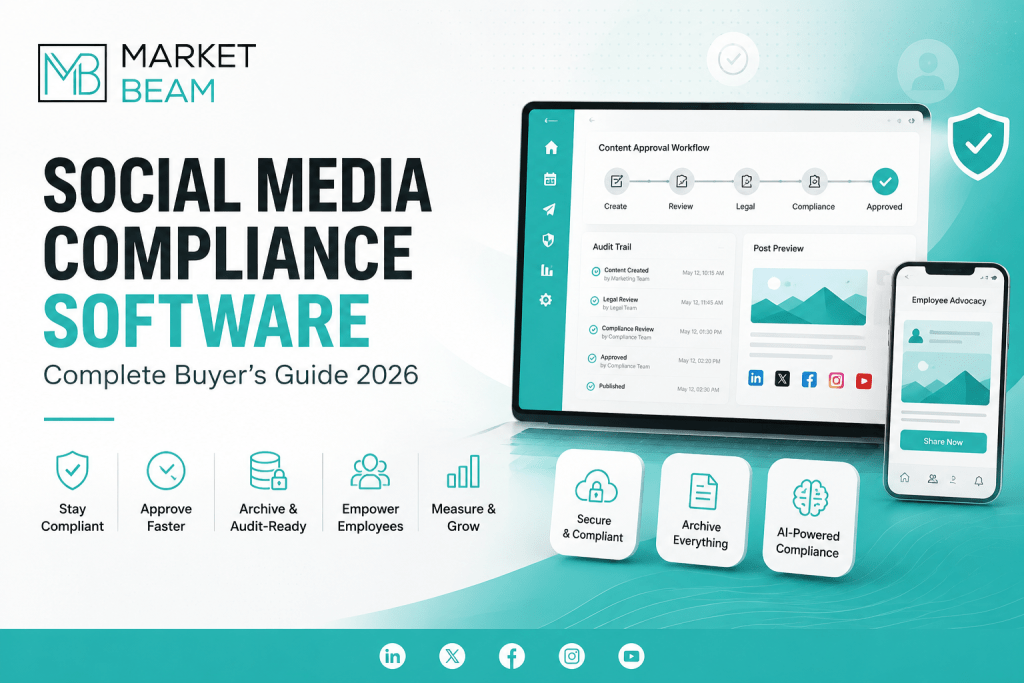
Social media has become one of the most important communication channels for modern enterprises. Businesses use LinkedIn, X, Facebook, Instagram, YouTube, and other platforms to build brand awareness, engage customers, support sales teams, and strengthen trust with key audiences. However, for companies operating in regulated industries such as pharmaceuticals, life sciences, healthcare, banking, insurance, and financial services, social media also creates serious compliance risks.
Every post, comment, employee share, campaign update, and customer interaction can create regulatory exposure if proper governance is not in place. Marketing teams are under pressure to publish faster, while legal and compliance teams must ensure that every communication follows internal policies, industry rules, and regulatory standards. This is why social media compliance software has become essential for enterprise organizations in 2026.
A modern social media compliance platform helps businesses manage publishing, approvals, social media archiving, audit trails, employee advocacy compliance, AI compliance workflows, and performance reporting from one centralized system. Instead of relying on spreadsheets, email chains, manual approvals, and disconnected publishing tools, companies can use compliance software for social media to reduce risk while improving campaign speed.
This complete buyer’s guide explains what social media compliance software is, why it matters, which features buyers should prioritize, and how regulated organizations can choose the right solution for long-term growth.
What Is Social Media Compliance Software?
Social media compliance software is a specialized platform that helps organizations create, review, approve, publish, monitor, archive, and manage social media content while meeting regulatory requirements and internal governance standards.
Unlike basic social media scheduling tools, social media compliance software is built around risk management, approval workflows, governance, archiving, and audit readiness. It gives marketing, legal, regulatory, compliance, sales, and executive teams a controlled environment to collaborate before content goes live.
A strong social media compliance platform allows teams to manage every stage of the content lifecycle. Content can be created by marketing, reviewed through a structured social media approval workflow, approved by compliance teams, published across selected channels, archived for future reference, and measured through compliance reporting and engagement analytics.
This level of control is especially important for regulated industries. A pharmaceutical company may need digital MLR review before publishing social content. A financial services company may need FINRA social media compliance and SEC social media compliance controls. A healthcare organization may need to manage patient privacy concerns. A global business may also need GDPR-aligned governance and regional approval processes.
In all these cases, social media compliance software helps organizations reduce manual work, improve visibility, and maintain a complete social media audit trail.
Why Social Media Compliance Software Matters in 2026
The need for social media compliance software has increased because enterprise social media operations have become more complex. Brands are publishing more content, managing more channels, working across more regions, and involving more employees in content amplification.
At the same time, regulatory expectations continue to grow. In highly regulated industries, a single inaccurate claim, unapproved message, missing disclosure, or inappropriate response can result in legal exposure, financial penalties, reputational damage, or loss of customer trust.
For life sciences and pharmaceutical companies, pharma social media compliance is especially important because digital content may require review for medical accuracy, fair balance, adverse event risk, and promotional claims. Pharmaceutical social media compliance also requires strong documentation, controlled publishing, and proper routing through medical, legal, and regulatory teams.
For financial institutions, compliant social media management requires oversight of advisor communications, employee posts, customer interactions, advertising claims, and archived records. FINRA social media compliance and SEC social media compliance requirements make supervision, retention, and audit-ready reporting essential.
For enterprise marketing teams, the challenge is no longer only about content publishing. The real challenge is publishing content quickly while maintaining governance, control, traceability, and accountability. Social media governance software helps solve this problem by giving organizations a scalable framework for content review, approval, distribution, monitoring, and reporting.
Core Features to Look for in Social Media Compliance Software
Choosing the right social media compliance software requires more than comparing publishing calendars and scheduling features. Buyers need to evaluate whether the platform can support enterprise-level governance, regulated workflows, employee advocacy compliance, AI content approval, and audit-ready reporting.
One of the most important capabilities is a structured social media approval workflow. Every piece of content should move through the right review path before publication. Marketing teams should be able to submit content for approval, while compliance, legal, or MLR reviewers can approve, reject, or request changes from one centralized workspace. This reduces confusion, prevents unauthorized publishing, and ensures that every post follows the correct review process.
Another critical feature is a complete social media audit trail. Audit trails allow organizations to see who created content, who edited it, who reviewed it, who approved it, when it was published, and what changes were made along the way. This documentation is essential for compliance reviews, internal audits, and regulatory examinations.
Social media archiving software is also a key requirement. Regulated organizations must often retain records of published posts, comments, messages, employee shares, and engagement activity for a defined period. A strong archiving system makes these records searchable, accessible, and ready for review when needed.
Social media risk management should also be part of the evaluation process. The platform should help teams detect potential risks before content is published. This may include identifying missing disclosures, restricted claims, unapproved language, risky keywords, or content that requires additional review.
Role-based permissions are another important feature. Not every user should have the same level of access. Executives, sales representatives, marketing admins, compliance reviewers, legal teams, and employee advocates may all need different permissions. Role-based access helps reduce accidental errors and ensures that only authorized users can publish, approve, or modify content.
Enterprise security features such as SSO integration are also important for large organizations. Single sign-on helps improve user access management, strengthens security, and simplifies adoption across distributed teams.
The Role of Social Media Governance Software
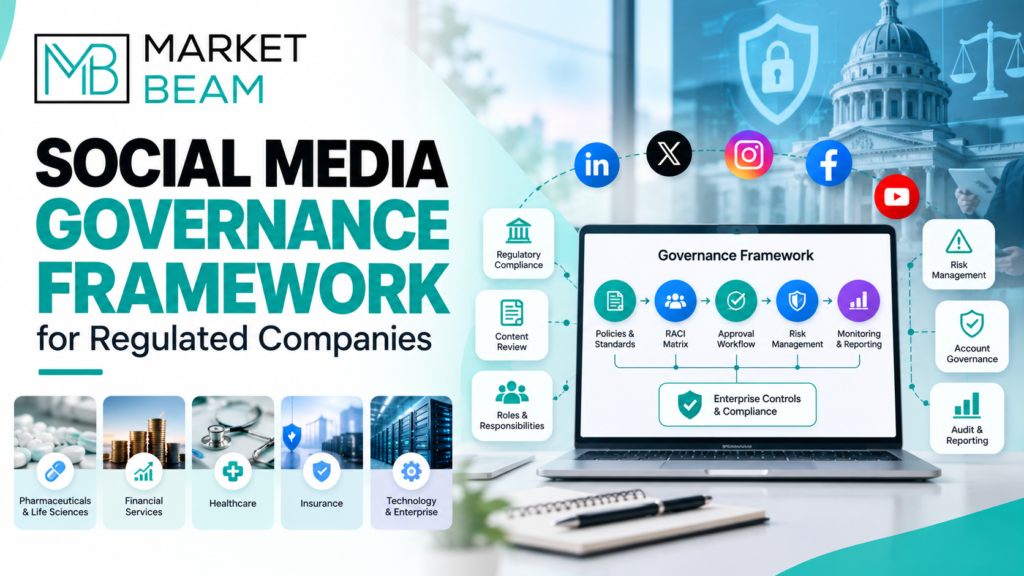
Social media governance software gives organizations the structure they need to manage digital communication at scale. It defines how content is created, reviewed, approved, published, archived, and measured across departments, brands, and regions.
Without governance, social media operations can become fragmented. Different teams may use different tools, approval standards, messaging rules, and reporting formats. This creates inconsistency and increases compliance risk.
With a strong social media governance software solution, organizations can create standardized workflows while still allowing local teams to execute campaigns based on regional needs. This is especially useful for enterprises managing multiple business units, subsidiaries, product lines, or geographic markets.
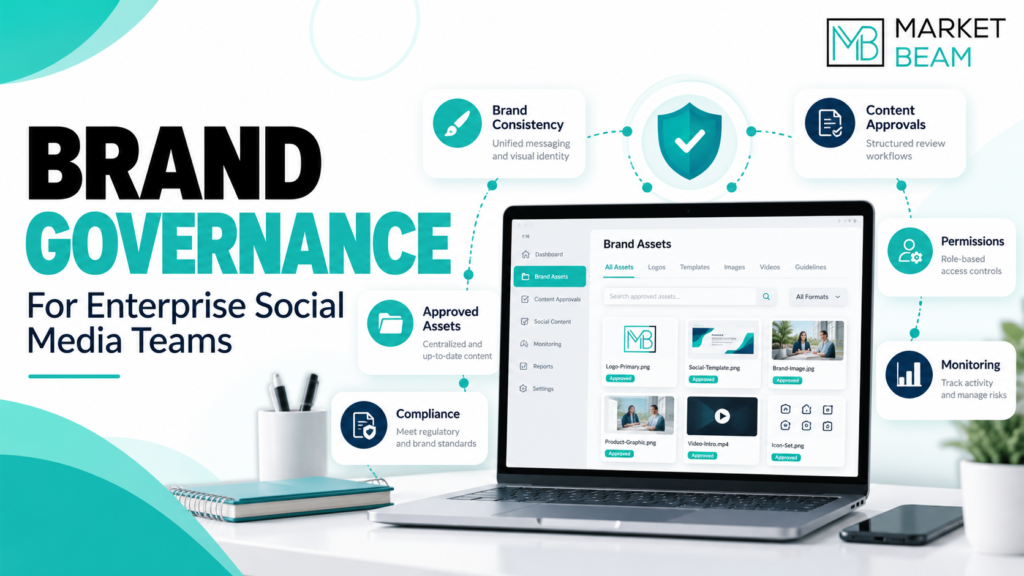
Governance also supports brand consistency. Teams can work from approved content libraries, messaging frameworks, compliance rules, and publishing calendars. This ensures that corporate communication remains consistent while reducing the burden on compliance teams.
For regulated industries, governance is not optional. It is the foundation of compliant social media management.
Social Media Archiving and Audit-Ready Reporting
Social media archiving software is one of the most important parts of any compliance strategy. In many regulated sectors, organizations must maintain records of social media activity for regulatory, legal, or internal review purposes.
Archiving should capture more than published posts. It should also preserve edits, comments, replies, approvals, employee shares, campaign records, and engagement activity. These records should be searchable and exportable so teams can respond quickly during audits or internal investigations.
Audit-ready reporting helps organizations prove that proper controls were followed. Instead of manually collecting screenshots, emails, approval notes, and publishing records, compliance teams can access a centralized record of activity.
A strong compliance reporting system should show approval history, user activity, content status, workflow performance, employee participation, and publishing outcomes. This makes it easier for teams to identify bottlenecks, improve governance, and demonstrate accountability.
When evaluating social media compliance software for enterprises, buyers should carefully review the platform’s archiving, reporting, and audit trail capabilities.
Employee Advocacy Compliance
Employee advocacy has become a powerful way for organizations to expand social media reach and build trust. Content shared by employees often feels more authentic than content shared only from corporate brand pages. However, employee advocacy can create compliance risks if it is not managed properly.
Employee advocacy compliance ensures that employees share approved content in a controlled and measurable way. Instead of asking employees to create posts manually, marketing teams can distribute approved content through an employee advocacy platform. Employees can then share content with confidence, knowing it has already passed the necessary approval process.
A compliant employee advocacy program should include approved content libraries, controlled messaging, user permissions, content expiration rules, engagement tracking, and reporting. These features help organizations scale advocacy while reducing the risk of unapproved claims, inconsistent messaging, or non-compliant communication.
Employee advocacy software is especially valuable for financial services, life sciences, healthcare, and enterprise B2B organizations because employees often have strong professional networks. When combined with social media compliance software, advocacy becomes both scalable and safe.
AI Compliance Workflows and Automated Compliance Review
Artificial intelligence is changing how marketing teams create content. AI can help generate post ideas, captions, summaries, campaign variations, and personalized messaging faster than manual workflows. However, AI also introduces new risks for regulated industries.
AI-generated content may include inaccurate claims, unsupported statements, missing disclosures, or language that requires legal or regulatory review. This is why AI compliance workflows are becoming a major feature in modern social media compliance software.
AI social media compliance should not mean replacing human reviewers entirely. Instead, AI should support faster and more consistent review by identifying potential risks before content reaches the final approval stage. AI-powered compliance software can help flag risky phrases, detect policy violations, suggest safer alternatives, and route content to the correct reviewer.
AI content approval is especially useful when teams are producing high volumes of social media posts across multiple brands, regions, and channels. Automated compliance review can reduce repetitive manual work while maintaining oversight.
For buyers, the most important question is whether the platform uses AI responsibly. The best social media compliance software will combine automation with human review checkpoints, clear governance rules, and transparent approval history.
Industry-Specific Compliance Requirements
Different industries have different social media compliance needs. A platform that works for one sector may not be enough for another.
In pharmaceuticals and life sciences, life sciences social media compliance often involves MLR review, promotional content approval, adverse event awareness, fair balance requirements, and documentation of regulated claims. MLR approval software and digital MLR review workflows help marketing teams coordinate with medical, legal, and regulatory reviewers before content is published.
Pharma social media compliance also requires strong control over employee sharing, campaign messaging, and post-publication monitoring. Since pharma brands operate in a highly regulated environment, every digital communication must be accurate, approved, and properly documented.
In financial services, social media compliance software must support advisor supervision, record retention, disclosure management, and regulatory examination readiness. FINRA social media compliance and SEC social media compliance require organizations to supervise communications and maintain records that can be retrieved when needed.
In healthcare, compliance often involves privacy protection, patient data concerns, and appropriate communication boundaries. Healthcare organizations must ensure that social media teams do not expose sensitive information or respond in ways that create privacy risk.
For global enterprises, compliance also includes regional data privacy rules, brand governance, localization requirements, and user access controls. This is why enterprise social media compliance requires a flexible and scalable platform.
How to Choose Social Media Compliance Software
Many buyers begin by searching for the best social media compliance software, but the right choice depends on the organization’s industry, team structure, compliance requirements, and growth goals.
The first step is to identify the regulatory requirements that apply to your business. A pharma company may prioritize MLR approval software and digital MLR review. A financial services company may prioritize FINRA social media compliance, SEC social media compliance, and social media archiving software. A multinational enterprise may prioritize regional governance, SSO integration, and role-based permissions.
The second step is to evaluate workflow flexibility. The platform should support your existing review process while also helping you improve speed and accountability. A rigid workflow can slow teams down, while an overly simple workflow may fail to meet compliance standards.
The third step is to assess usability. Social media compliance software only works if people use it consistently. Executives, employees, sales teams, marketing admins, and compliance reviewers should be able to use the platform without unnecessary complexity.
The fourth step is to review reporting and analytics. Compliance software should not only prevent risk. It should also help teams understand approval timelines, content performance, employee engagement, and campaign impact.
The fifth step is to consider scalability. The platform should support additional users, business units, brands, channels, and regions as the organization grows.
Common Mistakes Buyers Should Avoid
One common mistake is choosing a basic scheduling tool instead of a true social media compliance platform. Publishing tools may help teams schedule posts, but they often lack governance, approval workflows, archiving, audit trails, and compliance reporting.
Another mistake is treating employee advocacy as separate from compliance. Employee sharing must be part of the overall governance model, especially in regulated industries. Without employee advocacy compliance, organizations may increase reach but also increase risk.
A third mistake is overlooking social media audit trail requirements. If a company cannot prove who approved content, when changes were made, and how the content was published, it may struggle during audits or regulatory reviews.
A fourth mistake is ignoring AI governance. As AI-generated content becomes more common, organizations need AI compliance workflows that keep human oversight in place.
A final mistake is selecting software only for current needs. Enterprise social media compliance should support future growth, additional channels, new regions, expanded employee advocacy, and evolving regulatory expectations.
How MarketBeam Supports Social Media Compliance
MarketBeam helps regulated organizations manage social media growth while maintaining compliance, governance, and control.
The platform combines social media publishing, social media compliance software, employee advocacy software, social media governance software, analytics, approval workflows, and compliance reporting into one unified system. Marketing teams can create and schedule content, while compliance teams can review and approve posts through structured workflows.
MarketBeam supports compliant employee advocacy by enabling marketing teams to distribute approved employee sharing content directly to teams and executives. Employees can amplify content without manually creating posts from scratch, helping organizations expand reach while maintaining message consistency.
For regulated industries, MarketBeam helps streamline social media approval workflow processes, maintain audit-ready reporting, support role-based permissions, and track engagement across corporate and employee channels. The platform also supports AI-assisted content creation and governance workflows that help teams improve speed without sacrificing oversight.
For life sciences organizations, MarketBeam’s Veeva Vault PromoMats integration helps align social media publishing with digital MLR review and broader compliance processes. This makes it easier for pharma and life sciences teams to manage approved content, publishing workflows, and compliance records in one connected ecosystem.
MarketBeam is built for organizations that need compliant social media management, employee advocacy compliance, and measurable growth across regulated digital channels.
The Future of Social Media Compliance Software
The future of social media compliance software will be shaped by AI, automation, real-time monitoring, and predictive governance.
AI-powered compliance software will help organizations identify content risks earlier in the workflow. Automated compliance review will become more advanced, allowing teams to detect risky claims, missing disclosures, policy violations, and regulatory concerns before content is published.
AI compliance workflows will also improve content routing. Instead of manually deciding who needs to review each post, platforms will be able to send content to the right reviewer based on topic, region, product, risk level, or campaign type.
Social media monitoring compliance will also become more important. Organizations will need real-time visibility into published content, employee activity, comments, and audience engagement. For pharma and life sciences brands, this may include adverse event detection and escalation. For financial services firms, this may include monitoring advisor activity and customer-facing communications.
As regulations evolve, organizations will need platforms that combine flexibility, automation, governance, and reporting. The best social media compliance software for regulated industries will not simply help teams avoid risk. It will help them build faster, safer, and more effective digital communication programs.
Conclusion
Social media is now a core business channel, but regulated organizations cannot manage it with basic publishing tools alone. They need a platform that supports compliance, governance, approval workflows, employee advocacy, archiving, audit trails, AI review, and enterprise-level security.
The right social media compliance software helps organizations reduce risk, improve approval speed, maintain audit-ready records, and scale compliant employee advocacy. It gives marketing teams the ability to grow engagement while giving legal, compliance, and regulatory teams the control they need.
When evaluating social media compliance software in 2026, buyers should prioritize social media governance software, social media archiving software, social media approval workflow capabilities, social media audit trail functionality, AI compliance workflows, role-based permissions, SSO integration, employee advocacy compliance, and compliance reporting.
For regulated industries such as life sciences, pharmaceuticals, healthcare, banking, insurance, and financial services, choosing the right social media compliance platform is not just a marketing decision. It is a risk management, governance, and growth decision.
Frequently Asked Questions
What is social media compliance software?
Social media compliance software helps organizations create, review, approve, publish, archive, monitor, and report on social media content while following regulatory requirements and internal governance policies.
Why do regulated industries need social media compliance software?
Regulated industries need social media compliance software because every digital communication can create legal, regulatory, or reputational risk. The software helps teams manage approvals, maintain audit trails, archive records, and enforce compliance policies before content is published.
What is the difference between social media compliance software and social media governance software?
Social media compliance software focuses on meeting regulatory and legal requirements, while social media governance software focuses on managing policies, roles, workflows, permissions, and brand standards. In enterprise environments, both capabilities are often included in one platform.
What is social media archiving software?
Social media archiving software captures and stores social media posts, comments, messages, employee shares, approvals, and engagement records so organizations can access them for audits, compliance reviews, or legal needs.
What is a social media approval workflow?
A social media approval workflow is a structured review process that ensures content is checked by the right teams before publication. It may include marketing review, legal review, compliance review, MLR review, or executive approval depending on the industry.
How does social media compliance software support employee advocacy?
Social media compliance software supports employee advocacy by allowing marketing teams to distribute approved content to employees. Employees can share compliant content while the organization tracks engagement, controls messaging, and maintains governance.
What is employee advocacy compliance?
Employee advocacy compliance ensures that employee-shared content follows approved messaging, regulatory rules, brand guidelines, and internal policies. It helps organizations increase reach while reducing risk.
How do AI compliance workflows help marketing teams?
AI compliance workflows help marketing teams identify potential risks in social media content before publication. They can support automated compliance review, flag risky language, suggest improvements, and route content to the correct reviewer.
What should buyers look for in the best social media compliance software?
Buyers should look for approval workflows, audit trails, social media archiving, compliance reporting, role-based permissions, SSO integration, employee advocacy compliance, AI compliance workflows, and scalability across brands, regions, and teams.
Is MarketBeam a social media compliance platform?
Yes. MarketBeam is a social media compliance platform designed for regulated industries. It supports compliant social media management, employee advocacy, approval workflows, AI-assisted content creation, audit-ready reporting, governance controls, analytics, and Veeva Vault PromoMats integration for life sciences organizations.