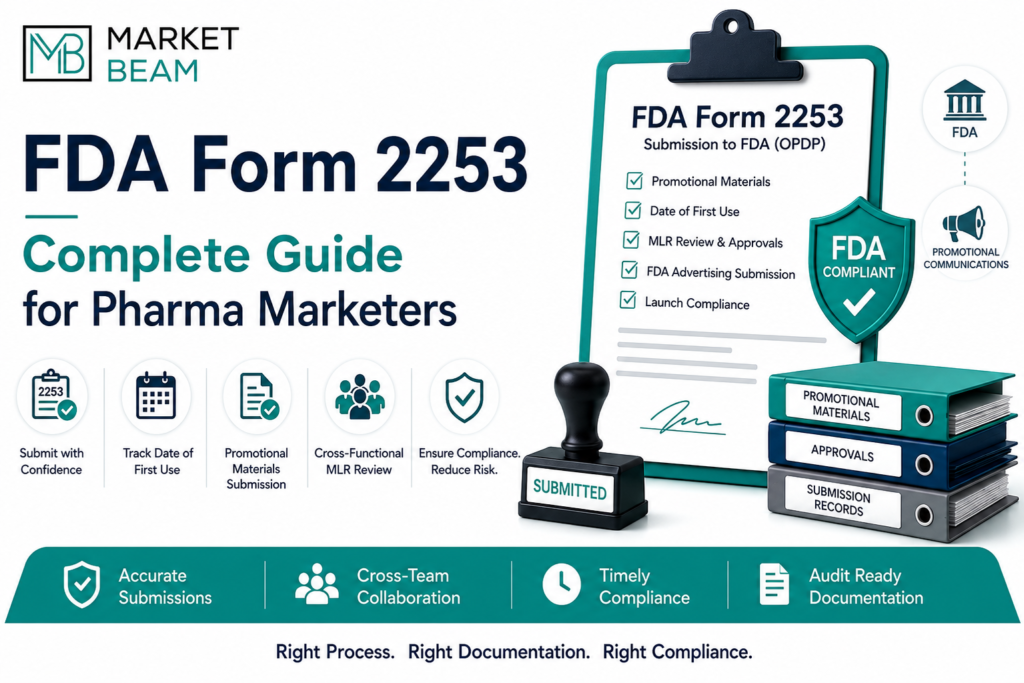
Pharmaceutical marketing operates in one of the world’s most regulated environments. Every promotional campaign, product launch, digital advertisement, and printed marketing asset must meet strict regulatory expectations before and after reaching healthcare professionals or consumers. One important requirement for prescription drug promotion is FDA Form 2253, which helps pharmaceutical companies submit promotional materials to the U.S. Food and Drug Administration (FDA) for regulatory review.
Understanding FDA Form 2253 is essential for marketing, medical, legal, and regulatory (MLR) teams involved in promotional campaigns. Incorrect or delayed submissions can create compliance risks, slow product launches, and increase regulatory scrutiny. As digital marketing continues to expand across websites, email campaigns, and social media, organizations need efficient processes that ensure every FDA Form 2253 submission is accurate and timely.
MarketBeam helps regulated organizations streamline promotional governance through centralized collaboration, approval workflows, content management, and social media compliance. Combined with well-defined internal review processes, enterprise platforms enable pharmaceutical companies to manage promotional campaigns with greater confidence while supporting regulatory requirements.
What Is FDA Form 2253?
FDA Form 2253, officially known as Form FDA 2253, is the form pharmaceutical companies use to submit prescription drug promotional materials to the FDA’s Office of Prescription Drug Promotion (OPDP). The submission allows the agency to review promotional communications and verify that marketing materials align with approved prescribing information and applicable regulations.
Promotional materials covered by FDA Form 2253 may include printed advertisements, sales aids, email campaigns, websites, digital banners, brochures, social media promotions, videos, and other branded communications intended to promote prescription drug products.
Submitting Form FDA 2253 demonstrates that promotional materials have been distributed according to FDA requirements while providing regulators with documentation for oversight and review.
Why FDA Form 2253 Is Important
For pharmaceutical companies, compliance begins long before promotional materials reach healthcare professionals or patients. FDA Form 2253 plays an important role in maintaining transparency between manufacturers and regulators.
Timely submissions help regulatory authorities monitor promotional communications while supporting industry accountability. Proper documentation also allows companies to demonstrate that required promotional materials have been submitted according to applicable FDA expectations.
Understanding FDA Form 2253 reduces the likelihood of delayed submissions, incomplete documentation, and unnecessary compliance issues that could affect product launches or marketing campaigns.
Beyond regulatory requirements, consistent submission practices improve collaboration between marketing, legal, regulatory affairs, medical affairs, and commercial operations.
When Should Form FDA 2253 Be Submitted?
One of the most common questions among pharmaceutical marketers involves the timing of Form FDA 2253 submissions.
In general, promotional materials must be submitted to the FDA at the date of first use or initial dissemination, depending on applicable regulatory requirements. The date of first use refers to the first time promotional content is publicly distributed or presented to healthcare professionals or consumers.
Understanding the date of first use is critical because submission timing directly affects regulatory compliance. Delays may create unnecessary regulatory concerns and increase the administrative burden associated with corrective actions.
Organizations should establish internal processes that clearly define submission responsibilities, approval timelines, and documentation requirements to ensure every FDA Form 2253 is submitted appropriately.
Understanding Promotional Materials Submission
A successful promotional materials submission process requires careful coordination across multiple departments.
Marketing teams develop campaign messaging and creative assets, medical reviewers verify scientific accuracy, legal teams evaluate regulatory considerations, and compliance specialists ensure alignment with FDA expectations.
Every promotional materials submission should include the required documentation, approved promotional assets, supporting prescribing information when applicable, and a completed Form FDA 2253.
Organizations that rely on manual processes often encounter version-control issues, approval delays, and incomplete documentation. Standardized workflows significantly reduce these challenges while improving efficiency and consistency.
The Importance of the Date of First Use
The date of first use is one of the most significant concepts associated with FDA Form 2253.
Whether a company launches a new website, distributes a digital advertisement, publishes promotional social media content, or introduces printed materials to healthcare professionals, organizations must accurately document when promotional communications first become publicly available.
Maintaining accurate records of the date of first use supports internal audits, regulatory inspections, and future compliance reviews.
Companies should maintain centralized documentation that records campaign approvals, publication dates, distribution channels, and associated submission records.
Accurate recordkeeping also improves organizational readiness when responding to regulatory inquiries or internal compliance assessments.
Promotional Materials Commonly Submitted Using FDA Form 2253
| Promotional Material | Typical Submission Requirement |
| Print Advertisements | Submit using FDA Form 2253 at the date of first use |
| Product Brochures | Include with promotional materials submission |
| Website Promotional Pages | Submit promotional digital content where applicable |
| Email Marketing Campaigns | Document promotional communications appropriately |
| Digital Banner Advertisements | Include in FDA advertising submission process |
| Sales Aids | Maintain approval records and submission documentation |
| Social Media Promotional Content | Evaluate under promotional compliance policies |
Common FDA Form 2253 Compliance Challenges
Even experienced pharmaceutical organizations encounter challenges when managing FDA Form 2253 submissions.
Marketing teams often work under aggressive launch timelines while regulatory reviewers focus on ensuring complete compliance. Multiple revisions, decentralized document storage, and inconsistent approval processes can delay submissions and increase operational complexity.
Another common issue involves incomplete promotional materials submission documentation. Missing approvals, outdated creative assets, or inaccurate supporting materials may require additional review before campaigns proceed.
Organizations also struggle with maintaining accurate records for the date of first use, especially when promotional campaigns launch simultaneously across websites, email, social media, and digital advertising platforms.
Implementing standardized workflows, centralized document management, and structured approval processes helps organizations improve submission accuracy while reducing compliance risk.
Why Cross-Functional Collaboration Matters
Preparing FDA Form 2253 is rarely the responsibility of a single department. Successful submissions depend on close collaboration among marketing, medical affairs, legal counsel, regulatory affairs, and compliance teams.
Marketing professionals contribute campaign messaging and promotional assets. Medical reviewers verify scientific accuracy. Legal experts ensure communications comply with applicable regulations, while regulatory affairs professionals oversee submission requirements and documentation.
A collaborative approach reduces errors, shortens review cycles, and helps organizations maintain consistent compliance across every promotional campaign.
As pharmaceutical marketing continues to expand into digital channels, coordinated governance becomes increasingly important for managing both traditional promotional materials and modern digital communications.
FDA Advertising Submission Workflow
An effective FDA advertising submission process helps pharmaceutical companies maintain regulatory compliance while reducing delays during product launches and promotional campaigns. Rather than treating submissions as a final administrative task, organizations should integrate FDA Form 2253 into their overall promotional review workflow.
The process typically begins with campaign planning, where marketing teams define objectives, target audiences, and promotional channels. Medical reviewers then validate scientific accuracy, legal teams assess compliance with applicable regulations, and regulatory affairs professionals confirm that all materials satisfy submission requirements.
After internal approval, the completed Form FDA 2253 and supporting promotional materials are prepared for submission according to FDA requirements. Maintaining organized documentation throughout this process helps organizations respond efficiently to audits and regulatory inquiries.
A structured FDA advertising submission workflow minimizes manual errors, improves collaboration, and ensures every promotional campaign follows consistent governance standards.
Launch Compliance Best Practices
Every pharmaceutical product launch involves numerous moving parts, making launch compliance one of the most important responsibilities for marketing and regulatory teams.
Organizations should begin compliance planning well before launch by creating detailed submission schedules, assigning ownership for approvals, and establishing review deadlines. Marketing assets, prescribing information, creative content, and digital communications should all move through a standardized Medical, Legal, and Regulatory (MLR) review process before publication.
Maintaining version control is equally important. Teams should work from centralized repositories that prevent outdated promotional materials from being submitted or published.
Another critical aspect of launch compliance is ensuring that every FDA Form 2253 submission aligns with the correct date of first use. Coordinating launch dates across websites, email campaigns, social media, webinars, and printed materials helps organizations maintain accurate records and avoid unnecessary compliance risks.
Regular compliance training also strengthens launch readiness by ensuring every stakeholder understands regulatory responsibilities before promotional campaigns begin.
Leveraging Technology for Better Compliance
As promotional campaigns become increasingly digital, manual processes alone are no longer sufficient.
Enterprise technology helps regulated organizations automate repetitive tasks while maintaining oversight throughout the promotional lifecycle. Automated workflows reduce administrative burden by routing promotional content through predefined approval stages, tracking revisions, and maintaining comprehensive audit trails.
Digital asset management also simplifies promotional materials submission by keeping approved creative assets, supporting documents, and historical versions in one secure location.
Real-time collaboration improves communication between marketing, medical, legal, and regulatory teams, allowing issues to be resolved more quickly without sacrificing compliance quality.
Organizations that combine standardized governance with modern technology are better positioned to manage growing marketing volumes while maintaining regulatory confidence.
Best Practices for FDA Form 2253 Compliance
| Best Practice | Compliance Benefit |
| Standardize MLR review workflows | Improves review consistency and accuracy |
| Maintain centralized document management | Reduces version-control issues |
| Track the date of first use | Supports timely FDA submissions |
| Automate approval workflows | Accelerates promotional review cycles |
| Archive submission records | Improves audit readiness |
| Monitor promotional campaigns | Identifies compliance issues early |
| Train marketing and regulatory teams | Strengthens organizational compliance culture |
How MarketBeam Supports FDA Form 2253 Governance
Managing promotional compliance across multiple products, campaigns, and digital channels requires more than spreadsheets and email approvals. Organizations need a centralized platform that supports governance, collaboration, and operational efficiency.
MarketBeam helps regulated organizations streamline activities associated with FDA Form 2253 by providing enterprise-grade workflows that improve visibility across the promotional content lifecycle. Marketing, medical, legal, and regulatory teams can collaborate within a single platform, reducing communication gaps while maintaining complete approval histories.
Structured workflows help organizations coordinate promotional materials submission, document approvals, and organize supporting files before FDA advertising submission. Centralized governance also improves launch compliance by ensuring every campaign follows standardized review procedures before publication.
Although regulatory submissions remain the responsibility of the organization, MarketBeam supports the internal governance processes that make compliant execution easier. Teams can manage content calendars, coordinate approvals, maintain audit-ready documentation, and oversee digital communications from one centralized environment.
By combining intelligent workflow automation, collaboration tools, and enterprise social media management, MarketBeam enables pharmaceutical companies to improve operational efficiency while supporting strong compliance practices.
Conclusion
Understanding FDA Form 2253 is essential for pharmaceutical marketers responsible for compliant promotional communications. From preparing Form FDA 2253 and coordinating promotional materials submission to managing FDA advertising submission, maintaining launch compliance, and accurately documenting the date of first use, every stage of the process contributes to successful regulatory operations.
Organizations that establish standardized governance, centralized documentation, and collaborative approval workflows reduce compliance risks while improving operational efficiency. As digital marketing continues to evolve, technology-driven governance becomes increasingly valuable for managing promotional activities across multiple channels.
MarketBeam empowers regulated organizations with enterprise collaboration, workflow automation, content governance, and audit-ready processes that simplify promotional operations. Combined with robust internal regulatory procedures, these capabilities help pharmaceutical companies execute compliant marketing campaigns with greater confidence and consistency.
Connect With Us
Ready to strengthen your promotional governance and streamline compliant marketing workflows?
Sales: sales@marketbeam.io
Tech Support: support@marketbeam.io
Discover how MarketBeam helps regulated organizations improve collaboration, manage promotional content efficiently, and support enterprise-wide compliance throughout the marketing lifecycle.
Frequently Asked Questions
1. What is FDA Form 2253?
FDA Form 2253 is the form pharmaceutical companies use to submit prescription drug promotional materials to the FDA’s Office of Prescription Drug Promotion (OPDP) at the required time, typically associated with the first use of the promotional material.
2. What is Form FDA 2253 used for?
Form FDA 2253 is used to submit promotional materials such as print advertisements, digital campaigns, websites, brochures, and other promotional communications for FDA oversight.
3. What does the date of first use mean?
The date of first use is the first date a promotional piece is publicly distributed or presented to healthcare professionals or consumers. Maintaining accurate records of this date is essential for compliance.
4. Why is promotional materials submission important?
A complete promotional materials submission helps pharmaceutical companies meet FDA requirements, maintain transparency, and support regulatory oversight of promotional communications.
5. How can companies improve launch compliance?
Organizations can strengthen launch compliance by implementing standardized MLR review processes, maintaining centralized documentation, tracking submission timelines, and ensuring every FDA Form 2253 is prepared accurately before promotional materials are released.
6. How does MarketBeam help regulated pharmaceutical teams?
MarketBeam provides centralized collaboration, approval workflows, content governance, audit-ready documentation, and enterprise social media management that help regulated organizations improve internal compliance processes and promotional campaign coordination.