Social media has become an important source of customer feedback, market intelligence, and brand conversations. For organizations in pharmaceuticals, healthcare, financial services, insurance, and other regulated sectors, however, listening to these conversations requires more than simply tracking mentions. Teams must understand what audiences are saying while maintaining appropriate governance, privacy, compliance, and escalation processes.
A structured social listening strategy helps regulated organizations turn online conversations into actionable insights without creating unnecessary operational or compliance risks. Instead of reacting to individual comments, teams can establish clear objectives, monitor relevant topics, identify emerging issues, and route important conversations to the right stakeholders.
A strong social listening strategy also supports marketing performance. Organizations can analyze campaign reactions, understand customer sentiment, monitor competitors, and identify emerging topics that influence their audiences.
For regulated marketing teams, the goal is to balance intelligence with control. MarketBeam helps enterprises bring social media listening, analytics, governance, workflows, and collaboration together so teams can make informed decisions while maintaining consistent processes.
What Is a Social Listening Strategy?
A social listening strategy is a structured approach for monitoring, analyzing, and acting on online conversations related to a brand, product, industry, campaign, competitor, or relevant topic.
Unlike basic social monitoring, which focuses primarily on mentions and interactions, a social listening strategy defines what an organization wants to learn from digital conversations and how those insights should influence business decisions.
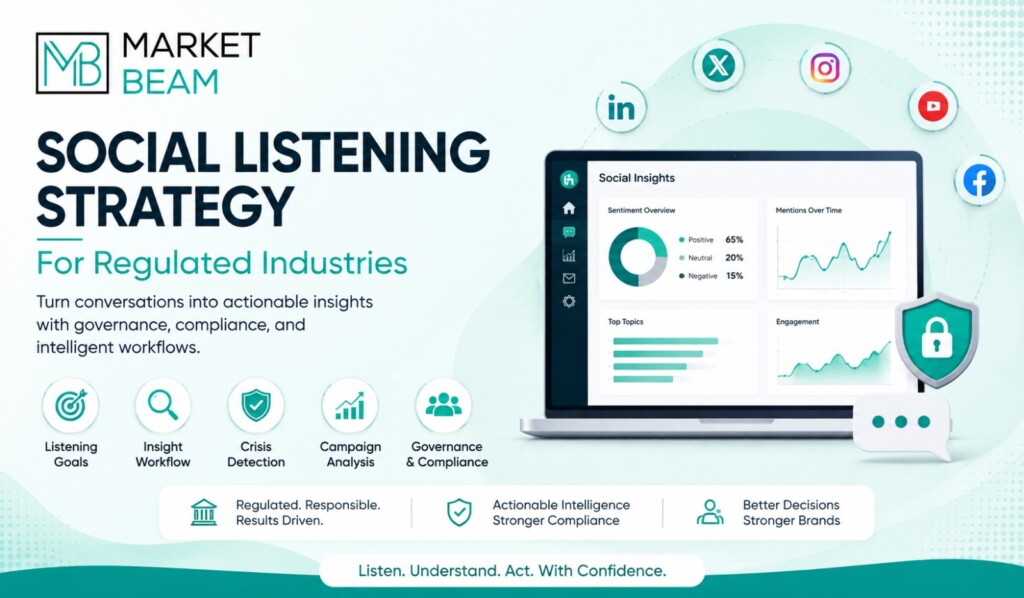
A successful strategy typically establishes specific listening goals, creates targeted search queries, identifies appropriate data sources, analyzes conversations, and establishes an insight workflow for turning findings into action.
For regulated organizations, the strategy should also define governance requirements. Teams need to understand which conversations can be handled by marketing or community managers and which situations require escalation to legal, compliance, medical, regulatory, or communications teams.
This structured approach makes listening more purposeful and reduces the risk of collecting large amounts of information without a clear business objective.
Why Regulated Industries Need a Social Listening Strategy
Regulated industries face unique communication challenges. Marketing teams must engage audiences while ensuring that public-facing activities remain consistent with organizational policies and applicable regulations.
A well-designed social listening strategy provides visibility into customer conversations without relying entirely on manual searches. Pharmaceutical companies, for example, can monitor discussions around products, campaigns, and relevant health topics while establishing appropriate internal review procedures.
Financial services organizations can identify customer concerns about products or services, while healthcare organizations can analyze general feedback about patient experiences and service quality.
The strategy should not replace professional compliance review. Instead, it creates a structured intelligence layer that helps organizations identify conversations requiring attention.
For regulated companies, this combination of listening, governance, and escalation can improve responsiveness while reducing operational risk.
Define Clear Listening Goals
The first step in developing a social listening strategy is establishing specific listening goals.
Organizations should determine what they want to learn from online conversations. Goals might include measuring brand perception, understanding customer concerns, analyzing campaign performance, monitoring competitors, identifying emerging trends, or detecting potential reputation issues.
Clear listening goals prevent teams from creating overly broad monitoring programs that generate large amounts of irrelevant information.
For example, a pharmaceutical marketing team might establish goals around campaign perception and brand awareness, while a financial institution may focus on customer experience and emerging service concerns.
Each goal should have measurable outcomes. Teams can then determine which conversations matter, what metrics should be monitored, and which departments should receive the resulting insights.
Building an Effective Query Setup
Once goals are defined, organizations need a structured query setup. Queries determine which conversations the listening platform identifies and analyzes.
An effective query setup may include brand names, product names, campaign terms, competitor names, industry terminology, relevant hashtags, and common variations or misspellings.
Regulated organizations should be particularly careful when developing queries around sensitive topics. Monitoring criteria should be aligned with organizational policies and applicable privacy requirements.
Queries should also be reviewed regularly. New product names, campaigns, competitors, trends, and terminology can emerge over time, making outdated queries less effective.
A well-maintained query setup improves data quality and ensures the social listening strategy remains aligned with current business objectives.
Core Components of a Social Listening Strategy
| Component | Purpose |
| Listening Goals | Defines what the organization wants to learn |
| Query Setup | Identifies relevant conversations and topics |
| Data Sources | Determines where conversations are collected |
| Insight Workflow | Converts findings into business actions |
| Crisis Detection | Identifies potentially high-risk conversations |
| Campaign Analysis | Measures audience response and campaign perception |
Selecting Relevant Data Sources
A social listening strategy is only as effective as the information it analyzes. Organizations should identify the digital channels most relevant to their audiences and industries.
Social networks provide valuable conversations, but forums, blogs, review websites, news platforms, and online communities can also contain important insights.
Regulated companies should evaluate data sources carefully and ensure their monitoring practices respect platform requirements and applicable privacy considerations.
The objective is not simply to collect more information. It is to collect relevant information that supports defined listening goals and can be analyzed within an appropriate governance framework.
Building an Effective Insight Workflow
A strong social listening strategy should not stop at collecting conversations. The real value comes from turning those conversations into actionable business insights. This requires a structured insight workflow that defines how information is reviewed, categorized, shared, and acted upon.
For regulated organizations, the workflow should identify which teams are responsible for different types of conversations. Marketing teams may review campaign feedback, customer service may handle general complaints, while legal, compliance, medical, or regulatory teams may review higher-risk topics.
An effective insight workflow should also establish response priorities. Not every mention requires immediate action, but significant changes in sentiment, unusual conversation volumes, or potentially sensitive topics may require rapid review.
Automation can make this process more efficient by categorizing conversations, generating alerts, and routing relevant insights to designated teams. This reduces manual work while improving response consistency.
When the insight workflow is connected to clearly defined listening goals, organizations can measure whether their listening program is generating meaningful business value.
Using Social Listening for Crisis Detection
One of the most important applications of a social listening strategy is crisis detection. Negative conversations can spread quickly across digital channels, making early identification essential for protecting brand reputation.
A listening platform can monitor unusual increases in conversation volume, negative sentiment, emerging keywords, or rapidly developing topics. These signals can help organizations identify potential issues before they become widespread.
For regulated industries, crisis detection may involve product concerns, misleading information, customer complaints, regulatory discussions, or other sensitive topics. The listening platform should not determine the final response independently. Instead, it should provide early intelligence that enables qualified teams to investigate and decide on the appropriate action.
Organizations should establish predefined escalation procedures that specify who receives alerts, how quickly issues should be reviewed, and which departments should participate in the response.
Integrating crisis detection into a broader social listening strategy helps organizations move from reactive communication to proactive risk management.
Campaign Analysis Through Social Listening
Traditional campaign reporting typically focuses on impressions, clicks, engagement, conversions, and other platform metrics. These measurements are useful, but they do not always explain how audiences perceive campaign messaging.
Campaign analysis through social listening adds another layer of insight by examining the conversations generated by a campaign. Teams can identify audience reactions, recurring themes, questions, positive feedback, and potential concerns.
For regulated marketing teams, campaign analysis can also help determine whether messaging is being interpreted as intended. If audiences consistently misunderstand a campaign message, marketing teams can use those insights to improve future communications.
Comparing conversation sentiment before, during, and after a campaign can reveal changes in brand perception and audience interest.
When combined with defined listening goals, campaign insights help marketing teams make evidence-based decisions instead of relying exclusively on engagement metrics.
Governance and Compliance Best Practices
A regulated social listening strategy requires clear governance. Organizations should establish policies defining who can access listening data, how insights are shared, and when conversations must be escalated.
Role-based access can help ensure employees only access information relevant to their responsibilities. Documented workflows also provide consistency when handling potentially sensitive conversations.
Organizations should regularly review their query setup and monitoring practices to ensure they remain aligned with business objectives and applicable requirements. Data retention and access procedures should also be documented according to organizational policies.
Compliance teams should be involved in developing governance processes rather than being brought into the workflow only after an issue occurs.
The goal is to create a listening environment where marketing intelligence and compliance requirements work together rather than operating as separate processes.
Social Listening Strategy for Regulated Teams
| Strategy Area | Recommended Approach |
| Listening Goals | Connect monitoring objectives to measurable business outcomes |
| Query Setup | Use relevant brand, product, campaign, and industry terms |
| Insight Workflow | Route findings to the appropriate internal teams |
| Crisis Detection | Establish alerts and predefined escalation procedures |
| Campaign Analysis | Measure audience response beyond engagement metrics |
| Governance | Define access, review, escalation, and documentation requirements |
How MarketBeam Supports Social Listening Strategy
MarketBeam helps enterprise organizations bring social listening strategy, social media management, analytics, and governance together within a centralized environment.
Marketing teams can use listening insights to understand campaign performance and audience reactions, while communications teams can monitor brand conversations and identify emerging reputation concerns.
MarketBeam’s workflow capabilities can support structured insight workflow processes by helping organizations coordinate information across marketing, communications, customer service, and other relevant teams. This creates greater visibility into how digital conversations are identified and handled.
For regulated organizations, centralized governance can also help establish consistent processes around crisis detection, campaign monitoring, and internal escalation.
By combining listening intelligence with enterprise social media workflows, MarketBeam helps organizations move beyond simply collecting conversations. Teams can use insights to improve campaigns, understand audiences, identify potential issues, and make more informed decisions while maintaining greater operational control.
Conclusion
A successful social listening strategy gives regulated organizations a structured way to understand customers, monitor market conversations, evaluate campaigns, and identify potential risks.
The strongest strategies begin with clear listening goals, carefully developed query setup, relevant data sources, and a defined insight workflow. Adding crisis detection and campaign analysis enables organizations to respond proactively while improving marketing performance.
Governance should remain central to the process. Clear access controls, escalation procedures, documentation, and collaboration between marketing and compliance teams help organizations use listening intelligence responsibly.
MarketBeam provides enterprise social media management, analytics, workflow automation, and governance capabilities that help regulated organizations turn digital conversations into actionable intelligence.
Connect With Us
Ready to strengthen your social listening strategy?
Sales: sales@marketbeam.io
Tech Support: support@marketbeam.io
Connect with MarketBeam to explore how enterprise listening, analytics, governance, and workflow automation can help your organization manage digital conversations more effectively.
Frequently Asked Questions
1. What is a social listening strategy?
A social listening strategy is a structured approach to monitoring and analyzing online conversations to achieve specific business objectives such as brand monitoring, campaign analysis, customer insights, and risk detection.
2. Why are listening goals important?
Listening goals define what an organization wants to learn from online conversations. Clear goals help teams select relevant queries, data sources, metrics, and workflows.
3. What is query setup in social listening?
Query setup involves defining keywords, brand names, products, competitors, campaigns, hashtags, and related terms that a listening platform should monitor.
4. How does crisis detection support regulated organizations?
Crisis detection helps identify sudden increases in negative conversations, emerging concerns, or unusual activity so appropriate teams can investigate and respond according to established escalation procedures.
5. How can social listening improve campaign analysis?
Campaign analysis uses audience conversations and sentiment alongside traditional performance metrics to understand how customers perceive campaign messaging and identify opportunities for improvement.
6. How does MarketBeam support a social listening strategy?
MarketBeam combines social listening, analytics, workflow automation, governance, and enterprise social media management to help organizations monitor conversations, coordinate insights, support escalation processes, and make informed marketing decisions.