Introduction
Pharmaceutical companies need to move quickly in social media, but speed cannot come at the expense of medical accuracy, legal protection, or regulatory compliance. A single social media post can contain product claims, safety information, promotional language, or patient-facing statements that require careful review before publication. This makes a well-structured MLR workflow essential for pharmaceutical marketing teams.
MLR stands for Medical, Legal, and Regulatory review. It is the process used to evaluate promotional and other regulated content before it reaches the intended audience. In pharma social media, the process needs to work efficiently because teams may publish content across several platforms, campaigns, markets, and formats.
A modern MLR workflow helps organizations establish clear responsibilities, review content consistently, manage revisions, document approvals, and publish only approved materials. It also helps marketing and compliance teams work together without relying on long email chains or disconnected spreadsheets.
MarketBeam supports regulated organizations with centralized content workflows, approval management, compliance controls, publishing, monitoring, and social media management. When these capabilities are combined with an organization’s established medical, legal, and regulatory procedures, teams can create a more controlled and efficient publishing process.
What Is an MLR Workflow?
An MLR workflow is a structured review process through which pharmaceutical content is evaluated by medical, legal, and regulatory stakeholders before publication.
The medical review focuses on scientific accuracy. Reviewers assess whether product claims, clinical statements, scientific references, and medical information are accurate and appropriately supported.
The legal review considers issues such as legal exposure, advertising requirements, intellectual property, disclosures, and other applicable legal considerations.
The regulatory review evaluates whether the content aligns with relevant regulatory requirements, approved product information, and the organization’s internal promotional policies.
A strong MLR workflow assigns responsibilities to each reviewer and establishes the sequence in which content should be evaluated. It also provides a formal record of comments, revisions, approvals, and the final version that is published.
For social media, this structure is especially useful because a short post may still contain complex promotional or compliance considerations.
Why Pharma Social Media Needs MLR Review
Pharmaceutical social media content often needs to be concise and engaging. However, reducing the length of a message does not reduce its regulatory importance.
A social media post may mention a product benefit, clinical result, indication, safety statement, or patient experience. Depending on the content and context, these communications may require review before publication.
A formal MLR workflow helps teams evaluate this content systematically instead of relying on individual judgment.
The process also improves consistency. When several marketers or agencies are creating content for the same brand, standardized review helps ensure that approved claims and language remain consistent across platforms.
For organizations operating across several markets, structured review is even more important because local requirements may differ. A centralized workflow can help teams route content to the appropriate reviewers while maintaining a clear record of each decision.
Medical, Legal, and Regulatory Review Explained
The three parts of an MLR workflow have different responsibilities, but they work toward the same goal: ensuring that content is suitable for publication.
Medical Review
Medical reviewers check scientific accuracy and ensure statements are supported by appropriate evidence. They may review product claims, clinical data, references, disease information, and scientific terminology.
Medical review is particularly important when social media content discusses efficacy, safety, treatment outcomes, or clinical research.
Legal Review
Legal reviewers assess whether content creates legal or advertising risks. Depending on the organization and communication, this may include checking disclosures, intellectual property, privacy considerations, comparative claims, and other legal issues.
Regulatory Review
Regulatory reviewers determine whether promotional content aligns with applicable regulations, approved labeling, and internal regulatory standards.
Together, these functions create a comprehensive review process. A clearly defined MLR workflow ensures that content reaches each reviewer at the appropriate stage and that unresolved concerns are addressed before publication.
Pharma Approvals and Claim Review
Effective pharma approvals depend on having a defined process for evaluating content claims. A marketing team may create a post quickly, but claims should not move directly to publication without the required review.
Claim review helps determine whether statements are accurate, supported, appropriately worded, and consistent with approved information.
Organizations should maintain approved claim libraries and supporting references where possible. This allows marketers to create content using established language rather than repeatedly developing claims from scratch.
A structured MLR workflow can route claims to the relevant reviewers and record the final decision. It also reduces confusion when content is revised because reviewers can see what changed between versions.
This approach becomes especially valuable for recurring social media programs, where teams may create dozens or hundreds of posts around a product or therapeutic area.
Building an Effective MLR Workflow
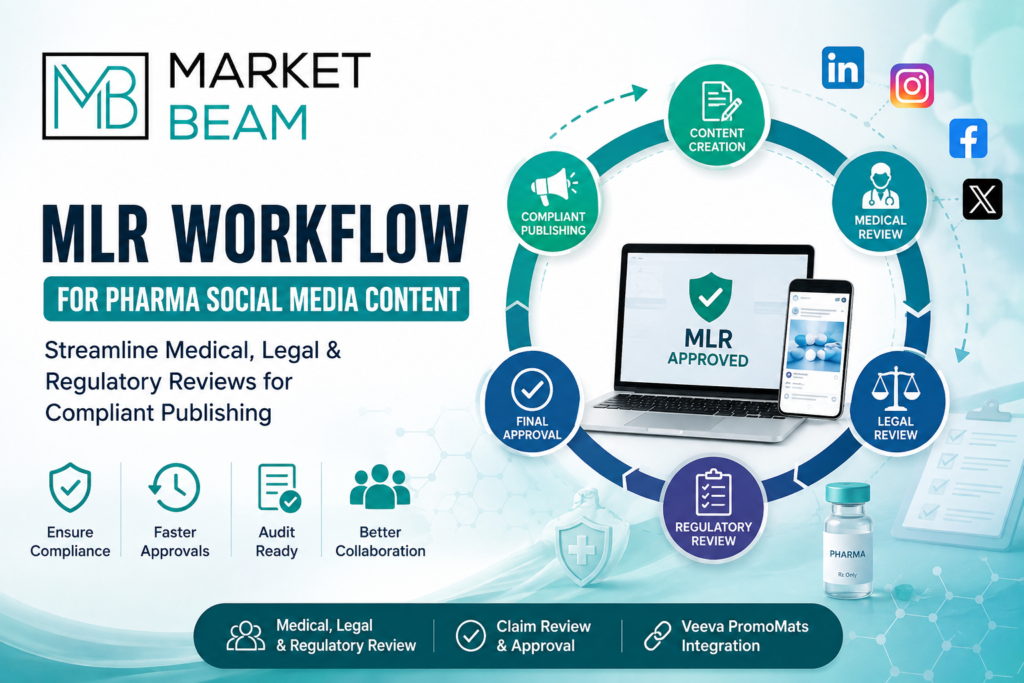
An effective MLR workflow begins with clearly defined content stages.
First, marketing teams create a draft based on the campaign objective and approved messaging. Next, the content is prepared for review with the supporting references, claims, creative assets, and required information attached.
The content then moves through medical, legal, and regulatory review according to the organization’s process. Reviewers provide comments, request changes, or approve the material.
When revisions are requested, the updated version should remain connected to the original content and its review history. This prevents teams from losing track of which version was approved.
After all required approvals are complete, the final version can move to compliant publishing. The organization should retain a record of the approved content and its review history.
This structured process improves accountability and helps reduce publishing errors.
Veeva PromoMats and Content Governance
Many pharmaceutical organizations use specialized systems for managing regulated promotional content. Veeva PromoMats is one example of a platform used for managing promotional content, review, approval, and related compliance processes.
Where organizations use Veeva PromoMats or similar systems, the social media process should be designed to complement the organization’s approved content governance model.
The goal is to avoid creating disconnected processes in which a social media team maintains one version of content while the regulated content repository contains another.
A coordinated MLR workflow helps maintain consistency between approved promotional materials and the content ultimately published on social platforms.
MarketBeam currently highlights Veeva integration as part of its life sciences capabilities, alongside content approval, publishing, monitoring, and compliance workflows.
Key Stages of an MLR Workflow
| Stage | Primary Responsibility | Main Objective |
| Content Creation | Marketing | Develop campaign content |
| Medical Review | Medical Team | Verify scientific accuracy |
| Legal Review | Legal Team | Assess legal and advertising risks |
| Regulatory Review | Regulatory Team | Check regulatory alignment |
| Revision | Marketing + Reviewers | Resolve requested changes |
| Final Approval | Authorized Stakeholders | Confirm publication readiness |
| Compliant Publishing | Social/Marketing Team | Publish approved content |
Common MLR Workflow Challenges
Pharmaceutical organizations often struggle with slow review cycles, unclear ownership, and version-control issues.
One frequent problem is feedback arriving through multiple channels. Marketing may receive comments by email while legal reviewers use shared documents and regulatory teams track changes elsewhere. This makes it difficult to determine the current status of an asset.
Another issue is incomplete information. Reviewers may need to request additional references or supporting documentation before completing their assessment, creating avoidable delays.
Version control can also become a major concern. When several versions of a social post exist, teams may accidentally publish an outdated version or assume that an earlier approval applies to a revised asset.
Centralized workflows, clear responsibilities, documented approvals, and appropriate automation can reduce these problems significantly while making the MLR workflow easier for both marketing and review teams to manage.
Compliant Publishing After MLR Approval
Completing the MLR workflow does not mean the compliance process is finished. Once medical, legal, and regulatory reviewers approve a social media asset, the organization still needs to ensure that the correct version is published through the approved channel.
This is where compliant publishing becomes important. Teams should confirm that the approved content is identical to the content being scheduled or published. Any last-minute edits can potentially invalidate previous approvals and may require additional review.
A centralized publishing process reduces this risk by connecting approved content directly with the publishing workflow. It also gives teams better visibility into which assets are approved, scheduled, published, or awaiting action.
For pharmaceutical organizations managing multiple brands and social accounts, controlled publishing helps maintain consistency while reducing the chance of unauthorized or outdated content going live.
Using Automation to Improve the MLR Workflow
Manual coordination can make an MLR workflow slow and difficult to manage. Marketing teams may spend significant time sending reminders, tracking reviewer feedback, updating spreadsheets, and checking whether content has received all required approvals.
Automation can reduce this administrative burden. Workflow software can route content to the appropriate reviewer, send reminders when deadlines approach, and update approval status automatically.
AI can also support the early review stage by identifying potential issues before content reaches human reviewers. For example, automated checks may flag unapproved claims, missing disclosures, or language that requires additional attention.
However, automation should support—not replace—qualified medical, legal, and regulatory professionals. Final decisions should remain with the appropriate reviewers according to the organization’s policies and procedures.
When automation is combined with human oversight, the MLR workflow becomes faster without removing critical review controls.
MLR Workflow for Social Media Content
Social media presents unique challenges because pharmaceutical teams often produce a high volume of short-form content. A single campaign may include LinkedIn posts, Instagram graphics, videos, paid advertisements, and employee advocacy content.
A strong MLR workflow should account for the specific format and risk level of each asset. Not every piece of content will require the same review path.
Organizations can establish workflows that automatically route higher-risk promotional content through additional review while allowing appropriate low-risk content to follow a simpler process.
Content should remain linked to its supporting references and approved claims throughout the process. This makes reviews easier and creates a clear record of why particular language was approved.
After final approval, the content can move into compliant publishing, with the system preserving the approved version and associated audit information.
Governance and Audit Readiness
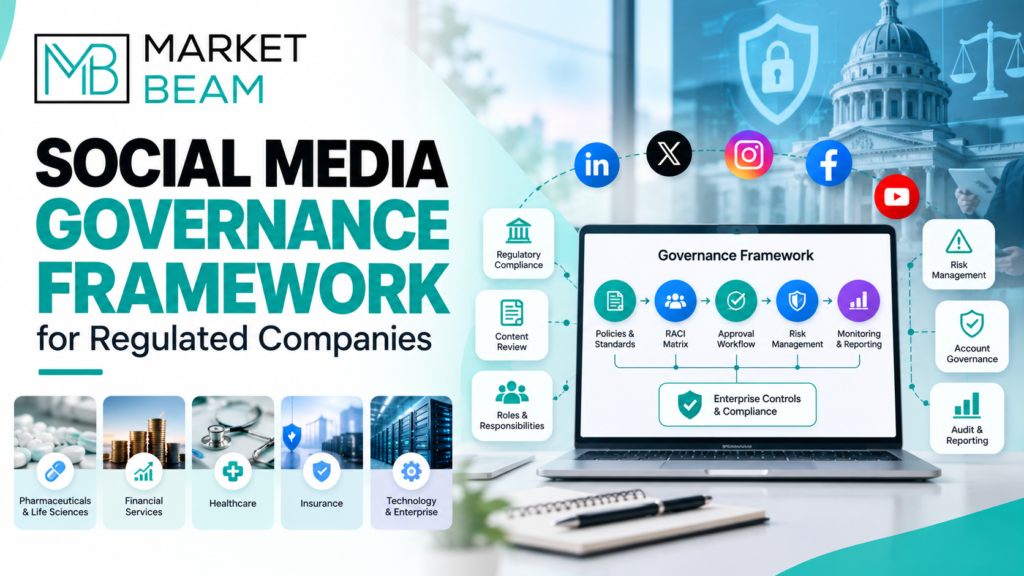
Strong governance is an essential part of every MLR workflow. Pharmaceutical companies should be able to demonstrate how promotional content was developed, reviewed, approved, revised, and published.
A centralized workflow can maintain records of reviewer comments, approvals, timestamps, content versions, and publishing activity. These records make internal audits easier and provide greater visibility into the promotional content lifecycle.
Audit readiness also improves accountability. Teams can quickly determine who approved an asset, what changes were requested, and which version was ultimately published.
Organizations should periodically review their workflow to identify bottlenecks and ensure processes remain aligned with internal policies and applicable regulatory requirements.
Manual vs. Automated MLR Workflow
| Area | Manual Process | Automated Workflow |
| Reviewer Assignment | Email or manual tracking | Automatic routing |
| Approval Tracking | Spreadsheets | Centralized status |
| Reminders | Manual follow-up | Automated notifications |
| Version Control | Multiple files | Centralized versions |
| Claim Review | Separate documents | Connected content and references |
| Audit Records | Manually maintained | Automatic activity history |
| Publishing | Manual transfer | Controlled publishing workflow |
How MarketBeam Supports Pharma MLR Workflows
MarketBeam helps regulated organizations connect social media content management with structured review and publishing processes. Its current life sciences offering highlights AI-powered compliance prechecks, human review workflows, publishing controls, monitoring, and integration with Veeva PromoMats.
This can help pharmaceutical teams manage the operational side of an MLR workflow more efficiently. Marketing teams can prepare content, route assets for review, track approvals, and publish approved material through a centralized process.
MarketBeam also describes AI checks that can identify potential compliance concerns before content reaches human reviewers. This can help reduce repetitive manual checking while keeping expert review as an essential part of the process.
For organizations using Veeva PromoMats, MarketBeam highlights integration capabilities designed to connect approved promotional content with social media publishing workflows.
The exact workflow should still be configured according to each organization’s medical, legal, regulatory, and promotional policies. Technology can support the process, but it does not replace the organization’s compliance responsibility or the judgment of qualified reviewers.
Conclusion
A well-designed MLR workflow gives pharmaceutical organizations a structured way to review and approve social media content before publication. By coordinating medical, legal, and regulatory review, teams can improve content quality, reduce version-control problems, and maintain better oversight.
The process becomes more effective when it includes clear pharma approvals, structured claim review, appropriate Veeva PromoMats integration where applicable, and controlled compliant publishing.
Automation can further improve efficiency by routing content, tracking approvals, sending reminders, and supporting early compliance checks. However, human medical, legal, and regulatory judgment should remain central to the final approval process.
MarketBeam helps regulated organizations bring content workflows, compliance checks, publishing, monitoring, and governance together in one enterprise environment.
Connect With Us
Ready to streamline your pharmaceutical social media review process?
Sales: sales@marketbeam.io
Tech Support: support@marketbeam.io
Connect with MarketBeam to explore how centralized workflows, AI-assisted compliance checks, governance, and compliant publishing can support your organization’s social media operations.
Frequently Asked Questions
1. What is an MLR workflow?
An MLR workflow is a structured process for reviewing pharmaceutical content through medical, legal, and regulatory teams before it is approved and published.
2. Why is MLR review important for pharma social media?
MLR review helps organizations verify scientific accuracy, legal considerations, regulatory alignment, and approved messaging before pharmaceutical social media content is published.
3. How does claim review work?
Claim review involves evaluating promotional or scientific statements to ensure they are accurate, properly supported, appropriately worded, and consistent with the organization’s approved information and review requirements.
4. Can Veeva PromoMats support social media content workflows?
Veeva PromoMats can be part of a pharmaceutical organization’s promotional content management process. Where an organization uses it, social media workflows can be designed to work with approved content and established governance procedures.
5. How does automation improve pharma approvals?
Automation can route content to the right reviewers, send reminders, track approval status, manage versions, and maintain activity records, making pharma approvals more efficient.
6. How does MarketBeam support compliant publishing?
MarketBeam combines AI-assisted compliance checks, human review workflows, publishing, monitoring, governance, and Veeva PromoMats integration capabilities to help pharmaceutical teams manage compliant publishing more efficiently.