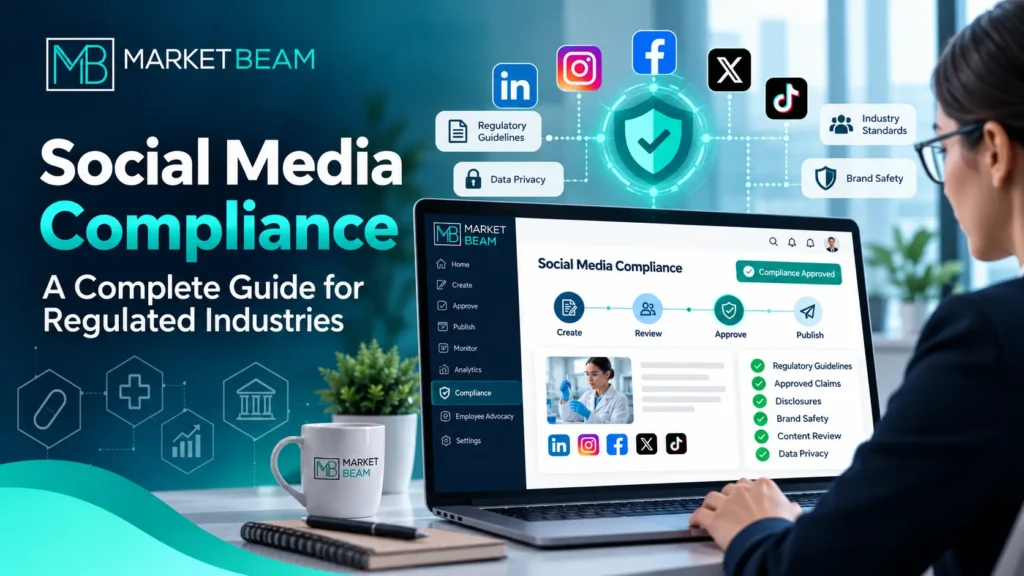
Social Media Compliance: A Complete Guide for Regulated Organizations
Social media has become a key way for organizations to connect with customers, employees, healthcare professionals, investors, and partners. However, regulated companies face more challenges than simply creating a post and clicking “publish.”
Every post can create risks related to privacy, security, advertising, brand reputation, and internal approval. As a result, social media compliance has become an important part of enterprise social media management.
Social media compliance means making sure that social media activity follows relevant laws, industry rules, company policies, advertising standards, privacy rules, and platform requirements.
For companies in pharma, life sciences, healthcare, financial services, and other regulated fields, a written policy is only the starting point. Teams also need a clear process for creating, reviewing, approving, publishing, monitoring, and storing social content.
Modern platforms such as MarketBeam help teams bring these tasks into one workflow. As a result, marketing teams can scale social media while compliance teams keep the controls they need.
In addition, regulated organizations must manage more than content quality. They also need to control approvals, access, records, and employee activity. As a result, a clear compliance process can help marketing teams work faster while keeping important checks in place.
At the same time, social media teams need to respond quickly to customers and market changes. Therefore, organizations should build compliance into the publishing process instead of treating it as a final step.
What Is Social Media Compliance?
Social media compliance is the practice of ensuring that social media activities follow the laws, regulations, organizational policies, and platform requirements applicable to a business.
It can cover everything from protecting customer information to ensuring advertising claims are appropriately reviewed.
Depending on the organization and industry, social media compliance can involve data privacy, advertising disclosures, intellectual property, account permissions, content approvals, record keeping, employee advocacy, adverse-event monitoring, and security.
The challenge is that there is no single social media compliance regulation.
A pharmaceutical company may need to consider FDA requirements and internal Medical, Legal, and Regulatory (MLR) processes. A financial institution may need controls related to FINRA and SEC requirements. Healthcare organizations may need to consider HIPAA when handling protected health information.
Organizations operating internationally may also need to account for privacy requirements such as GDPR.
As organizations expand across channels and regions, these requirements become increasingly difficult to manage through spreadsheets, email approvals, shared passwords, and disconnected publishing tools.
That is where a centralized social media compliance workflow becomes valuable.
Social Media Compliance is really Important?
Social media moves quickly. Regulation and enterprise approval processes often do not.
That creates a fundamental challenge for regulated organizations.
Marketing teams want to participate in conversations while they are relevant. Compliance teams need sufficient time and information to verify that communications meet applicable requirements.
A strong social media compliance program helps connect these priorities.
Instead of treating compliance as the final checkpoint before publication, organizations can incorporate it directly into the social media workflow.
This can help organizations reduce unauthorized publishing, prevent sensitive information from being shared, maintain more consistent messaging, establish accountability, and provide employees with clearer boundaries for social media activity.
Most importantly, compliance does not have to slow social media down. With clear approval paths and permissions, teams can work faster and spend less time deciding what they can publish.
What Regulations Affect Social Media Compliance?
Regulations affecting social media compliance depend on the organization’s industry, audience, location, and type of communication.
Some of the major regulatory areas include:
| Regulation / Standard | Region | Primary Social Media Consideration |
| GDPR | EU/EEA | Personal data, consent and privacy rights |
| CCPA/CPRA | California | Consumer privacy and data rights |
| HIPAA | United States | Protected health information |
| FINRA requirements | United States | Financial communications and recordkeeping |
| SEC requirements | United States | Financial communications and records |
| FTC guidelines | United States | Advertising, endorsements and disclosures |
| COPPA | United States | Children’s privacy |
| FERPA | United States | Student education records |
| ASA/CAP standards | United Kingdom | Advertising standards and disclosures |
| EU AI Act | European Union | Certain uses and disclosures involving AI |
Applicable rules should always be determined with an organization’s legal and compliance professionals.
Technology can facilitate social media compliance, but software does not replace legal judgment.
Social Media Compliance in Pharmaceutical and Life Sciences Organizations
Pharmaceutical and life sciences organizations face particularly complex social media workflows.
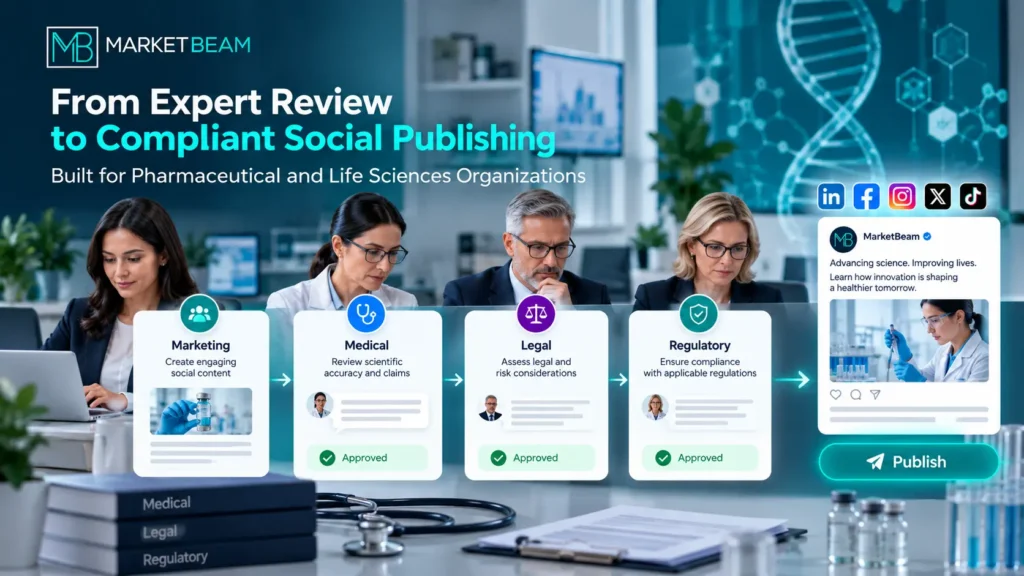
Content may need to move through Medical, Legal, and Regulatory review before publication. Claims must be controlled, approved language needs to remain consistent, and organizations may need processes for identifying and escalating potential adverse-event information found through social channels.
A typical social post might therefore involve several stakeholders:
First, marketing creates the content. Next, medical teams review scientific accuracy. At the same time, legal teams evaluate relevant legal risks. Finally, regulatory teams check applicable promotional requirements. Only after all required reviews are complete should the content move to publishing.
If this process takes place across email threads, spreadsheets, screenshots, and multiple publishing tools, teams can lose visibility into what was approved and which version is final.
A centralized social media compliance workflow can reduce this fragmentation.
MarketBeam is designed for regulated social media workflows and can help organizations connect social publishing with structured governance and approval processes.
For life sciences teams already working with Veeva Vault PromoMats, integrating social workflows with existing review processes can also help reduce unnecessary handoffs between marketing and compliance systems.

Social Media Compliance Biggest Risks
Understanding risk is one of the first steps toward developing an effective social media compliance strategy.
Data Privacy
Social platforms contain significant amounts of personal information.
Organizations must consider how information obtained through comments, direct messages, social listening, advertising, and other social interactions is collected, processed, shared, and retained.
A social media management process therefore needs appropriate access controls and governance around sensitive information.
Confidential Information
Employees can unintentionally expose confidential company, customer, patient, or partner information.
The risk becomes greater as more employees participate in corporate social programs.
A successful social media compliance strategy needs to extend beyond the central social media team.
Unauthorized Publishing
Shared passwords and unrestricted account access make it difficult to establish who can publish content.
Role-based access and defined publishing permissions provide stronger governance.
Marketing teams can continue creating content while organizations retain control over who can approve and publish it.
Unapproved Claims
A single sentence can create substantial risk in a regulated industry.
This is particularly important in pharmaceutical, healthcare, and financial communications where product, performance, medical, or financial claims may be subject to specific requirements.
Pre-publication approval workflows are therefore an important part of social media compliance.
Advertising and Disclosure
Sponsored content, partnerships, testimonials, endorsements, and influencer campaigns can require appropriate disclosures.
Social media compliance processes should make disclosure requirements part of content creation and review rather than something checked after publication.
Intellectual Property
Images, videos, music, quotations, graphics, and other creative materials can be protected by intellectual property rights.
Teams should establish procedures for confirming that assets are owned, licensed, or otherwise approved for use before publication.

AI Is Changing Social Media Compliance
Generative AI has introduced another dimension to social media compliance.
Marketing teams can now create captions, images, campaign concepts, replies, and content variations much faster.
But faster content generation can also mean faster creation of potentially non-compliant content.
Employees should avoid entering confidential or sensitive information into AI systems that are not approved by their organization.
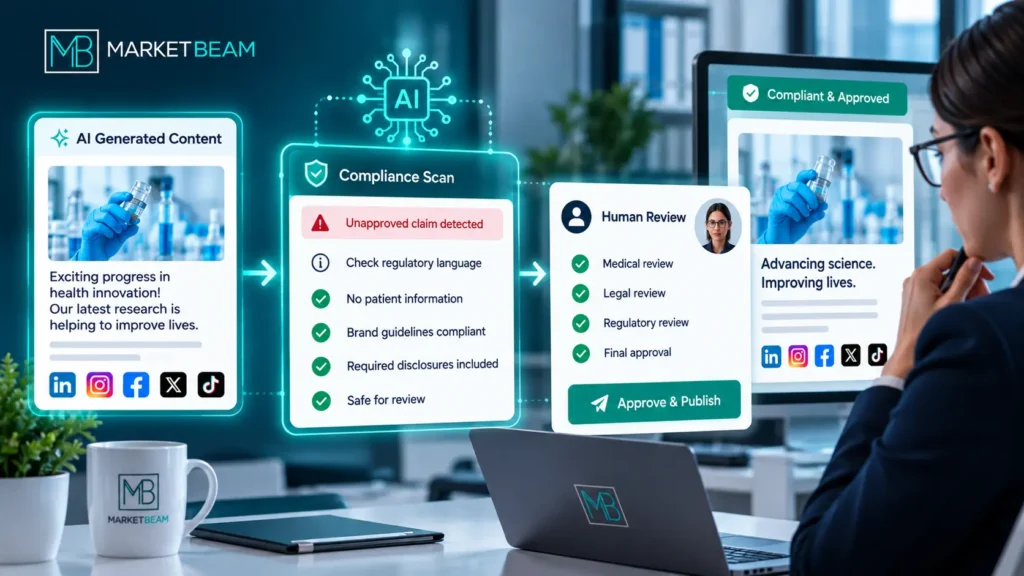
AI-generated content may also require human review for factual accuracy, claims, intellectual property concerns, disclosure requirements, and brand policies.
This makes governance particularly important.
Organizations should determine which AI tools employees may use, what information may be entered into those systems, what types of content require additional review, and who remains accountable for final approval.
AI can also support compliance.
Automated monitoring can help teams identify potentially risky language, unusual activity, missing disclosures, complaints, or other content that may warrant human attention.
The most effective model is therefore not AI instead of compliance teams.
It is AI supporting a structured social media compliance workflow with human oversight.
Employee Advocacy and Social Media Compliance
Employee advocacy creates an interesting compliance challenge.
Employees can significantly expand the reach of corporate content by sharing it through their personal professional networks.
But giving hundreds or thousands of employees complete freedom to create corporate messaging introduces obvious governance concerns.
The solution does not have to be preventing employees from participating.
Organizations can instead provide employees with pre-approved content.
A centralized advocacy platform can give employees access to compliant posts that have already completed the organization’s required review process.
Employees can then select and share appropriate content without creating every corporate message independently.
MarketBeam’s Employee Advocacy capabilities are designed around this approach.
Marketing and compliance teams can maintain control over approved content while employees help expand organizational reach.
This turns social media compliance from a barrier to advocacy into the framework that makes advocacy scalable.
For example, an employee may want to share a company announcement with their professional network. In that case, an approved content library can provide a ready-to-use message.
As a result, employees can participate without creating new corporate claims. At the same time, marketing and compliance teams can keep better control over the original message.
How to Build a Social Media Compliance Program
A mature program should combine people, policies, processes, and technology.
1. Identify Applicable Requirements
Start by working with legal and compliance teams to determine which regulations and internal policies apply.
Requirements may vary according to geography, industry, content type, product, social network, and audience.
2. Establish Roles and Permissions
Not every employee needs administrator access to every social account.
Create clearly defined roles for content creators, reviewers, approvers, publishers, and administrators.
Role-based access helps organizations maintain control without preventing teams from collaborating.
3. Build Approval Workflows
Approval should be part of the content lifecycle.
Organizations should determine which content requires review, who needs to review it, and what happens when changes are requested.
In life sciences organizations, this can include formal MLR review.
MarketBeam helps regulated organizations establish structured social publishing and approval workflows rather than relying on disconnected email conversations.
4. Maintain Pre-Approved Content
Frequently used corporate messaging does not always need to be recreated from scratch.
A controlled content library allows organizations to maintain approved posts and assets that can be reused appropriately.
This is particularly useful for employee advocacy.
5. Monitor Social Activity
Social media compliance does not end when content is published.
Organizations should monitor social activity for complaints, unauthorized claims, brand impersonation, potential adverse events, and other issues requiring attention.
MarketBeam’s social monitoring capabilities can help regulated organizations maintain visibility into conversations relevant to their brands.
6. Maintain Appropriate Records
Regulated organizations may need records demonstrating what was communicated and how content moved through review.
Maintaining an audit trail can provide important context during internal reviews, regulatory examinations, investigations, or audits.
7. Train Employees
Technology alone cannot create an effective compliance program.
Employees need to understand what they can publish, which information is confidential, how approved content should be used, how sponsored relationships should be disclosed, and when an issue should be escalated.
Training should be repeated as regulations, organizational policies, and social platforms evolve.
8. Review the Program Regularly
Social media changes constantly.
AI capabilities evolve. Platforms introduce new content formats. Regulations change. Organizations expand into new regions.
A social media compliance program should therefore be reviewed and updated regularly.
Why Manual Social Media Compliance Becomes Difficult at Scale
Manual processes can work when one marketer manages one or two social accounts.
They become significantly harder when an enterprise has multiple brands, countries, business units, agencies, employees, approvers, and social channels.
Imagine a pharmaceutical organization operating across several regions.
Marketing drafts a post.
The copy is emailed to compliance.
Someone requests an edit.
A new version is uploaded.
Medical requests another change.
The final copy is approved.
Someone accidentally publishes an older version.
The problem is not necessarily that the organization lacks a compliance policy.
The problem is that the workflow does not enforce it.
Enterprise social media compliance therefore requires operational controls as much as written rules.
Before choosing a platform, teams should define their key needs. For instance, one organization may focus on approval workflows, while another may need stronger monitoring and employee advocacy.
In addition, regulated companies should review how the platform handles records and permissions. This helps ensure that technology supports the compliance process instead of creating another disconnected system.
What Should Social Media Compliance Software Include?
Organizations evaluating social media compliance software should look beyond basic scheduling.
An enterprise platform should support governance throughout the content lifecycle.
Important capabilities can include role-based permissions, structured approvals, controlled publishing, pre-approved content, employee advocacy, social monitoring, auditability, analytics, and integrations with existing enterprise systems.
For regulated industries, integration with existing compliance infrastructure can be especially important.
Instead of forcing compliance teams to adopt an entirely separate process, social media workflows can connect with systems they already use.
This is where MarketBeam differs from a conventional social scheduler.
MarketBeam combines social publishing, employee advocacy, analytics, monitoring, prospect intelligence, and compliance-oriented workflows for organizations that need greater governance around social media.
Social Media Compliance Should Enable Marketing, Not Block It
There is a common assumption that stronger compliance inevitably means slower marketing.
That is usually a workflow problem rather than an unavoidable outcome.
If employees do not know which content is approved, they may ask more questions. Meanwhile, email-based approvals can force teams to spend extra time tracking down reviewers. Shared passwords also reduce control over account access. In addition, scattered content libraries can make it difficult for employees to find the latest approved version.
A well-designed social media compliance system addresses these problems by establishing clear guardrails.
Marketing teams know what they can publish.
Compliance teams know what they need to review.
Employees know which content they can share.
Administrators know who has access.
Everyone works within the same governed process.
How MarketBeam Supports Social Media Compliance
MarketBeam is built for organizations that need to scale social media while maintaining greater governance and control.
Rather than treating compliance as an external process that happens after content creation, MarketBeam can incorporate governance into everyday social workflows.
Teams can manage social publishing while maintaining structured approval processes and permissions.
Organizations can distribute approved content through Employee Advocacy so employees can participate in social amplification without requiring every employee to create corporate messaging independently.
Social monitoring can help organizations maintain visibility into conversations requiring attention.
For life sciences organizations, MarketBeam’s integration capabilities can also help connect social workflows with established compliance processes such as Veeva Vault PromoMats.
The result is a more unified approach to social media compliance where marketing, employees, and compliance teams can operate within defined guardrails.
Overall, social media compliance works best when people, processes, policies, and technology work together.
First, organizations need clear rules. Second, employees need practical training. Third, teams need reliable approval and monitoring workflows.
Finally, companies should review their process on a regular basis. By doing so, they can respond to new platforms, new risks, and changing business needs more effectively.
The Future of Social Media Compliance
Social media compliance is becoming more complex rather than less.
Organizations are publishing across more channels. Employees are becoming part of corporate distribution strategies. AI is dramatically increasing the volume of content teams can create. Customers expect faster responses. Regulators continue to scrutinize digital communications.
Traditional processes built around spreadsheets, email chains, and shared account credentials will become increasingly difficult to scale.
The next generation of social media compliance will be embedded directly into social media operations.
Governance will happen during content creation.
Approval workflows will connect marketing with compliance systems.
Employees will distribute pre-approved content.
Monitoring systems will help identify potential risks quickly.
AI will help surface potential issues while humans retain decision-making authority.
For regulated organizations, this shift can make compliance a competitive operational capability rather than simply a requirement.
FAQ: Social Media Compliance
What is social media compliance?
Social media compliance means following the laws, industry regulations, internal policies, advertising requirements, privacy rules, and platform standards that apply to an organization’s social media activities.
Why is social media compliance important?
Social media compliance helps organizations reduce regulatory, legal, privacy, security, and reputational risks. It also provides employees and marketing teams with clearer rules for creating, approving, and publishing social content.
Which industries need social media compliance?
Every organization should consider social media compliance, but it is especially important for regulated industries such as pharmaceuticals, life sciences, healthcare, financial services, insurance, and other industries with strict communication, privacy, or recordkeeping requirements.
What are the biggest social media compliance risks?
Common risks include sharing confidential information, publishing unauthorized claims, mishandling personal information, failing to disclose sponsored relationships, inappropriate account access, intellectual property violations, inadequate recordkeeping, and employees publishing unapproved corporate messaging.
How does AI affect social media compliance?
AI can increase content-production speed but can also introduce risks involving confidential data, inaccurate information, intellectual property, unapproved claims, and disclosures. Organizations should establish clear AI policies and maintain human review for regulated communications.
What is social media compliance software?
Social media compliance software helps organizations apply governance to social media activities through capabilities such as permissions, approval workflows, monitoring, controlled publishing, content libraries, records, reporting, and alerts.
How can MarketBeam help with social media compliance?
MarketBeam provides social media capabilities designed for regulated enterprise environments, bringing publishing, approval workflows, Employee Advocacy, monitoring, analytics, and compliance-oriented processes into a more centralized workflow. For life sciences organizations, integrations with established compliance systems can further connect marketing and review processes.
Build Social Media Compliance Into Your Workflow
The question for regulated organizations is no longer whether they should use social media.
The question is how they can use it at enterprise scale without losing governance.
Effective social media compliance requires more than policies stored in a document. It requires clear permissions, repeatable approval processes, approved content, monitoring, employee training, and technology that supports those controls throughout the social media lifecycle.
When compliance is built directly into social operations, organizations can give marketing teams greater clarity while giving compliance teams greater visibility.
MarketBeam helps regulated organizations bring those pieces together—so social media can move at the speed of modern marketing while remaining within the organization’s required guardrails.