
Introduction
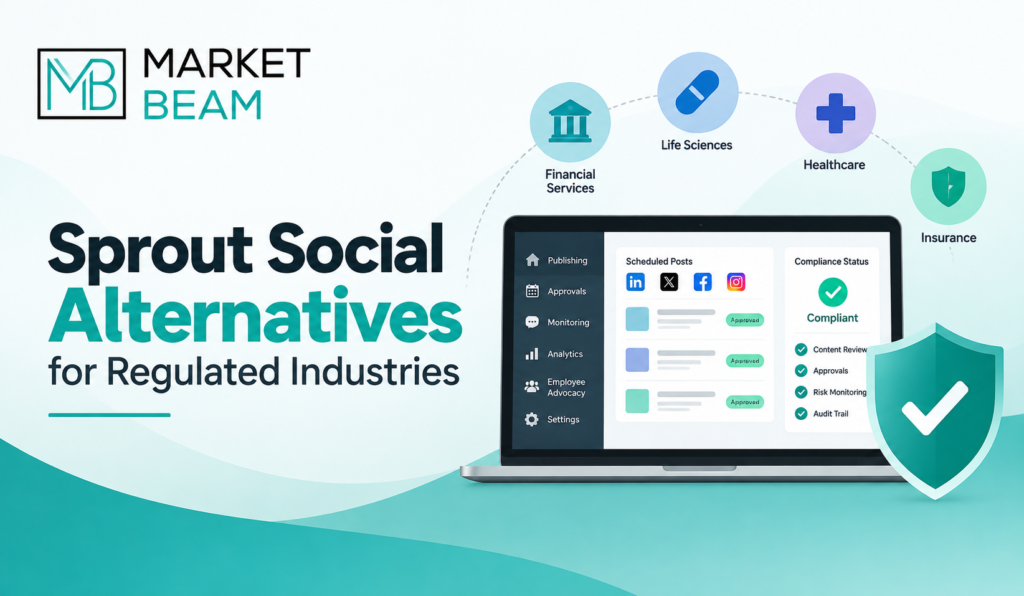
Regulated organizations need more from a social media platform than scheduling and analytics. Financial services, healthcare, life sciences, insurance, and other regulated teams often need approvals, governance, monitoring, employee advocacy, and reliable records within the same process. That is why companies researching Sprout Social alternatives often begin with compliance and workflow requirements rather than publishing features alone.
Sprout Social currently offers enterprise capabilities such as message approval workflows, employee advocacy, and Guardian features designed for risk controls, data protection, and regulated social media operations. Its approval workflows support multiple steps and approvers, while Guardian includes features such as blocked words, data masking, and secure forms.
For organizations comparing Sprout Social alternatives, the most useful approach is to evaluate how content moves from creation to review, approval, publishing, monitoring, and reporting.
Why Regulated Organizations Evaluate Sprout Social Alternatives
Regulated social media programs can involve marketing, compliance, legal, medical, regulatory, customer service, and regional teams. A single post may need several reviews before it reaches the public.
Sprout Social provides multi-step message approval workflows and lets organizations assign users to approval steps. Its approval system also provides activity visibility, internal comments, notifications, and options for external approvers on applicable plans.
Even with these capabilities, companies may evaluate Sprout Social alternatives when they want a platform that is more closely aligned with their industry-specific compliance process or existing technology stack.
A pharmaceutical company may prioritize MLR review and approved-content publishing. A financial institution may focus on supervisory review, recordkeeping, and controlled employee advocacy. A healthcare organization may place greater emphasis on data protection and monitored customer interactions.
The important question is not which platform has the most features. It is which platform supports the complete operating model.
What to Look for in Sprout Social Alternatives
A strong evaluation should cover compliance, publishing, governance, analytics, employee advocacy, and scalability. These areas become more important as organizations add brands, regions, users, and regulated campaigns.
Compliance and Approval Workflows
Regulated teams need clear ownership at every stage. Content should move through defined review steps, and stakeholders should be able to see the current status.
Sprout Social provides approval workflows that support multiple steps and multiple users. Its documentation also explains approval activity, comments, workflow notifications, and approval controls.
When assessing Sprout Social alternatives, look for flexible approval routing, role-based permissions, revision visibility, approval records, and controls that reduce the chance of publishing unapproved content.
A useful workflow may look like:
Create → Review → Approve → Publish → Monitor → Archive
Enterprise Publishing
Enterprise teams can manage many brands, accounts, countries, and campaigns at once. The platform should make it easier to schedule content while preserving control over who can publish to each account.
MarketBeam describes centralized social publishing, calendars, monitoring, engagement, analytics, and AI-assisted content creation for regulated organizations.
For Sprout Social alternatives, teams should review publishing permissions, content calendars, campaign coordination, account management, and the ability to support complex organizational structures.
Governance and Risk Controls
Governance defines who can create, approve, publish, edit, and monitor social content.
Sprout Social’s Guardian offering includes blocked words, data masking, and secure forms intended to help organizations manage brand and data risks in regulated environments.
When comparing Sprout Social alternatives, governance should include more than user roles. Consider policy enforcement, controlled publishing, content safeguards, escalation procedures, and visibility into activity.
Employee Advocacy
Employee advocacy can help organizations amplify approved content through employee networks. However, regulated teams need stronger control over the messages employees receive and share.
Sprout Social describes Employee Advocacy as a way to distribute approved content and pre-approved message ideas to employees.
For Sprout Social alternatives, evaluate whether employee advocacy is connected to the same governance process as corporate publishing. Teams should be able to determine what content is approved, who can access it, and how activity is measured.
Sprout Social Alternatives for Financial Services
Financial organizations often require social media processes that address regulatory review, disclosures, recordkeeping, and supervisory responsibilities.
MarketBeam describes its financial services solution around compliance workflows, approval controls, regulatory segmentation, and recordkeeping for regulated social media.
This type of specialized workflow can matter when a financial institution needs social publishing to connect directly with compliance operations.
When evaluating Sprout Social alternatives, financial teams should ask whether the platform supports their approval structure, monitoring process, recordkeeping needs, and internal governance model.
Sprout Social Alternatives for Life Sciences
Life sciences organizations have a different set of workflow requirements. Marketing content can require medical, legal, and regulatory review before publication.
MarketBeam’s life sciences offering describes workflows that connect social publishing and monitoring with MLR review and Veeva Vault PromoMats. It also describes monitoring and escalation processes for potential adverse events.
For pharmaceutical teams, Sprout Social alternatives should therefore be assessed for MLR workflow integration, approved-content controls, employee advocacy, monitoring, and documentation.
A platform that supports general publishing may not provide the same workflow fit as one designed specifically around regulated content operations.
Social Analytics and Reporting
Analytics should help regulated teams measure business results without separating performance data from campaign context.
Useful reporting can include engagement, reach, clicks, conversions, campaign performance, audience activity, and channel trends. The exact metrics should match the organization’s business objectives.
When comparing Sprout Social alternatives, ask whether reports can be organized by campaign, channel, brand, region, or team. Also consider whether the platform can connect with existing analytics systems.
The goal is not simply to collect more metrics. The goal is to help marketing and compliance leaders understand what was published, where it was published, how it performed, and which campaigns need attention.
Common Risks When Selecting a Platform
One common mistake is selecting a platform based only on scheduling or analytics. A tool may look strong in a product demo but create manual work when compliance reviewers enter the process.
Another issue is fragmented workflows. If content is drafted in one system, approved in email, published in another tool, and archived somewhere else, teams may struggle to determine which version was approved.
Employee advocacy can create another risk when employees receive content without clear controls. Monitoring can also become difficult if customer messages and public interactions are handled separately from the broader compliance process.
For this reason, Sprout Social alternatives should be tested using real workflows rather than sample posts alone.
How to Compare Sprout Social Alternatives
A practical comparison can use a weighted requirements matrix.
| Evaluation Area | Questions to Ask |
|---|---|
| Compliance | Can the platform support your review and governance process? |
| Publishing | Can teams manage multiple accounts and approval gates? |
| Employee advocacy | Can employees access and share approved content? |
| Monitoring | Can teams track comments, messages, and potential risks? |
| Analytics | Can teams measure campaign and business performance? |
| Governance | Are roles, permissions, and publishing rights configurable? |
| Integrations | Does the platform connect to required systems? |
| Scalability | Can it support more brands, regions, users, and channels? |
This framework helps organizations compare Sprout Social alternatives against actual business requirements instead of relying on a generic feature list.
A Practical Evaluation Process
Start by documenting the current workflow. List every stakeholder who creates, reviews, approves, publishes, monitors, or reports on social content.
Next, identify where delays occur. Are approvals handled through email? Are revisions difficult to track? Does employee advocacy happen outside the main workflow? Are records difficult to retrieve?
Then create a shortlist of Sprout Social alternatives and test each platform against the same use cases.
A useful pilot should include a routine post, a higher-risk post, a multi-step approval chain, an employee advocacy campaign, a monitoring scenario, and an analytics report.
The goal is to observe how each platform behaves under real operating conditions, not just how the interface looks during a demonstration.
MarketBeam for Regulated Social Media
MarketBeam positions its platform for regulated organizations across financial services, life sciences, healthcare, and other highly regulated sectors. Its current offering emphasizes social publishing, compliance automation, employee advocacy, monitoring, analytics, and audit-oriented workflows.
For life sciences, MarketBeam describes integration with Veeva Vault PromoMats for MLR review and social publishing. For regulated organizations more broadly, it describes workflows that connect content creation, compliance checks, publishing, monitoring, and measurement.
This makes MarketBeam one platform organizations can include when researching Sprout Social alternatives, particularly when compliance workflows and social media management need to operate together.
Organizations should still evaluate every platform based on their own requirements, regulations, integrations, budget, team structure, and implementation resources.
Final Thoughts
The best way to assess Sprout Social alternatives is to focus on operational fit instead of feature counts.
Regulated organizations should evaluate approval workflows, publishing, governance, employee advocacy, monitoring, analytics, integrations, and scalability together. A platform should support the full path from content creation to post-publication oversight.
Sprout Social provides established enterprise capabilities for approvals, employee advocacy, and risk controls, while MarketBeam positions its platform around regulated social media workflows and industry-focused compliance operations.
By testing Sprout Social alternatives with real content and realistic approval scenarios, organizations can determine which platform aligns with their current processes and long-term social media strategy.
Connect With Us
Looking for a regulated social media platform that connects publishing, compliance, employee advocacy, monitoring, and analytics?
MarketBeam helps regulated organizations build more structured social media workflows with greater visibility and control.
Sales
Tech Support
FAQs
1. Why are companies looking for Sprout Social alternatives?
Organizations may evaluate Sprout Social alternatives when they need different compliance workflows, specialized industry controls, integrations, employee advocacy processes, analytics, or governance capabilities.
2. What should regulated companies compare?
Key areas include approval workflows, compliance controls, publishing, monitoring, employee advocacy, analytics, permissions, auditability, integrations, and scalability.
3. Is MarketBeam designed for regulated industries?
MarketBeam positions its platform for regulated industries including financial services, life sciences, and healthcare, with compliance-focused workflows, publishing, monitoring, and employee advocacy capabilities.
4. Do Sprout Social alternatives support employee advocacy?
Many enterprise platforms support employee advocacy. During evaluation, check whether employees receive approved content, whether sharing is controlled, and how advocacy performance is measured.
5. What makes a social media platform suitable for financial services?
Financial services teams may need approval workflows, supervisory controls, recordkeeping, regulatory segmentation, and controlled employee advocacy. Exact requirements depend on the organization’s obligations.
6. How should a company test Sprout Social alternatives?
Use real scenarios. Test routine publishing, regulated content review, approval chains, employee advocacy, monitoring, reporting, and integrations before making a final platform decision.