How FDA Fair Balance Shapes Pharma Social Media Advertising
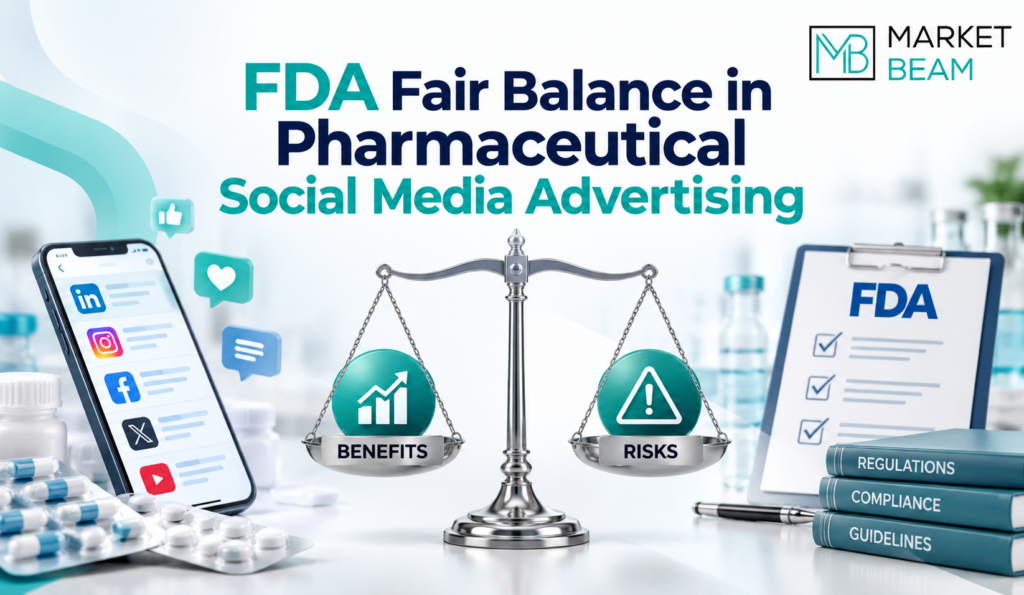
Pharmaceutical companies use social media to educate healthcare professionals, share disease information, support patient awareness, and promote approved products. However, pharma advertising must present product information in a way that is truthful and not misleading. As a result, FDA fair balance is an important consideration when companies communicate benefits and risks through digital channels.
The FDA explains that prescription drug advertising must provide a fair balance between information about effectiveness and information about risks. Federal regulations also address advertisements that are false, misleading, or lacking in fair balance.
For social media teams, this requirement can be difficult because posts often use short copy, visuals, videos, and links. Therefore, pharma organizations need a process that connects creative development with medical, legal, and regulatory review.
What Does FDA Fair Balance Mean?
FDA fair balance refers to the requirement that information about a prescription drug’s benefits and effectiveness should be appropriately balanced with relevant information about risks and contraindications.
Under 21 CFR 202.1, an advertisement does not meet the required standard when effectiveness information receives greater scope, depth, or detail without a comparable presentation of relevant risk information. The regulation also addresses prominence, readability, and the overall presentation of risk information.
In simple terms, a pharmaceutical advertisement should not make the benefits look much more important while making the risks difficult to notice.
The FDA Office of Prescription Drug Promotion states that its role includes helping ensure prescription drug promotion is truthful, balanced, and accurately communicated.
Therefore, FDA fair balance should be considered during content planning, not only during the final review.
Why FDA Fair Balance Matters on Social Media
Social media creates a unique challenge because every platform has its own format, layout, and audience behavior.
A short post may focus on one product benefit. A video may emphasize effectiveness within the first few seconds. An image may highlight a headline while placing risk information in a smaller area.
For that reason, FDA fair balance should be reviewed across the complete communication, including copy, images, video, headlines, captions, and supporting links.
The FDA’s social media resources include guidance on Internet and social media platforms with character-space limitations. That draft guidance explains the agency’s thinking on presenting benefit and risk information together when a firm chooses to make a benefit claim in a character-limited communication.
Importantly, that document is still identified by FDA as draft and nonbinding.
So, pharma teams should use it as FDA’s stated thinking while also considering applicable regulations, current labeling, internal policies, and professional regulatory advice.
Key Principles of FDA Fair Balance
A practical FDA fair balance process should focus on several areas.
Present Benefits and Risks Together
When a promotional communication makes a product benefit claim, teams should consider how the related risk information appears within the same communication.
The FDA’s draft character-space guidance says that risk information should be presented with benefit information within each individual character-limited communication when the firm chooses to present a benefit claim. It also discusses including the most serious risks and providing a prominent way to reach more complete risk information.
Therefore, teams should not assume that adding a general link to safety information will solve every presentation issue.
Give Risk Information Appropriate Prominence
FDA fair balance is not only about whether risk information exists. Presentation also matters.
The regulation addresses whether risk information is presented with prominence and readability reasonably comparable to the effectiveness information, considering factors such as typography, layout, contrast, headlines, paragraphing, and white space.
This is especially important for social content. A clear headline can make a benefit stand out, while a crowded design can make risk information easy to overlook.
As a result, MLR teams should review both the words and the visual treatment of risk information.
Avoid Overstating Benefits
Another important part of FDA fair balance is avoiding claims that make a product appear safer or more effective than the available evidence supports.
FDA identifies several common concerns, including unsupported claims, misleading study presentations, misleading comparisons, and statements that overstate safety or effectiveness.
For example, phrases such as “100% effective” or “cure-all” can create serious concerns when the evidence does not support those claims. FDA’s recent public education materials specifically mention exaggerated claims and misleading presentations as common problems in prescription drug promotion.
FDA Fair Balance and Social Media Formats
Different social formats require different review considerations.
| Social Format | Key Fair Balance Consideration |
|---|---|
| Short text post | Benefit and relevant risk information |
| Paid social ad | Overall message, disclosures, and risk presentation |
| Video | Audio and visual presentation of important information |
| Image post | Text prominence, layout, and readability |
| Carousel | Relationship between benefit and risk information |
| Influencer content | Approved messaging and required review |
| Employee advocacy | Use of approved content without unauthorized changes |
The FDA fair balance review should cover the actual format that the audience will see rather than reviewing only the plain text.
For example, a caption may appear compliant in a document but become difficult to read when placed inside a mobile graphic.
MLR Review and FDA Fair Balance
Medical, Legal, and Regulatory review plays a major role in managing FDA fair balance for pharma social media.
A typical workflow can follow:
Brief → Draft → Medical Review → Legal Review → Regulatory Review → Approval → Publish → Monitor
Marketing teams can create the initial message. Medical reviewers can assess scientific accuracy. Legal teams can evaluate legal considerations. Regulatory teams can review promotional requirements.
The important point is version control.
If a designer changes the headline after approval, the updated asset may need another review. Similarly, if the marketing team shortens a caption to fit a platform, the final version should remain within the approved communication strategy.
Common FDA Fair Balance Risks
Pharma organizations can face several common risks when managing digital advertising.
Benefit-Heavy Messaging
A post may emphasize efficacy while giving risks less space or visual importance.
Small or Hard-to-Read Risk Text
Risk information may technically appear but still receive weak presentation.
Unsupported Claims
A statement may suggest greater effectiveness or safety than the evidence supports.
Misleading Comparisons
A product may appear better or safer than another treatment without appropriate support.
Selective Data
An advertisement may present favorable study results without enough context.
Unapproved Changes
Employees, agencies, or creators may modify approved messaging before publication.
The FDA identifies fair balance, omitted material facts, unsupported claims, misleading comparisons, and misrepresented study information among common concerns in prescription drug promotion.
How to Build a Fair Balance Review Workflow
A structured process makes FDA fair balance easier to apply consistently.
First, identify the product claim and the intended audience. Next, identify the relevant risk information and supporting sources.
After that, create platform-specific versions while keeping the approved communication strategy intact.
Then, route the content through the required MLR reviews.
Finally, connect the approved version to publishing and monitoring.
| Workflow Stage | Main Question |
|---|---|
| Content planning | What benefit or product message is being communicated? |
| Medical review | Is the scientific information accurate? |
| Risk review | Are relevant risks included appropriately? |
| Legal review | Are there legal or disclosure concerns? |
| Regulatory review | Does the communication meet applicable requirements? |
| Design review | Are benefits and risks presented appropriately? |
| Publishing | Is the approved version being used? |
| Monitoring | Are comments or responses creating new concerns? |
This workflow helps make FDA fair balance part of daily social media operations instead of a last-minute quality check.
FDA Fair Balance and MLR Technology
Technology can reduce manual work across the approval process.
A social media platform can help route content to reviewers, track revisions, control publishing access, and maintain a record of approvals.
MarketBeam states that its life sciences platform connects social publishing with Medical, Legal, and Regulatory review and integrates with Veeva Vault PromoMats.
This type of connection can help teams keep approved content linked to the final publishing workflow.
For FDA fair balance, that link is valuable because it reduces the chance of publishing a version that differs from the one reviewed by the appropriate teams.
AI and FDA Fair Balance
AI can support pharma marketing teams by reviewing content for possible issues before human approval.
For example, AI can flag words associated with exaggerated claims, identify potentially risky content, or compare drafts against predefined internal rules.
However, AI should not make final regulatory decisions.
The meaning of a pharmaceutical claim can depend on context, evidence, product labeling, audience, and presentation. Therefore, human MLR review remains important.
An effective FDA fair balance workflow can use AI for early checks while leaving final decisions to qualified reviewers.
Employee Advocacy and Fair Balance
Employee advocacy can expand the reach of pharmaceutical content. However, employees should not independently rewrite regulated claims.
A safer process provides approved content through a controlled advocacy library.
Employees can then share approved posts without changing important product claims, risk information, or approved wording.
This approach helps preserve FDA fair balance across employee networks.
It also reduces the risk of employees creating their own product statements without the required review.
Monitoring After Publication
Compliance does not stop when an approved post goes live.
Comments and replies can introduce new issues. A user may ask about safety, effectiveness, dosage, or an indication that is not approved for the product.
Therefore, social teams need clear escalation procedures.
FDA maintains resources addressing social media and Internet communications, including materials related to misinformation and unsolicited off-label requests.
MarketBeam also describes monitoring workflows for life sciences teams, including potential adverse-event detection and escalation to pharmacovigilance teams.
These controls can support the wider FDA fair balance process by helping teams monitor what happens after publication.
Best Practices for FDA Fair Balance
A practical FDA fair balance program should follow several simple principles.
Start with approved product information. Then, identify the main benefit claim and the related risk information.
Next, review the entire communication rather than looking only at one sentence.
Also, check visual prominence. Risk information should not become difficult to find because of design choices.
In addition, test the final content on the actual platform and device format where possible.
Finally, keep the approved version connected to the publishing process and monitor relevant interactions after launch.
How MarketBeam Supports Pharma Social Media Workflows
MarketBeam is designed for regulated life sciences teams that need social publishing connected to review and compliance workflows.
Its current life sciences offering describes MLR review, Veeva Vault PromoMats integration, approved publishing, monitoring, employee advocacy, and audit-oriented capabilities.
For teams managing FDA fair balance, a connected workflow can help keep approved claims, risk information, reviews, and final social versions aligned.
The technology does not replace regulatory judgment. Instead, it can help marketing and compliance teams manage the process more efficiently and consistently.
Final Checklist for Pharma Teams
Before publishing a promotional social communication, ask:
Is the benefit claim accurate and supported?
Are the relevant risks presented appropriately?
Does the overall communication remain balanced?
Is risk information easy to find and understand?
Has the final visual design received the required review?
Is the exact version approved?
Can the publishing process prevent unauthorized changes?
Is monitoring in place after publication?
This checklist can help teams incorporate FDA fair balance into everyday content review.
Conclusion
FDA fair balance is an important part of prescription drug advertising because FDA requirements address the relationship between effectiveness information and risk information. Federal regulations also address prominence, readability, misleading presentations, unsupported claims, and omitted material facts.
For social media, the challenge becomes greater because content is often short, visual, mobile-focused, and highly shareable. FDA’s social media resources include a draft guidance document on character-space-limited communications that discusses presenting benefit and risk information within the same communication.
Therefore, pharma organizations should build FDA fair balance into planning, MLR review, design, publishing, monitoring, and employee advocacy workflows.
A strong process combines approved product information, appropriate risk presentation, human review, controlled publishing, and ongoing monitoring. Technology can then support these steps by connecting content, approvals, and publishing records.
Connect With Us
Looking to strengthen your FDA fair balance workflow for pharmaceutical social media advertising?
MarketBeam helps pharma, biotech, and medtech teams connect MLR review, approved social publishing, monitoring, employee advocacy, and compliance workflows in a more structured environment.
Sales
Tech Support
FAQs
1. What does FDA fair balance mean?
FDA fair balance means that prescription drug advertising should appropriately balance information about effectiveness with information about risks and contraindications. Federal regulations also address the prominence and presentation of risk information.
2. Does FDA fair balance apply to social media?
The underlying advertising requirements can apply to promotional communications distributed through digital channels. FDA also maintains social media guidance and resources addressing Internet and social media communications.
3. What is the biggest fair balance risk in social media?
A common risk is presenting product benefits prominently while making risk information less noticeable or less understandable. Unsupported or misleading claims can create additional concerns.
4. Does FDA have guidance for character-limited social media?
Yes. FDA has a draft guidance document addressing presentation of risk and benefit information on Internet and social media platforms with character limitations. FDA currently identifies that document as draft and nonbinding.
5. How does MLR review support fair balance?
MLR review allows medical, legal, and regulatory teams to check claims, risk information, supporting evidence, and presentation before publication. A connected workflow can also help maintain version control.
6. Can software help manage FDA fair balance?
Yes. Compliance-focused social media software can connect content creation, review, approvals, controlled publishing, monitoring, and records. MarketBeam describes these capabilities for regulated life sciences workflows.