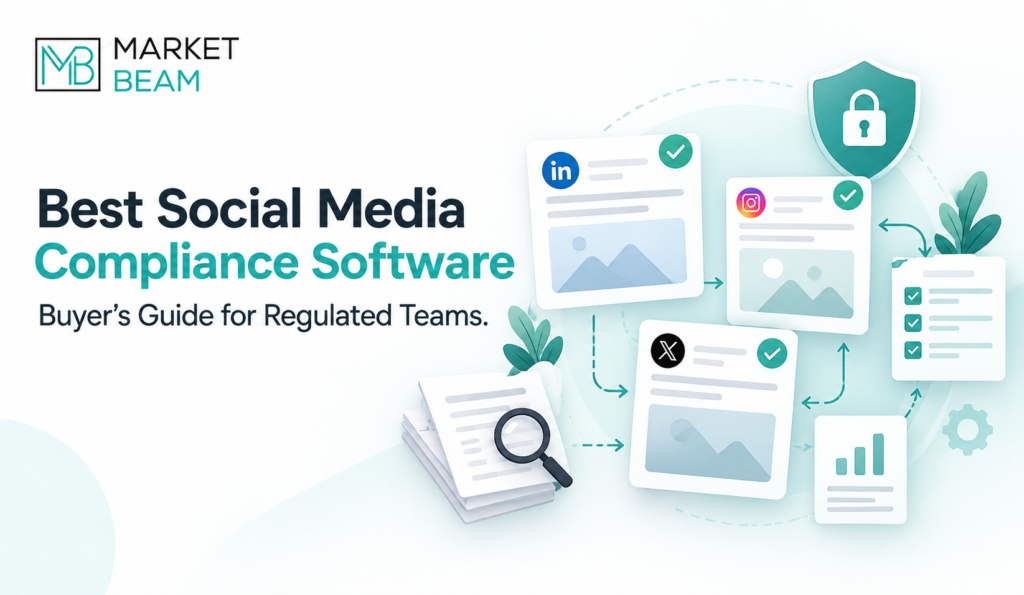
Why Choose the Best Social Media Compliance Software?
Choosing the best social media compliance software is becoming more important for organizations that use social channels in regulated markets. Financial services firms, pharmaceutical companies, healthcare organizations, insurance providers, and other regulated teams need to move quickly while also controlling approvals, access, records, and risk.
The best social media compliance software should do more than schedule posts. It should support the full content journey, from planning and drafting to review, approval, publishing, monitoring, and recordkeeping. Moreover, it should make those steps easy for marketers and clear for compliance teams.
Social media creates a special challenge because content can reach a large audience within minutes. Therefore, the best social media compliance software should connect fast publishing with clear controls. A small error can also spread quickly through comments, shares, and employee networks.
This guide explains how to compare the best social media compliance software, which features matter most, and how to test a platform before choosing it.
What Is Social Media Compliance Software?
The best social media compliance software helps organizations add governance to everyday social media work. Instead of keeping content in one tool, approvals in email, and records in another folder, teams can manage key steps in a connected workflow.
The best social media compliance software can support access controls, approvals, publishing, monitoring, content libraries, employee advocacy, analytics, and audit trails. However, feature depth varies by vendor.
For financial services, social media communications can fall under existing regulatory requirements. FINRA states that its communication rules apply to social media and explains that firms must retain business-related communications and supervise applicable activity.
Investment advisers also need to consider SEC requirements. The SEC Marketing Rule covers advertising practices for covered advisers and includes related books-and-records requirements for advertisements and certain information involving performance, testimonials, endorsements, and third-party ratings.
As a result, the best social media compliance software should help teams build controls around the rules that apply to their organization.
Why Regulated Teams Need Social Media Compliance Software
A small company may manage social media with a content calendar and a simple approval process. Enterprise teams, however, often need the best social media compliance software to coordinate many stakeholders. Larger organizations can have marketing, compliance, legal, brand, regional, and publishing teams involved in one post.
Without a connected system, these steps can become difficult to track.
The best social media compliance software can reduce this friction by connecting content, reviewers, approvals, and publishing actions. It can also create a clear activity record.
Regulated organizations also face risks after publication. A customer may post a complaint. An employee may add an unapproved statement. A third-party creator may publish a message that does not match approved guidance.
Therefore, compliance needs to continue beyond the initial approval.
What Makes the Best Social Media Compliance Software?
The best social media compliance software should combine control with usability. A system that creates too much friction can lead teams to avoid the approved workflow. On the other hand, a system with weak controls may not meet enterprise needs.
Look for a platform that supports the following areas. When reviewing the best social media compliance software, test each area with a real campaign.
Approval Workflow
The best social media compliance software should make approval steps clear. Users should know who needs to review a post and what happens when someone requests a change.
A corporate post may need one review, while a regulated campaign may need marketing, legal, and compliance approval.
A strong workflow can follow:
Create → Review → Revise → Approve → Publish → Monitor → Archive
For regulated teams, the best social media compliance software should keep this sequence visible to every stakeholder.
MarketBeam describes approval workflows with review status, approval actions, revision requests, and records of workflow activity. Its financial services offering also describes compliance gates that connect approval with publishing.
Role-Based Access
Access control is another core requirement. The best social media compliance software should let administrators decide who can create, review, approve, publish, and manage accounts.
This approach limits unnecessary access while keeping collaboration practical.
For instance, a content creator may prepare drafts, while a compliance reviewer can approve them. A publisher can schedule approved posts, but cannot bypass required review.
Audit Trail
An audit trail records key actions during the content lifecycle. The best social media compliance software should help teams identify who created a post, who reviewed it, what changes were requested, and when it was approved or published.
This information can support internal reviews and regulatory examinations when applicable.
MarketBeam describes audit-oriented records for regulated social media workflows, including approval and publishing activity.
Controlled Publishing
Approval has limited value when users can publish around it. Therefore, the best social media compliance software should connect approval status with publishing permissions.
A controlled process can prevent unapproved posts from moving into the live publishing queue. As a result, teams can reduce the risk of accidental or unauthorized publishing.
Build a Buyer’s Checklist
Before comparing platforms, create a list of your organization’s requirements. The best social media compliance software should match those requirements rather than force your team into a new process.
| Capability | What to Check | Why It Matters |
|---|---|---|
| Approval workflow | Review steps, comments, revisions | Keeps approval clear |
| Access control | User roles and permissions | Limits unauthorized access |
| Audit trail | History and timestamps | Improves accountability |
| Publishing | Approval-linked scheduling | Reduces publishing risk |
| Monitoring | Posts, comments, messages | Supports ongoing oversight |
| Recordkeeping | Search and retrieval | Simplifies reviews |
| Employee advocacy | Approved content sharing | Expands reach with control |
| Analytics | Campaign and channel data | Measures results |
| Integrations | Existing business systems | Reduces manual work |
| Scalability | Teams, brands, and regions | Supports growth |
Use this checklist to compare the best social media compliance software across the same use cases. That way, each vendor receives a consistent evaluation.
Compliance Workflows by Industry
The best social media compliance software should match the rules and workflow of your industry.
Financial Services
Financial firms may need to manage communications, supervision, recordkeeping, employee activity, and advertising requirements.
FINRA notes that the content of a social media communication can determine whether it relates to a firm’s business and therefore needs retention. FINRA also provides guidance on supervising social media activity.
For investment advisers, the SEC Marketing Rule adds requirements for covered advertisements and related records.
Therefore, the best social media compliance software for financial services should support approval gates, records, permissions, monitoring, and clear workflow ownership.
Pharma and Life Sciences
Life sciences organizations often have Medical, Legal, and Regulatory review before publishing promotional content.
The FDA maintains industry resources covering Internet and social media promotion of prescription drugs and medical devices. Its resources include material on character-limited communications, misinformation, interactive promotional media, and unsolicited off-label requests. Some of these materials are draft guidance, so organizations should confirm the current status and applicability before relying on them. (U.S. Food and Drug Administration)
For these teams, the best social media compliance software should connect content creation with MLR review, approved publishing, monitoring, and records. In addition, the best social media compliance software can help keep approved versions tied to each campaign.
MarketBeam states that it integrates social publishing with Veeva Vault PromoMats for life sciences workflows.
Banking and Insurance
Banks and insurers may need controls for financial promotions, privacy, employee activity, customer interactions, and records.
FFIEC guidance explains that existing consumer protection and compliance laws apply to financial institution activity conducted through social media and recommends risk management across governance, policies, training, monitoring, third-party relationships, and audit functions.
For insurance teams, state requirements can differ. Therefore, est social media compliance software should support flexible policies, approvals, monitoring, and retention practices.
AI and Automated Compliance Checks
AI can increase the speed of social content creation. However, it can also increase the amount of content that needs review.
The best social media compliance software can use automation to flag possible risks before content reaches a human reviewer. For example, a system may identify restricted language, a missing disclosure, or content that needs additional attention.
MarketBeam describes AI-assisted content creation and pre-check capabilities that can review drafts before the human approval stage.
Still, automated checks should support human judgment. Regulated content can depend on context, evidence, audience, and policy details that automated rules may not fully understand.
Therefore, the best social media compliance software should make it clear when automation flags an issue and when a qualified reviewer needs to decide what happens next.
Social Media Monitoring After Approval
Publishing does not end the compliance process.
The best social media compliance software should also support monitoring after content goes live. Teams may need to review comments, direct messages, customer complaints, potential policy issues, or other activity.
For financial institutions, FFIEC guidance recommends monitoring social media risks and considering tools that can help identify issues such as brand impersonation and spoofing.
Life sciences teams may have additional monitoring procedures for potential safety information. MarketBeam describes social monitoring and escalation workflows for potential adverse events.
For this reason, the best social media compliance software should connect monitoring with the content and workflow that produced the original post. The best social media compliance software should also make escalation easier.
Employee Advocacy Controls
Employee advocacy can help companies extend the reach of approved content. At the same time, it creates another governance question.
Employees should know which messages are approved and what they can share. They should also understand what types of content they should not create or alter.
The best social media compliance software should provide an approved content library and allow organizations to control access to advocacy content.
MarketBeam describes employee advocacy that lets employees share approved content while the organization maintains oversight.
This approach can improve consistency. It also gives employees useful content without asking each person to create corporate messaging independently.
Pharmaceutical and Financial Content Workflows
Different regulated industries can need different approval paths. Therefore, your software should support workflow variations.
For example, a financial promotion may require compliance review and recordkeeping before publishing. A pharma post may need medical, legal, and regulatory review.
The best social media compliance software should allow teams to create these separate workflows without maintaining multiple disconnected publishing systems.
A strong platform can also help teams reuse approved assets. This can reduce repeated work while improving consistency.
Recordkeeping and Audit Readiness
Recordkeeping is one of the most important areas to review during a platform evaluation.
The best social media compliance software should make it easy to retain relevant communications and retrieve the information later.
FINRA says firms that permit business-related social media communications must ensure they can retain records as required by applicable rules.
Similarly, the SEC requires covered vestment advisers to make and keep copies of advertisements and specified records under the Marketing Rule framework.
Retention periods and record sets vary. Therefore, legal, compliance, and records teams should define requirements before selection.
A centralized audit trail can give teams a clearer record of approvals, revisions, publication activity, and other workflow events.
Analytics and Reporting
Compliance is essential, but marketing teams still need to measure results.
The best social media compliance software should combine governance with useful analytics. Teams may want to track reach, engagement, clicks, conversions, campaign performance, publishing activity, and review times.
However, more data does not automatically create better decisions.
Instead, reports should help leaders understand how content performs and how the social program operates. For example, marketing leaders may want campaign results, while compliance leaders may want approval activity and exception trends.
A platform that connects these views can reduce the need for separate reporting systems. The best social media compliance software should also keep reports tied to approved campaigns.
Integrations and Enterprise Fit
The best social media compliance software should fit into the tools your organization already uses.
Enterprise teams may rely on CRM platforms, analytics systems, collaboration tools, content management systems, or compliance systems. If social workflows remain isolated, users may continue to copy information between applications.
MarketBeam lists integrations including Veeva Vault PromoMats, HubSpot, Slack, Google Analytics, and major social platforms.
Before choosing a platform, create a simple integration map. Identify what information needs to move between systems and which team owns each step.
The best social media compliance software should reduce manual handoffs instead of adding another disconnected tool.
Security and Data Protection
Regulated organizations should also examine vendor security.
Social media platforms can contain business communications, account information, employee data, customer interactions, approval records, and other sensitive information.
Ask vendors about authentication, permissions, encryption, audit logs, data retention, incident response, and independent security reviews.
MarketBeam presents security and compliance information for its platform as part of its enterprise offering.
Still, every organization should complete its own security and vendor risk assessment before selecting a provider.
Ease of Use Matters
The best social media compliance software should be easy enough for daily use.
A platform may have excellent controls, but users will struggle if every basic task requires too many steps.
For this reason, test common activities such as creating a post, requesting approval, making revisions, publishing content, and retrieving a record.
Also, test the platform with users from different teams. Marketers, compliance reviewers, executives, and administrators may have very different needs.
How to Compare Vendors
A structured vendor comparison makes the buying process easier. Start with required features, assign priorities, and test every shortlisted vendor against the same scenarios.
The best social media compliance software should perform well in real workflows, not only in a product demonstration.
A useful pilot can test the best social media compliance software in realistic workflows, such as:
Scenario 1: Create and approve a routine social post.
Scenario 2: Send regulated content through multiple reviewers.
Scenario 3: Request revisions and verify version history.
Scenario 4: Attempt to publish content before approval.
Scenario 5: Share approved content through employee advocacy.
Scenario 6: Monitor comments and escalate a potential issue.
Scenario 7: Retrieve the complete record of a published post.
Scenario 8: Generate a report for marketing and compliance leaders.
These scenarios reveal whether the software fits your workflow.
Common Buying Mistakes
One common mistake is focusing only on scheduling or analytics. Approval features also need to connect with publishing, permissions, and records.
Another issue is over-automation. AI can reduce repetitive work, but human review still matters for regulated communications. Teams should also test record retrieval before they select a vendor.
When MarketBeam May Fit
MarketBeam positions its platform around social media management for regulated industries. Its current materials describe content creation, compliance checks, approvals, publishing, monitoring, employee advocacy, analytics, and audit-oriented workflows.
For financial services, MarketBeam describes regulatory prechecks, compliance-gated publishing, employee advocacy, and audit-focused workflows.
For life sciences, MarketBeam describes Veeva Vault PromoMats integration, MLR workflows, approved publishing, monitoring, and potential adverse-event escalation.
This can make MarketBeam a relevant platform to evaluate when an organization wants social media management and compliance workflows to operate together.
However, every company should compare vendors based on its own regulations, security requirements, internal processes, integrations, and budget.
Final Buyer Checklist
Before signing a contract, confirm that the best social media compliance software supports your complete content lifecycle. Test approvals, publishing, access, records, monitoring, advocacy, analytics, integrations, and security.
For regulated teams, the best social media compliance software should fit these workflows. Ask marketing, compliance, legal, IT, and security teams to review it before implementation.
Conclusion
The best social media compliance software should do more than manage a publishing calendar. Instead, it should connect content creation, review, approval, publishing, monitoring, recordkeeping, employee advocacy, and analytics.
For regulated organizations, this connected approach can reduce manual work and improve visibility. Moreover, it can give marketing teams clearer workflows while helping compliance teams maintain appropriate oversight.
The right choice depends on your industry and operating model. Financial services teams may focus on supervision and records. Life sciences teams may need MLR workflows. Healthcare and insurance organizations may have their own privacy, advertising, and state-specific requirements.
Therefore, evaluate software using real campaigns and real approval paths. Do not rely only on feature lists or product demonstrations.
MarketBeam is designed for regulated organizations and combines social media management with compliance-oriented workflows, monitoring, employee advocacy, analytics, and industry-specific integrations.
Ultimately, the best social media compliance software is the one that helps teams work efficiently while keeping needed controls in place.
Connect With Us
Looking for the best social media compliance software for your regulated organization?
MarketBeam helps regulated teams connect content creation, compliance checks, approval workflows, publishing, monitoring, employee advocacy, and analytics in one structured social media environment.
Sales
Tech Support
FAQs
1. What is the best social media compliance software?
The best social media compliance software depends on your industry, regulatory needs, social channels, security standards, team structure, and approval process. A real-world pilot is the best way to compare vendors.
2. What features should the best social media compliance software include?
Look for approval workflows, role-based access, controlled publishing, audit trails, monitoring, recordkeeping, employee advocacy, analytics, integrations, and strong security controls.
3. Why do financial services firms need social media compliance software?
Financial firms may need to supervise social communications and retain business-related records. FINRA states that its communication rules apply to social media and provides related guidance on supervision and recordkeeping. (
4. Can social media compliance software support pharma MLR review?
Yes, some platforms support regulated life sciences workflows. MarketBeam describes integration with Veeva Vault PromoMats for MLR review and social publishing.
5. Can AI improve social media compliance?
AI can help flag possible risks, review drafts, and reduce repetitive checks. However, human reviewers should remain responsible for important compliance decisions, especially for regulated content.
6. Does MarketBeam support regulated industries?
Yes. MarketBeam positions its platform for regulated sectors including financial services and life sciences. Its current offerings describe compliance workflows, approval controls, employee advocacy, monitoring, analytics, and industry-specific integrations.
7. Does the best social media compliance software replace legal or compliance teams?
No. Software can automate parts of a workflow, but legal, medical, regulatory, privacy, and compliance professionals still need to make decisions that require human judgment.
8. How should an enterprise test social media compliance software?
Use real content and real approval scenarios. Test creation, review, revisions, publishing controls, monitoring, employee advocacy, reporting, integrations, and record retrieval before making a final decision.