The life sciences industry is experiencing a profound digital transformation. Healthcare professionals, researchers, investors, patients, and industry decision-makers now rely heavily on digital channels to discover information, evaluate solutions, and engage with brands. As a result, organizations can no longer depend solely on conferences, field sales teams, and traditional outreach to drive growth.
This shift has made life science digital marketing one of the most important strategic investments for pharmaceutical companies, biotechnology firms, medical device manufacturers, and healthcare technology providers. However, success in this sector requires more than simply adopting new marketing channels. Organizations must balance visibility, engagement, and innovation with strict regulatory requirements and compliance standards.
According to guidance from regulatory bodies such as the FDA, digital communications in regulated industries must maintain accuracy, transparency, and appropriate oversight. This creates unique challenges that many traditional marketing platforms are not designed to address.
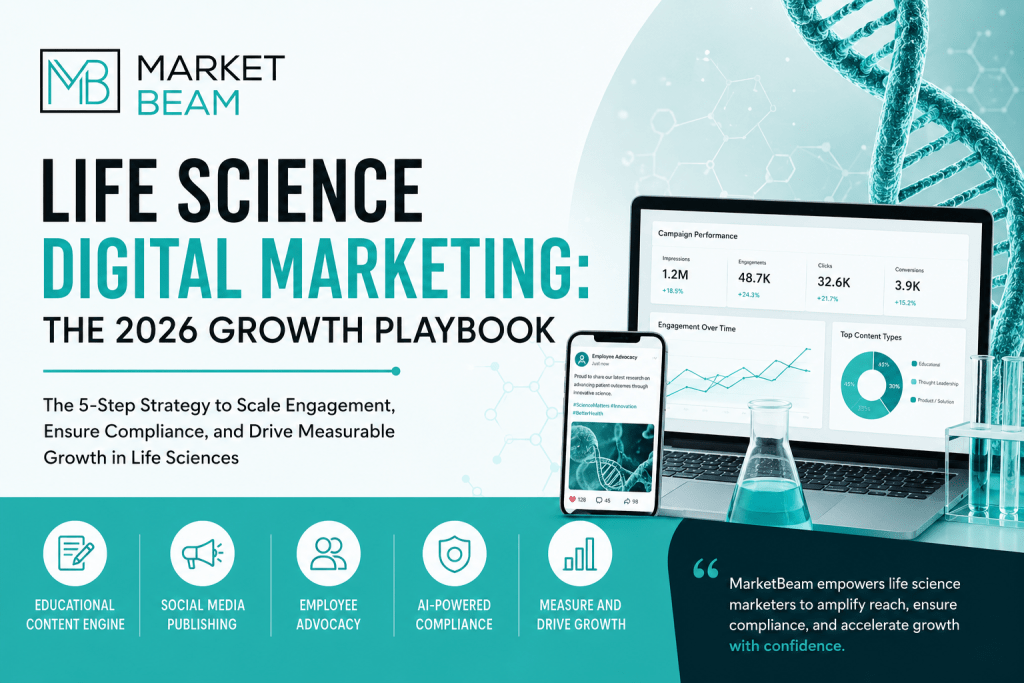
The organizations leading the market today are building integrated digital ecosystems that combine educational content, social media publishing, employee advocacy, analytics, and AI-powered compliance workflows. This playbook outlines the strategies driving growth across modern life sciences organizations.
The Digital Shift Reshaping Life Sciences
Over the past decade, buyer behavior has changed dramatically. Healthcare professionals increasingly consume educational content online before engaging with vendors. Researchers rely on digital resources to stay informed about innovations. Investors monitor industry developments through social media and digital publications. Even patients actively research healthcare information before making treatment decisions.
This evolution has transformed how organizations approach life science marketing. Instead of relying on one-time interactions, successful companies focus on building ongoing digital relationships that educate, inform, and engage audiences throughout the customer journey.
Search engines, webinars, thought leadership content, and social platforms now play a central role in influencing purchasing decisions. Organizations that fail to adapt risk losing visibility to competitors that have embraced modern digital engagement.
Why Traditional Life Sciences Marketing Is Losing Effectiveness
For years, many organizations relied heavily on conferences, print publications, email campaigns, and corporate social media accounts. While these channels still provide value, they often struggle to deliver the reach and engagement required in today’s digital-first environment.
Corporate social channels frequently reach only a small percentage of followers. Event attendance is limited by geography and budget. Email engagement rates continue to fluctuate as inboxes become more crowded.
Modern life sciences marketing requires a more integrated approach. Organizations must connect content creation, digital distribution, compliance management, employee engagement, and analytics into a unified strategy. This enables brands to reach audiences wherever they consume information while maintaining consistency across every touchpoint.
The result is stronger visibility, improved audience trust, and more measurable business outcomes.
The 5-Step Integrated Roadmap for Life Science Marketers
Step 1: Build an Educational Content Engine
Content remains the foundation of successful digital engagement. Audiences within regulated industries seek information that helps them understand scientific innovations, evaluate solutions, and solve complex challenges.
The most effective organizations publish content that prioritizes education over promotion. Blog articles, research summaries, case studies, webinars, whitepapers, and industry reports help establish credibility while improving search visibility.
Strong content strategies support every aspect of life science digital marketing. They attract organic traffic, generate qualified leads, and position organizations as trusted industry authorities.
Companies that consistently invest in educational content often experience higher engagement and stronger long-term brand recognition than those focused exclusively on promotional messaging.
Step 2: Optimize Social Media Publishing Workflows
Social media has become one of the most influential channels in regulated industries. Healthcare professionals actively engage with thought leadership on LinkedIn, researchers share discoveries online, and decision-makers follow industry trends through digital conversations.
However, successful social media publishing requires far more than scheduling posts.
Organizations must manage approvals, maintain audit trails, document revisions, and ensure compliance before content reaches public channels. Without structured workflows, marketing teams often face delays that reduce agility and limit campaign effectiveness.
Modern social media publishing platforms streamline this process by centralizing approvals, governance, and content distribution. Instead of relying on spreadsheets and email chains, teams can manage every stage of the workflow within a single environment.
For life sciences organizations, this approach improves efficiency while reducing compliance risks.
Step 3: Activate Employee Advocacy Programs
One of the most powerful growth opportunities available today is employee-driven content distribution.
Employees collectively have access to audiences that are often significantly larger than a company’s corporate social following. When employees share approved content, organizations can dramatically expand visibility while increasing credibility.
MarketBeam Insight: Organizations operating in regulated industries consistently achieve stronger engagement when approved content is distributed through employee networks. Audiences naturally place greater trust in people than brands, creating opportunities for higher reach and more meaningful interactions.
Modern employee advocacy software makes it possible to scale these programs safely. Marketing teams can provide employees with pre-approved content while maintaining governance, reporting, and compliance oversight.
Organizations using employee advocacy software often experience stronger engagement, increased brand awareness, and improved content distribution without increasing marketing spend.
Corporate Social Pages vs Employee Advocacy
| Metric | Corporate Social Pages | Employee Advocacy Programs |
|---|---|---|
| Organic Reach | Limited to page followers | Extended through employee networks |
| Audience Trust | Brand-generated | Peer-generated |
| Engagement Rate | Moderate | Typically higher |
| Compliance Control | Centralized | Requires governed workflows |
| Scalability | Limited | Organization-wide distribution |
The growing adoption of employee advocacy tools demonstrates how employee participation is becoming a critical component of modern digital growth strategies.
Step 4: Integrate AI Compliance Reviews
Compliance remains one of the most significant challenges facing regulated marketing teams.
Traditional review processes often involve multiple stakeholders, lengthy email threads, disconnected documentation, and repeated revisions. These workflows slow campaign execution and create operational bottlenecks.
Artificial intelligence is helping organizations modernize this process.
AI-powered systems can identify potential compliance concerns before formal review begins, reducing unnecessary revisions and accelerating approvals. Marketing teams can move faster while maintaining governance standards.
Traditional vs Modern Compliance Workflows
| Feature | Traditional Workflow | AI-Powered Workflow |
|---|---|---|
| Review Time | Multiple review cycles and email approvals | Automated pre-screening and faster approvals |
| Content Governance | Manual tracking | Centralized workflow management |
| Audit Readiness | Disconnected records | Automated audit trails |
| Social Distribution | Limited corporate publishing | Governed employee amplification |
| Reporting | Manual compilation | Real-time analytics and dashboards |
Organizations that adopt AI-powered compliance solutions often improve efficiency while strengthening regulatory oversight.
Step 5: Measure Revenue Impact
Marketing success should be measured by business outcomes rather than vanity metrics.
While impressions and engagement remain valuable indicators, leading organizations connect marketing performance directly to revenue generation, lead quality, customer acquisition, and pipeline growth.
Advanced analytics platforms help teams understand which channels, content formats, and campaigns drive meaningful business results. These insights enable continuous optimization and more informed investment decisions.
As competition increases, organizations that measure performance effectively gain a significant strategic advantage.
The Growing Influence of Biotech Marketing
Innovation continues to accelerate across the biotechnology sector, creating new opportunities for digital engagement.
Modern biotech marketing requires organizations to communicate complex scientific concepts to multiple audiences simultaneously. Researchers, investors, healthcare professionals, and strategic partners all require different information presented in different formats.
Successful biotech marketing combines scientific credibility with compelling storytelling. Organizations that translate technical innovation into accessible content often achieve stronger engagement and greater market visibility.
Digital channels provide biotechnology companies with unprecedented opportunities to educate audiences and establish leadership within highly specialized markets.
Lessons Life Sciences Can Learn From Pharma Digital Marketing
The pharmaceutical industry has become one of the most sophisticated adopters of digital engagement strategies.
Modern pharma digital marketing programs leverage analytics, automation, content personalization, compliance workflows, and omnichannel engagement to improve performance. These organizations have demonstrated that innovation and compliance can successfully coexist.
Many strategies pioneered within pharma digital marketing are now being adopted across broader life sciences sectors. Examples include approved content libraries, AI-assisted workflows, automated governance, and integrated social media programs.
Organizations that learn from these advancements can accelerate digital maturity while reducing implementation risk.
Choosing the Right Life Sciences Software Stack
Technology plays a central role in modern marketing operations.
The most effective organizations build integrated ecosystems supported by specialized life sciences software designed to address regulatory requirements and operational complexity.
Key technology categories include customer relationship management platforms, analytics solutions, content management systems, compliance tools, social media publishing platforms, and employee advocacy software.
Selecting the right life sciences software enables teams to streamline operations, improve collaboration, strengthen governance, and increase overall marketing effectiveness.
What About Fintech Digital Marketing?
Although life sciences and financial services operate in different industries, both share a common challenge: regulatory compliance.
Many principles used in fintech digital marketing can be applied within healthcare and pharmaceutical sectors. These include governance-driven content workflows, approval automation, audit readiness, and data-driven decision-making.
Organizations that learn from compliance-focused industries often discover opportunities to improve operational efficiency while maintaining regulatory standards.
Why MarketBeam Is Built for Modern Life Sciences Marketing
Most marketing platforms were designed for general consumer brands. Regulated industries require a different approach.
MarketBeam combines social media publishing, employee advocacy software, analytics, governance controls, and AI-powered workflow automation within a single platform built for regulated organizations.
Marketing teams can streamline approvals, increase content distribution, strengthen compliance oversight, and expand employee participation without sacrificing governance.
For pharmaceutical companies, biotechnology firms, medical device manufacturers, and healthcare technology providers, this unified approach simplifies operations while improving marketing performance.
Future Trends Shaping the Industry
Several trends will continue influencing the future of digital engagement across regulated industries.
Artificial intelligence will play a larger role in content creation, optimization, and compliance monitoring. Employee-driven distribution will become increasingly important as organizations seek to expand organic reach. Personalization will continue evolving as audiences expect more relevant experiences. Social intelligence platforms will provide deeper visibility into audience behavior and market trends.
Organizations that embrace these trends early will be better positioned to compete in an increasingly digital environment.
Conclusion
The future of life science digital marketing belongs to organizations that successfully combine education, compliance, technology, and audience engagement into a unified strategy.
Digital transformation has fundamentally changed how healthcare professionals, researchers, investors, and decision-makers interact with brands. Companies that continue relying on traditional approaches will find it increasingly difficult to maintain visibility and influence.
By investing in social media publishing, employee advocacy tools, AI-powered compliance workflows, and modern life sciences software, organizations can build scalable programs that drive measurable growth while maintaining regulatory confidence.
The companies leading tomorrow’s market are already building these capabilities today.
Frequently Asked Questions
What is life science digital marketing?
Life science digital marketing refers to the use of digital channels, content, analytics, and technology platforms to promote products, services, and innovations within pharmaceutical, biotechnology, healthcare, and medical device industries.
Why is social media important for life sciences companies?
Social media helps organizations educate audiences, share thought leadership, engage stakeholders, and expand brand visibility while supporting digital growth initiatives.
How does employee advocacy improve marketing performance?
Employee advocacy increases content reach, improves audience trust, and expands engagement by enabling employees to share approved content with their professional networks.
What role does AI play in regulated marketing?
AI helps automate compliance reviews, identify risks, streamline approvals, optimize content, and improve overall operational efficiency.
What software do life sciences marketing teams use?
Teams commonly use CRM systems, analytics platforms, content management tools, social media publishing solutions, employee advocacy software, and compliance-focused technologies.
How do pharmaceutical companies stay compliant on social media?
Organizations maintain compliance through structured approval workflows, governance controls, audit trails, content reviews, and regulatory oversight processes.
What is the difference between biotech marketing and pharma digital marketing?
Biotech marketing often focuses on scientific innovation and investor engagement, while pharma digital marketing typically emphasizes healthcare professional education, patient awareness, and regulated product communications.
How can life sciences organizations measure marketing ROI?
Organizations measure ROI through lead generation, pipeline contribution, customer acquisition, engagement metrics, attribution reporting, and revenue impact analysis.