Social media has evolved from a publishing channel into a measurable business function. Enterprises now use social platforms to build awareness, communicate with customers, support campaigns, strengthen employee advocacy, manage communities, and protect brand reputation. With activity spread across multiple platforms and business units, organizations need more than basic platform metrics. They need a structured way to understand what is working, where performance is changing, and how social activity contributes to business objectives.
That is where social media analytics becomes essential.
Modern social media analytics helps organizations collect, organize, interpret, and report data from social media activity. It can reveal which content generates engagement, which campaigns drive results, how audiences respond to messaging, and where performance can be improved. For regulated businesses, analytics can also connect performance reporting with governance, approval, and compliance records.
MarketBeam positions analytics as part of a broader enterprise social media workflow, alongside publishing, engagement, listening, compliance, and reporting. Its current platform specifically promotes analytics and reporting, compliance reporting, audit-ready visibility, and performance tracking within the same environment. (MarketBeam)
What Is Social Media Analytics?
Social media analytics is the process of collecting and analyzing data generated by social media activities to understand performance, audience behavior, content effectiveness, and business outcomes.
The data can include impressions, reach, engagement, clicks, video views, audience growth, conversions, publishing activity, and other platform-specific indicators. When these metrics are analyzed together, businesses gain a clearer view of how their social presence is performing.
However, analytics is not simply about collecting more numbers. The objective is to interpret those numbers and turn them into decisions.
For example, a post may receive thousands of impressions but very little interaction. Another post may reach fewer people but generate meaningful clicks or qualified leads. Looking only at impressions could make the first post appear more successful, while deeper analysis may show that the second contributed more value.
This is why effective social media analytics combines multiple metrics and connects them with campaign objectives, audience behavior, and business outcomes.
For enterprises, the value increases when analytics is centralized. Instead of downloading reports separately from LinkedIn, Facebook, Instagram, X, and other channels, teams can use a unified environment to compare performance and identify broader trends.
Why Social Media Analytics Matters for Enterprises
Enterprise social teams typically manage many campaigns, brands, regions, and social accounts simultaneously. Without centralized analytics, performance data can become fragmented across different platforms, spreadsheets, and reporting systems.
A strong social media analytics program provides a common view of performance across these activities. Marketing leaders can identify which campaigns deserve more investment, communications teams can evaluate audience response, and executives can track progress against broader business objectives.
Analytics also supports accountability. When teams can compare content performance over time, they can identify what is producing results and what requires adjustment.
For regulated organizations, the value extends beyond marketing performance. MarketBeam’s current platform describes analytics and reporting as part of its broader compliance-focused social media system, including compliance reporting and audit-ready visibility. (MarketBeam)
This creates an important advantage: teams can evaluate performance while maintaining visibility into the compliance context of the content being measured.
Social Reporting: Turning Data Into Business Information
Social reporting is the process of presenting social media data in a format that stakeholders can understand and use.
Effective reporting should answer practical questions. Which campaigns performed best? Which channels generated the strongest engagement? What changed during a particular reporting period? Which content formats should receive more investment?
Different audiences need different levels of reporting. A social media manager may need detailed post-level data, while a chief marketing officer may want a high-level view of campaign trends and business outcomes.
A good reporting system should therefore support customizable dashboards, scheduled reports, filters, date comparisons, and channel-level analysis.
Reports should also avoid vanity metrics. A large follower count may look impressive, but it does not necessarily indicate business success. The most useful social media analytics reports connect activity to meaningful outcomes.
For regulated organizations, reports may also need to demonstrate operational and compliance context. MarketBeam’s platform for financial services, for example, describes analytics that connect performance metrics with the compliance record of the associated content. (MarketBeam)
Understanding Engagement Analytics
Engagement analytics measures how audiences interact with social content. Common engagement indicators include likes, comments, shares, saves, clicks, reactions, video interactions, and other platform-specific actions.
Engagement can reveal whether content resonates with an audience, but it needs context.
A high engagement rate can indicate strong audience interest, but the quality of the interaction matters too. Positive comments may indicate trust and satisfaction, while a sudden increase in comments could be driven by confusion or complaints.
This is where social media analytics becomes more valuable than simply counting interactions. Teams should examine engagement alongside sentiment, reach, content format, audience characteristics, and campaign objectives.
For example, an educational pharmaceutical post may not generate as many reactions as a promotional post, but it may generate more meaningful clicks or healthcare professional engagement. Evaluating the right metrics ensures content is judged against its intended purpose.
Measuring Campaign Performance
Campaign measurement enables organizations to evaluate whether specific social initiatives achieved their intended goals.
Before a campaign launches, teams should define measurable objectives. These might include awareness, engagement, website traffic, event registrations, lead generation, employee amplification, or customer engagement.
Once the campaign is active, social media analytics can compare actual performance against those objectives.
A useful campaign measurement framework should examine results across several stages. First, teams can evaluate reach and visibility. Next, they can analyze engagement and audience response. Finally, they can connect those interactions with downstream actions where the organization’s technology stack supports that measurement.
Comparing campaigns over time is equally important. A one-time result can be misleading, while a pattern across multiple campaigns can reveal what consistently works.
MarketBeam highlights analytics and reporting alongside publishing, engagement, employee advocacy, compliance, and other enterprise capabilities, supporting the idea of measuring social activity as part of the wider social media lifecycle rather than as an isolated function. (MarketBeam)
Social KPIs Every Enterprise Team Should Monitor
Social KPIs are measurable indicators used to evaluate social media performance against defined objectives.
The right KPI set depends on the business goal. A brand awareness campaign may prioritize reach and impressions, while a lead-generation program may focus on clicks and conversions. A community-management team may care more about response time and engagement quality.
Common social KPIs include:
| KPI | What It Measures | Typical Use |
| Reach | Number of people exposed to content | Awareness |
| Impressions | Total content displays | Visibility |
| Engagement Rate | Audience interaction relative to exposure | Content quality |
| Click-Through Rate | Percentage of users clicking a link | Traffic generation |
| Video Completion | How many viewers finish a video | Video effectiveness |
| Follower Growth | Change in audience size | Community growth |
| Conversion Rate | Percentage completing a desired action | Campaign effectiveness |
| Response Time | Speed of community response | Customer engagement |
The important point is not to track every available metric. Strong social media analytics programs focus on the KPIs most closely aligned with the organization’s business objectives.
Performance Dashboard: Making Analytics Accessible
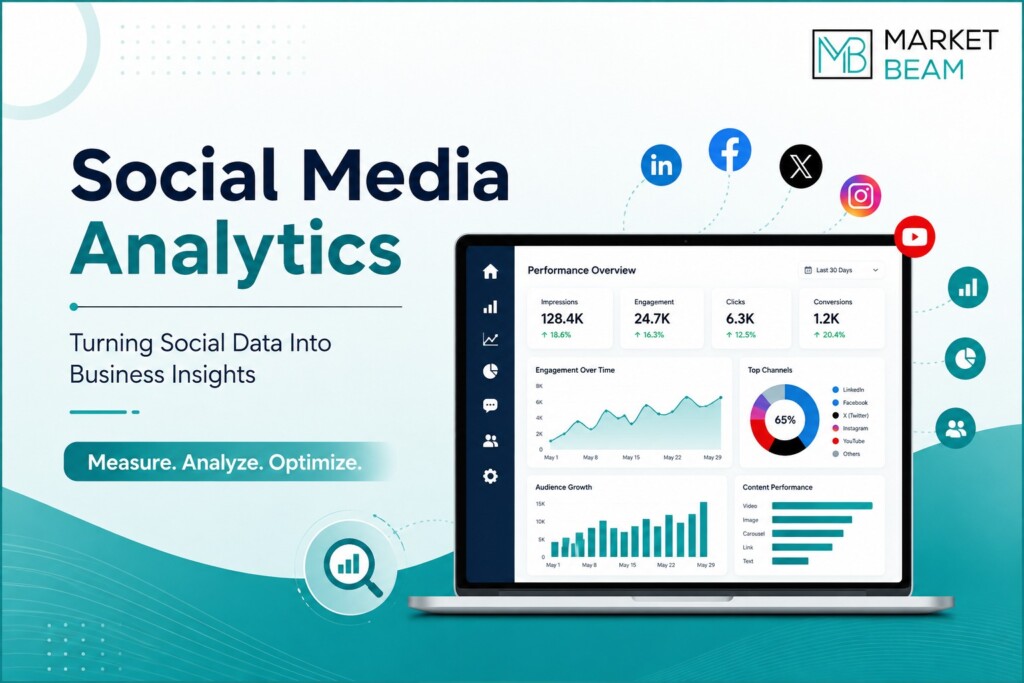
A performance dashboard provides a centralized view of the metrics that matter most to a business.
Instead of reviewing spreadsheets or separate platform reports, teams can use dashboards to monitor trends, compare channels, and identify significant changes.
An effective performance dashboard should make information understandable at a glance. It should highlight important trends, provide filters for brands and campaigns, and make it easy to compare current performance with previous periods.
Different stakeholders may also require different dashboard views. Marketing managers may need campaign-level detail, while executives may want a summary of overall performance.
The dashboard should also support decision-making rather than simply displaying numbers. For example, a sudden drop in engagement may warrant investigation into content strategy, audience changes, algorithmic shifts, or campaign timing.
When connected to broader social media analytics, a performance dashboard becomes a central decision-making tool rather than a passive reporting screen.
Comparing Organic and Paid Social Performance
Enterprises frequently manage both organic content and paid social campaigns. Comparing these activities requires a clear analytical framework.
Organic content can generate long-term engagement, awareness, and community growth, while paid campaigns are often designed around specific targeting and conversion objectives.
A complete social media analytics strategy should distinguish between organic and paid activity rather than combining them into one performance figure.
Teams can compare reach, engagement, click-through rates, conversions, audience segments, and cost-related metrics where applicable. This helps marketers determine which types of content work best organically and which campaigns justify paid investment.
Separating these results also prevents misleading conclusions. A large paid campaign may generate significant reach, but a smaller organic campaign may produce a stronger engagement rate or more loyal audience interaction.
Social Media Analytics for Regulated Industries
Regulated organizations have additional considerations when designing social media analytics programs.
Healthcare, pharmaceutical, financial services, and other regulated organizations must balance performance measurement with governance, documentation, and compliance requirements. Analytics should therefore be connected to the processes used to approve, publish, monitor, and retain social content.
MarketBeam’s current platform is explicitly positioned for regulated industries and highlights compliance automation, review workflows, publishing, engagement, and analytics as interconnected capabilities. (MarketBeam)
For regulated teams, this integrated approach can be valuable because performance data does not exist in isolation. Organizations may need to understand not just which content performed, but whether it followed the applicable approval process, which market or business unit published it, and what governance requirements applied.
MarketBeam also describes audit-ready publishing and monitoring reports within its life sciences offering, including reporting designed for FDA audit preparedness. (MarketBeam)
Connecting Analytics With Compliance
Traditional analytics focuses on performance. Enterprise analytics in regulated organizations must often answer an additional question: was the content managed according to required controls?
This is where governance-aware social media analytics can provide greater value.
For example, a compliance team may want to compare the performance of approved content categories, review how long approval processes take, or analyze whether specific content types generate higher engagement without increasing review risk.
MarketBeam’s current product messaging emphasizes AI compliance prechecks, human review workflows, audit trails, publishing controls, and analytics within one system. (MarketBeam)
Connecting these processes can help organizations build stronger reporting without forcing marketing and compliance teams to work from completely separate systems.
Building an Effective Social Media Analytics Workflow
A successful analytics program starts before reporting begins.
First, organizations should define business objectives. Next, they should select the channels and campaigns relevant to those objectives. Then teams should establish the KPIs that will determine success.
After data is collected, analysts should review performance by channel, audience, campaign, content type, and time period. The goal is to identify patterns rather than isolated successes.
Insights should then be distributed to the teams responsible for acting on them. Marketing may adjust content strategy, communications may refine messaging, and leadership may shift investment priorities.
Finally, organizations should measure whether those changes improve future performance.
This continuous cycle makes social media analytics an optimization process rather than a monthly reporting exercise.
Common Social Media Analytics Challenges
Organizations often encounter several challenges when building an enterprise analytics program.
The first is fragmented data. Each platform provides its own definitions, reporting structures, and metrics. Bringing these datasets together requires careful normalization.
The second challenge is metric overload. Teams can become focused on dashboards containing dozens of numbers without identifying which ones actually influence business decisions.
Another challenge is attribution. Social activity can contribute to customer journeys without being the final conversion point, making it difficult to assign business value to individual interactions.
For regulated organizations, governance adds another layer of complexity. Teams may need analytics that connects performance with approval status, content type, market, or compliance context.
Finally, reporting can become too manual. Analysts may spend significant time exporting platform data and building spreadsheets instead of interpreting insights.
A centralized platform can reduce these challenges by consolidating data, automating reporting, and providing consistent analytical views.
Choosing the Right Social Media Analytics Platform
Selecting a platform requires evaluating more than the number of available charts.
Organizations should assess data coverage first. The platform should support the social channels that matter to the business and provide sufficient historical data for meaningful comparisons.
Next, evaluate dashboard flexibility and social reporting capabilities. Different teams should be able to see the metrics relevant to their responsibilities without losing centralized governance.
Integration is another key consideration. Analytics should work with existing marketing, CRM, customer service, advertising, and business intelligence systems wherever appropriate.
Enterprise organizations should also examine access controls, data security, audit trails, and compliance capabilities. This is particularly important in regulated environments.
Finally, consider how easily the platform turns analytics into action. Reporting is most valuable when insights can feed directly into content planning, campaign optimization, engagement workflows, and decision-making.
How MarketBeam Supports Enterprise Social Media Analytics
MarketBeam’s current platform brings analytics and reporting together with publishing, engagement, social listening, employee advocacy, compliance, and workflow automation. The company describes its analytics capability as providing performance tracking and compliance reporting with audit-ready visibility. (MarketBeam)
This integrated model can help enterprise teams avoid operating analytics as a disconnected function.
Marketing teams can use performance insights to evaluate content and campaign effectiveness. Communications teams can monitor engagement and brand activity, while compliance teams can maintain visibility into governed social operations.
MarketBeam’s broader platform is designed around a centralized social media lifecycle, covering content creation, AI compliance prechecks, human review, publishing, engagement, and analytics. (MarketBeam)
For life sciences organizations, MarketBeam also promotes Veeva PromoMats integration and compliance-focused publishing and monitoring capabilities. (MarketBeam)
This makes the platform particularly relevant for organizations that need analytics alongside governance and compliance rather than a standalone reporting tool.
Best Practices for Better Analytics
The strongest social media analytics programs follow a few fundamental principles.
Start with business objectives rather than available metrics. Select a focused group of KPIs that clearly relate to those objectives. Standardize reporting definitions so different departments are not interpreting the same metric differently.
Use dashboards to monitor performance continuously, but reserve deeper analysis for questions that require investigation.
Review performance across time rather than judging individual posts in isolation. Compare campaigns, channels, audiences, and content formats to identify repeatable patterns.
Most importantly, connect insights to action. An analytics report that produces no changes in strategy has limited value. Teams should use findings to refine content, adjust campaigns, improve audience engagement, and allocate resources more effectively.
The Future of Social Media Analytics
The future of social media analytics will increasingly be shaped by artificial intelligence, predictive models, and deeper integration with enterprise systems.
AI can already help classify content and conversations, identify trends, and surface unusual patterns. As these capabilities mature, analytics platforms will increasingly move from describing what happened toward recommending what teams should do next.
Predictive analytics may help organizations identify the content formats most likely to resonate with specific audiences or detect emerging performance changes before they become obvious in traditional reports.
Another major development is the integration of analytics with social listening. Instead of measuring only engagement, organizations can combine performance metrics with audience sentiment, conversation trends, competitor activity, and brand perception.
For regulated industries, the next stage will likely involve deeper connections between performance analytics and governance data, creating reporting that shows both business outcomes and compliance context.
Social Media Analytics Framework for Enterprise Teams
| Analytics Area | Key Question | Example Action |
| Awareness | Are more people seeing our content? | Improve distribution |
| Engagement | Are audiences interacting meaningfully? | Refine content formats |
| Campaign Measurement | Did the campaign achieve its objective? | Optimize future campaigns |
| Social KPIs | Are we meeting defined targets? | Adjust strategy |
| Social Reporting | Can stakeholders understand performance? | Improve dashboards |
| Compliance Analytics | Was activity managed according to controls? | Strengthen workflows |
| Trend Analysis | What is changing over time? | Reallocate resources |
| Business Impact | Is social contributing to wider goals? | Align investment |
Conclusion
Social media analytics has become a core capability for enterprises that want to understand performance, improve customer engagement, and make better marketing decisions. The value extends far beyond likes and follower counts. Effective analysis connects content performance, campaign measurement, audience behavior, social KPIs, reporting, and business outcomes.
A mature approach combines engagement analytics with broader social reporting, campaign measurement, performance dashboards, and listening insights. For regulated organizations, analytics should also work alongside governance, compliance, publishing controls, and audit requirements.
MarketBeam’s current platform is designed around this broader model. It combines analytics and reporting with publishing, engagement, listening, governance, compliance workflows, and enterprise social media management. (MarketBeam)
By turning social data into actionable intelligence, organizations can identify what works, understand what needs improvement, and continuously optimize their digital strategy.
Connect With Us
Ready to improve your enterprise social media analytics strategy?
Sales: sales@marketbeam.io
Tech Support: support@marketbeam.io
Connect with MarketBeam to explore enterprise social media analytics, reporting, governance, compliance, and workflow capabilities.
Frequently Asked Questions
1. What is social media analytics?
Social media analytics is the process of collecting and analyzing data from social platforms to understand content performance, audience behavior, campaign results, and broader business outcomes.
2. What are the most important social media analytics metrics?
The most useful metrics depend on business objectives, but common measures include reach, impressions, engagement rate, clicks, conversions, audience growth, video performance, and response metrics.
3. Why are social KPIs important?
Social KPIs provide measurable targets for evaluating social media performance. They help organizations focus on metrics that directly support business objectives instead of tracking numbers that have little strategic value.
4. How does social reporting differ from social media analytics?
Social reporting presents social data in dashboards and reports for stakeholders, while social media analytics involves the deeper process of collecting, comparing, interpreting, and using that data to make decisions.
5. Why is a performance dashboard useful?
A performance dashboard centralizes important metrics and trends, making it easier for marketing managers, executives, and other stakeholders to understand performance and identify areas that require action.
6. How does MarketBeam support social media analytics?
MarketBeam combines analytics and reporting with publishing, engagement, listening, compliance, governance, and workflow automation. Its platform provides performance tracking and compliance-focused visibility for enterprise and regulated social media teams. (MarketBeam)