A social media approval workflow gives teams a structured way to create, review, approve, and publish social content before it reaches the public. For organizations operating in regulated industries, this process is more than a productivity tool. It creates accountability, reduces compliance risks, and helps ensure that every post follows internal policies and applicable requirements.
As social media becomes an important channel for customer engagement, brand communication, employee advocacy, and campaigns, organizations need a reliable process for controlling what gets published. A well-designed social media approval workflow connects content creators, marketing teams, reviewers, compliance professionals, and publishers through one repeatable process.
What Is a Social Media Approval Workflow?
A social media approval workflow is a defined sequence that content follows from creation to publication. Instead of allowing posts to move directly from a marketer to a social platform, the workflow assigns specific review and approval steps based on content type, risk level, and organizational requirements.
A typical social media approval workflow begins when a social media manager or content creator drafts a post. The content is then reviewed by the appropriate stakeholders, updated when necessary, approved, scheduled, and published. In regulated environments, the process can also maintain an audit trail showing who reviewed content, what changes were made, and when approval was granted.
The objective is not to create unnecessary approval layers. The objective is to make review predictable, transparent, and efficient while protecting the organization from preventable publishing mistakes.
Why Social Media Approval Matters
Without a structured approval process, social teams can face inconsistent messaging, unclear ownership, missed disclosures, outdated claims, and accidental publication of unapproved content. These risks can become more significant for organizations in life sciences, financial services, and other regulated industries.
A social media approval workflow establishes clear responsibilities. Content creators know who needs to review their work, reviewers understand what they are responsible for, and publishers know when content is ready to go live. This can reduce unnecessary back-and-forth communication and make social publishing easier to manage.
Documentation is equally important for regulated teams. A strong workflow can provide evidence of approvals and help organizations demonstrate that established policies were followed. MarketBeam positions its platform around social media compliance and automated review workflows, including policy enforcement and audit trails. Its website also highlights automated workflows designed to reduce review cycles and support compliant publishing.
Key Stages of a Social Media Approval Workflow
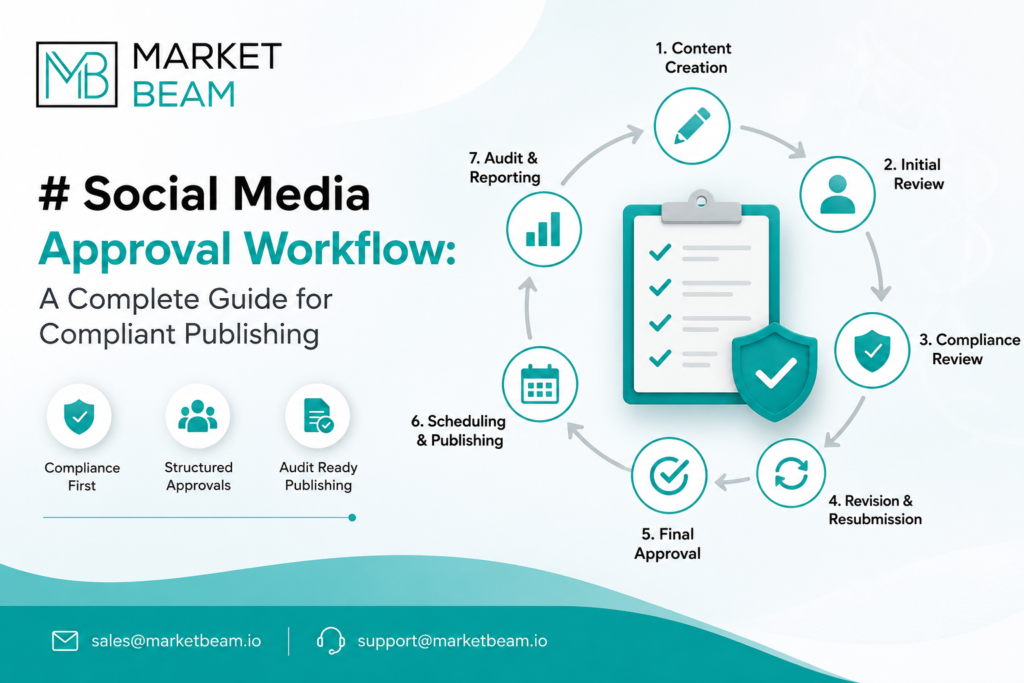
1. Content Creation
The process starts with a draft. The creator develops the copy, visuals, links, disclosures, and other required elements. At this stage, teams should work from approved brand guidelines and content standards.
2. Initial Review
A first reviewer checks the content for accuracy, brand consistency, tone, formatting, and completeness. This step can identify basic issues before content reaches legal or compliance reviewers.
3. Compliance Review
Higher-risk content may require specialized review. Reviewers can evaluate claims, disclosures, product statements, financial information, medical language, or other regulated elements depending on the organization.
4. Revision and Resubmission
If changes are required, the content returns to the creator with clear feedback. An effective social media approval workflow should make it easy to identify requested changes and understand who requested them.
5. Final Approval
Once the required reviewers are satisfied, the designated approver gives final approval. The approval should be recorded to establish accountability.
6. Scheduling and Publishing
Approved content can then be scheduled or published. Connecting approval with publishing reduces the possibility of content being published before required checks are complete.
7. Audit and Reporting
The final stage is maintaining a record of the process. Teams may need visibility into approval status, reviewer actions, revisions, timestamps, and published content.
Social Media Approval Workflow vs. Manual Approval
Many organizations still manage approvals through email, spreadsheets, chat messages, or shared documents. These methods may work for small teams, but they become increasingly difficult to control as content volume and stakeholder numbers grow.
| Manual Approval | Structured Social Media Approval Workflow |
|---|---|
| Approvals spread across email and chat | Approvals organized in one process |
| Difficult to track the latest version | Clear content and revision history |
| Ownership can be unclear | Defined reviewer roles |
| Limited visibility into status | Centralized approval status |
| Audit evidence may be incomplete | Audit trail can be maintained |
| Higher chance of publishing errors | Publishing follows approved steps |
A structured approach helps teams replace scattered communication with a repeatable process. It also makes it easier for managers to identify bottlenecks and improve turnaround times.
Essential Features to Look For
When selecting or designing a social media approval workflow, organizations should focus on capabilities that support both control and efficiency.
Role-based approvals allow organizations to assign different responsibilities to marketers, managers, legal teams, compliance reviewers, and other stakeholders. Not every post requires the same level of review, so flexible reviewer roles can prevent unnecessary delays.
Version control is another important capability. When several people edit a post, teams need confidence that the approved version is the version that will eventually be published.
Audit trails provide visibility into who approved content and when. This can be particularly important for regulated organizations that need documentation of their review process.
Workflow automation can further reduce administrative work. Automated routing can send content to the correct reviewer, trigger notifications, identify pending approvals, and move approved content toward publishing.
Integration with social publishing tools is also valuable. When review and publishing are disconnected, users may have to manually transfer approved content between systems, creating another opportunity for errors.
| Workflow Requirement | Why It Matters |
|---|---|
| Reviewer roles | Clarifies responsibility |
| Approval routing | Sends content to the right stakeholders |
| Version history | Prevents confusion over edits |
| Audit trail | Documents review and approval |
| Automated notifications | Reduces approval delays |
| Publishing controls | Helps prevent unauthorized posts |
| Reporting | Shows workflow performance |
Common Social Media Approval Workflow Risks
Even a formal workflow can create problems if it is poorly designed. One common issue is excessive approval layers. When every post requires multiple reviewers regardless of risk, teams can create unnecessary bottlenecks.
Another risk is unclear ownership. If users do not know who has final approval authority, content can remain stuck in review. Organizations should define approval responsibilities before implementing the process.
Teams should also avoid treating compliance review as a final checkbox. Risk identification should happen as early as possible. MarketBeam’s platform includes AI precheck capabilities that scan content for potential issues such as high-risk language, policy violations, unapproved claims, outdated information, and missing disclosures before human review.
How to Build an Effective Social Media Approval Workflow
Start by mapping the content lifecycle from draft to publication. Identify every person involved, the decisions they make, and the conditions that require additional review.
Next, categorize content by risk. A routine brand post may need a simple manager approval, while a regulated product claim may require compliance or legal review. Risk-based routing helps teams maintain control without slowing down low-risk content.
Define clear expectations for reviewers. If approvals regularly sit in queues for days, even a strong social media approval workflow can become a bottleneck. Automated reminders and escalation rules can help keep work moving.
Finally, measure the process. Track approval time, revision rates, rejection reasons, publishing delays, and workflow bottlenecks. These metrics can reveal where teams need better training, clearer policies, or more automation.
How MarketBeam Supports Social Media Approval
MarketBeam is positioned as a social media compliance platform for organizations that need to manage social media at scale. Its platform includes review and compliance automation, social media publishing, employee advocacy, engagement and community capabilities, analytics, and reporting.
Its approach combines automation with human review rather than treating AI as a replacement for compliance professionals. MarketBeam describes a process where teams create content, AI performs a compliance precheck, human reviewers focus on compliance risks, and approved content can be published.
This approach can help regulated teams make their social media approval workflow more consistent while reducing repetitive review work. MarketBeam specifically serves industries such as life sciences and financial services, where governance and compliance requirements can make social publishing more complex.
Benefits of a Well-Designed Workflow
A strong social media approval workflow can deliver benefits beyond compliance. Faster reviews can help marketing teams respond to opportunities while maintaining governance. Clear responsibilities can reduce confusion between departments. Centralized records can make audits and reporting easier.
The workflow can also improve collaboration. Instead of asking whether a post has been approved, team members can see its status and understand the next action. Over time, this creates a more predictable publishing operation.
For enterprise teams, scalability is another major advantage. As the number of channels, campaigns, contributors, and reviewers increases, informal approval methods become harder to manage. A structured process provides a foundation that can grow with the organization.
Frequently Asked Questions
What is a social media approval workflow?
A social media approval workflow is a structured process that moves social content through creation, review, approval, scheduling, publishing, and recordkeeping. It defines who reviews content and when each approval is required.
Why do regulated industries need social media approval?
Regulated organizations may need to verify claims, disclosures, messaging, and other content requirements before publication. A formal approval process helps reduce publishing risk and provides greater accountability.
How can workflow automation improve approvals?
Automation can route content to the right reviewers, send reminders, track status, and reduce manual administrative tasks. This allows teams to spend more time on meaningful review instead of managing approval logistics.
What should an approval workflow include?
A strong workflow should include defined reviewer roles, approval routing, version control, audit trails, notifications, publishing controls, and reporting. The exact process should reflect the organization’s risk and compliance requirements.
Can AI replace human approval?
AI can assist with early issue detection, but human review remains important for context, judgment, and regulatory interpretation. MarketBeam uses AI to precheck content before human review rather than positioning AI as a replacement for reviewers.
How can teams reduce approval delays?
Teams can reduce delays by using risk-based routing, clear reviewer responsibilities, automated reminders, standardized content requirements, and centralized approval tracking. Regularly reviewing workflow metrics can also identify recurring bottlenecks.
Conclusion
A social media approval workflow is essential for organizations that want to balance speed, engagement, governance, and compliance. By defining roles, automating repetitive steps, maintaining approval records, and connecting review with publishing, teams can create a more reliable social media operation.
The most effective workflow is not necessarily the one with the most approval stages. It is the one that applies the right level of control to the right content while keeping teams productive. With a compliance-focused platform such as MarketBeam, organizations can bring content review, approval, publishing, and monitoring into a more connected process.
Connect with Us
Ready to create a more efficient and compliant social media approval workflow? Connect with MarketBeam to explore how a structured, compliance-focused approach can support your organization’s social media operations.
Sales: sales@marketbeam.io
Tech Support: support@marketbeam.io