Marketing leaders need more than a collection of social media numbers. They need clear evidence that social activity is contributing to business objectives, audience growth, campaign performance, and long-term brand value. This is why selecting the right social media KPI is essential for enterprise marketing teams.
With multiple brands, channels, campaigns, and regional teams operating simultaneously, social performance can quickly become difficult to interpret. A useful measurement system connects social activity with specific objectives and provides leadership with a consistent way to evaluate results.
A strong social media KPI framework helps marketing leaders understand what is working, where performance is changing, and which activities deserve additional investment. It also creates a common measurement language across marketing, communications, analytics, and executive teams.
For regulated organizations, KPI measurement must also work alongside governance, compliance, and approval processes. MarketBeam supports enterprise social media operations by connecting publishing, analytics, engagement, listening, governance, and reporting within a centralized environment.
What Is a Social Media KPI?
A social media KPI is a measurable indicator used to determine whether social media activity is achieving a specific business or marketing objective.
Not every social metric should be treated as a KPI. Metrics such as likes, comments, impressions, and followers can provide useful information, but a KPI should have a clear relationship with an organizational goal.
For example, a company focused on awareness may use reach as a primary KPI, while a lead-generation campaign may prioritize qualified conversions. A customer engagement program may focus on response rates, engagement rate, or community growth.
The best social media KPI therefore depends on what the organization is trying to achieve. A single KPI framework may include different measurements for different campaigns while maintaining consistent definitions across the enterprise.
Why Social Media KPIs Matter for Marketing Leaders
Marketing leaders are responsible for allocating budgets, evaluating performance, and demonstrating the value of marketing investments. A well-defined social media KPI system helps them make these decisions using measurable evidence rather than assumptions.
Leadership reporting should make it easy to answer questions such as whether social campaigns are reaching the intended audience, whether content is generating meaningful engagement, and whether social activity is contributing to business outcomes.
A strong KPI approach also helps identify underperforming campaigns. If reach is increasing but engagement remains low, the organization may need to reconsider its content strategy. If engagement is strong but conversions remain weak, the issue may exist further along the customer journey.
For enterprise teams, social media KPI reporting also improves accountability. Different departments can work toward shared objectives while using consistent definitions and measurement standards.
Aligning KPIs With Social Media Objectives
The first step in building a useful KPI system is defining clear social media objectives.
Common social media objectives include increasing brand awareness, strengthening engagement, generating leads, driving website traffic, improving customer relationships, supporting product launches, and building communities.
Each objective should have specific measurements attached to it. Awareness objectives may focus on reach and impressions. Engagement objectives can emphasize engagement rate, comments, shares, and saves. Traffic campaigns may focus on clicks and click-through rate, while conversion campaigns should prioritize leads, registrations, or other desired actions.
This alignment prevents teams from focusing on numbers that look impressive but have little relationship to business performance.
Marketing leaders should review objectives regularly because the right social media KPI can change as a campaign moves from awareness to consideration and conversion.
Building a KPI Framework
A structured KPI framework gives organizations a consistent approach to selecting, measuring, and reporting social performance.
The framework should define the business objective, primary KPI, supporting metrics, reporting frequency, data source, owner, and target or benchmark.
For example, an awareness campaign might define reach as its primary KPI, impressions as a supporting metric, and a monthly growth target as its benchmark. A lead-generation campaign could define conversions as its primary KPI while tracking clicks and conversion rate as supporting measurements.
A clear KPI framework also prevents metric overload. Marketing teams should focus on the measurements that support decisions rather than filling dashboards with every available platform statistic.
For enterprise organizations, standardized KPI definitions are especially important because different teams may otherwise interpret the same metric differently.
Understanding Benchmark Metrics
KPIs become more useful when they are compared against meaningful benchmarks. Benchmark metrics provide a reference point that helps marketing leaders determine whether performance is improving, declining, or remaining stable.
Benchmarks can come from historical campaign performance, industry comparisons, platform averages, or internal targets. However, organizations should avoid comparing unrelated campaigns simply because they use the same KPI.
For example, a high-budget awareness campaign targeting a broad audience should not necessarily be compared directly with a niche B2B campaign targeting a specialized audience.
Instead, benchmark metrics should be evaluated within the appropriate context, taking audience, platform, campaign type, industry, and objective into account.
Essential Social Media KPIs for Marketing Leaders
| KPI | What It Measures | Best Used For |
| Reach | Unique audience exposure | Brand awareness |
| Impressions | Total content displays | Visibility |
| Engagement Rate | Audience interaction | Content performance |
| Click-Through Rate | Percentage clicking a link | Traffic generation |
| Conversions | Desired business actions | Lead generation and sales |
| Follower Growth | Audience expansion | Community building |
| Response Rate | Customer interaction effectiveness | Social care |
| Video Completion Rate | Content consumption | Video campaigns |
Common KPI Measurement Challenges
Enterprise organizations often struggle with fragmented data. Different social platforms may use different definitions and reporting methods, making cross-channel comparisons difficult.
Another challenge is focusing too heavily on vanity metrics. A large follower count or high impression volume does not necessarily mean that a campaign is producing meaningful business value.
Attribution can also be difficult. A customer may discover a brand through social media, interact with several campaigns, and eventually convert through another channel. Marketing leaders therefore need to interpret a social media KPI within the broader customer journey rather than treating every conversion as the direct result of one post.
For regulated organizations, reporting can become more complex because performance data may need to be viewed alongside approval status, content type, market, or governance requirements.
A consistent measurement process, centralized reporting, and clearly defined ownership can make these challenges easier to manage.
Campaign Goals and KPI Selection
A strong social media KPI framework begins with clearly defined campaign goals. Marketing teams should decide what each campaign is designed to achieve before selecting the metrics used to evaluate it.
For awareness campaigns, reach, impressions, and audience growth may be the most relevant indicators. Engagement-focused campaigns can prioritize engagement rate, comments, shares, and saves. Traffic campaigns may emphasize clicks and click-through rate, while lead-generation initiatives should focus on qualified conversions.
The key is to avoid using the same KPI for every campaign. A metric that indicates success for one objective may provide little value for another.
Marketing leaders should also define primary and secondary KPIs. The primary KPI measures the main campaign objective, while supporting metrics help explain why performance is changing.
This approach makes the social media KPI framework more focused and easier to communicate across marketing teams.
Creating Executive Reporting
Marketing leaders need reporting that connects social activity with business priorities rather than dashboards filled with disconnected metrics. Effective executive reporting should highlight the most important trends, explain performance changes, and show whether campaigns are contributing to defined objectives.
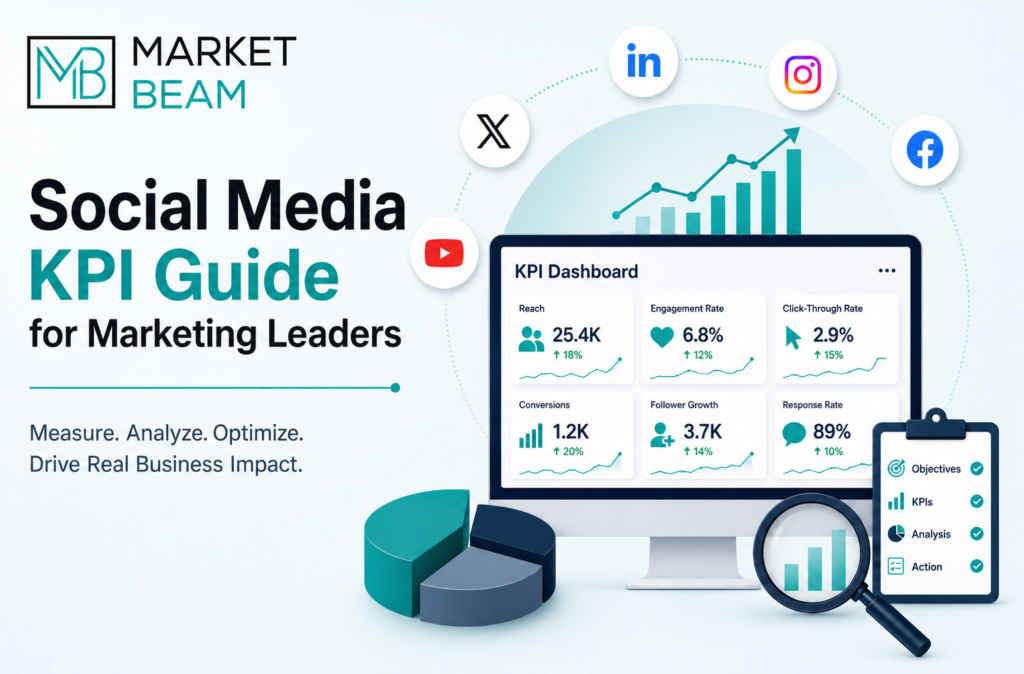
An executive report might summarize total reach, engagement, campaign conversions, audience growth, and performance against benchmarks. It should also provide context around major changes, such as a successful product launch or an underperforming campaign.
Visual executive reporting is particularly valuable for enterprises because leadership may not need detailed post-level information. Instead, they need a clear view of performance, risks, opportunities, and recommended actions.
A centralized reporting platform can help maintain consistency across regions and business units while giving executives access to the same validated data.
KPI Framework for Regulated Industries
Regulated organizations need to balance marketing measurement with governance and compliance. A social media KPI framework should therefore consider both performance and operational context.
Marketing leaders may want to compare campaign results by region, business unit, platform, or content type while maintaining visibility into approval and governance processes.
For example, teams can evaluate whether approved campaign content generated stronger engagement than previous initiatives. They can also analyze performance alongside publishing activity, audience responses, and compliance workflows.
This approach does not replace formal compliance processes. Instead, it helps organizations understand marketing performance while maintaining appropriate governance and documentation.
MarketBeam positions analytics alongside publishing, engagement, listening, compliance, and governance capabilities, making it relevant for organizations that need performance measurement within a broader enterprise social media workflow.
Using KPIs to Improve Decision-Making
The purpose of a social media KPI is not simply to report what happened. It is to help teams decide what to do next.
When engagement consistently performs above benchmark, marketers can identify the content themes or formats responsible and consider expanding them. When conversions fall despite strong traffic, teams can investigate the landing page, audience targeting, messaging, or customer journey.
Marketing leaders should review KPIs regularly and connect findings to concrete actions. This creates a continuous process of measurement, learning, optimization, and reassessment.
Teams should also document why KPI targets change. Business priorities evolve, campaigns mature, and market conditions shift. A flexible KPI framework ensures reporting remains aligned with current objectives.
KPI Framework by Marketing Objective
| Marketing Objective | Primary KPI | Supporting Metrics |
| Brand Awareness | Reach | Impressions, follower growth |
| Engagement | Engagement Rate | Comments, shares, saves |
| Website Traffic | Click-Through Rate | Clicks, landing-page visits |
| Lead Generation | Conversions | Clicks, conversion rate |
| Community Growth | Follower Growth | Engagement rate, mentions |
| Customer Engagement | Response Rate | Response time, conversations |
| Campaign Optimization | Campaign KPI | Benchmark metrics, trend changes |
How MarketBeam Supports Social Media KPI Tracking
MarketBeam combines social media management with analytics, reporting, listening, engagement, governance, and compliance capabilities. This broader approach can help enterprise teams manage a social media KPI framework without separating performance analysis from other social media operations.
Marketing teams can use centralized reporting to compare campaign performance across channels and identify trends. Leaders can use dashboards to understand progress against objectives, while other stakeholders can focus on metrics relevant to their responsibilities.
MarketBeam also supports regulated organizations by connecting social activity with broader governance and compliance workflows. This can provide additional context when evaluating campaign performance and operational activity.
By bringing reporting and social media workflows together, MarketBeam helps organizations move from simply collecting KPIs to using them as inputs for continuous improvement.
Conclusion
An effective social media KPI strategy helps marketing leaders connect social activity with measurable business objectives. The right KPI depends on the campaign goal, audience, platform, and desired outcome.
By defining clear social media objectives, establishing a structured KPI framework, using relevant benchmark metrics, and building effective executive reporting, enterprises can make better decisions from their social data.
For regulated organizations, KPI measurement should also work alongside governance and compliance processes. This provides a more complete picture of both marketing performance and operational control.
MarketBeam supports this connected approach through enterprise social media management, analytics, reporting, governance, listening, and workflow capabilities.
Connect With Us
Ready to strengthen your enterprise social media measurement strategy?
Sales: sales@marketbeam.io
Tech Support: support@marketbeam.io
Connect with MarketBeam to explore how centralized analytics, governance, and social media management can help your team measure what matters and act on it.
Frequently Asked Questions
1. What is a social media KPI?
A social media KPI is a measurable indicator used to evaluate whether social media activity is achieving a specific marketing or business objective.
2. How should marketing leaders choose social media KPIs?
Marketing leaders should select KPIs based on defined social media objectives. Awareness, engagement, traffic, and conversion campaigns require different primary and supporting measurements.
3. What is a KPI framework?
A KPI framework is a structured system that defines objectives, primary KPIs, supporting metrics, targets, reporting frequency, and ownership for measuring performance.
4. Why are benchmark metrics important?
Benchmark metrics provide context for performance by comparing current results with historical campaigns, industry references, or internal targets.
5. What should executive reporting include?
Effective executive reporting should focus on the most important KPIs, performance against targets, major trends, risks, opportunities, and recommended actions.
6. How does MarketBeam support social media KPI measurement?
MarketBeam combines analytics, reporting, publishing, engagement, listening, governance, and compliance capabilities to help enterprise teams track social media KPI performance within a centralized social media management environment.