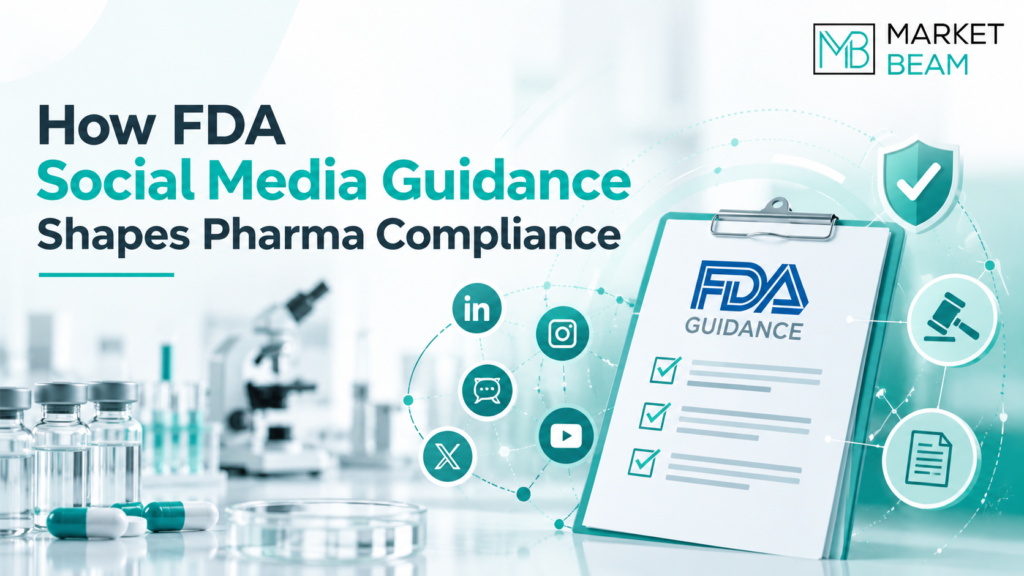
FDA Social Media Guidance for Pharma Compliance
Pharmaceutical companies now use social media to educate healthcare professionals, share disease information, support patient communities, promote products, and communicate with the public. However, pharma social media is different from ordinary brand marketing. Every promotional message needs careful attention to claims, risk information, audience, review, and recordkeeping.
That is why FDA social media guidance matters to pharmaceutical marketing teams. The FDA has published several guidance documents and resources related to Internet and social media promotion of prescription drugs and medical devices. These materials cover topics such as character-limited communications, misinformation, interactive promotional media, off-label requests, and communications that are consistent with FDA-required labeling. Some social media documents remain draft and nonbinding, while other related guidance is final.
For pharma companies, the practical goal is not simply to read FDA documents. Teams need to turn regulatory expectations into a repeatable workflow. Marketing, medical, legal, regulatory, pharmacovigilance, and social media teams should be able to work from the same process.
A modern social media system can help connect content creation, MLR review, publishing, monitoring, and audit records. As a result, companies can scale digital communication while keeping the right controls in place.
What Is FDA Social Media Guidance?
FDA social media guidance refers to FDA guidance and related resources that explain how firms should approach communications about FDA-regulated medical products through Internet and social media channels.
There is not one single document that covers every pharma social media activity. Instead, FDA maintains a group of resources addressing different communication situations. The FDA’s industry social media page explains that the agency has developed guidance around the promotion of regulated medical products through Internet and social media tools.
Some guidance is final. For example, FDA’s 2018 final guidance on medical product communications that are consistent with FDA-required labeling explains how firms can communicate certain information about approved or cleared uses while staying within the scope of that labeling.
Other documents remain draft. For example, FDA’s character-space-limited social media guidance is labeled draft and says it contains nonbinding recommendations.
This difference matters. Teams should identify whether a source is final or draft before using it as a basis for a campaign policy.
Why FDA Social Media Guidance Matters to Pharma
Social media allows companies to publish quickly. At the same time, pharma content often needs careful review before it goes live.
A short social post can include a product claim, risk information, link, image, video, or customer response. Each element can affect the overall communication.
The FDA’s social media resources reflect this complexity. Its materials address different digital formats and communication situations rather than treating all social posts in the same way.
Therefore, FDA social media guidance should be built into the marketing workflow early.
When teams include regulatory checks during content creation, they can spot issues before publication. Moreover, clear review rules can reduce repeated work between marketing and regulatory teams.
Key Areas Covered by FDA Social Media Guidance
Character-Limited Social Media Communications
One of the best-known areas of FDA social media guidance concerns platforms with limited character space.
FDA’s 2014 draft guidance addresses communications on platforms where firms have limited space to present information. It explains FDA’s thinking on presenting benefit and risk information in the same communication when a firm chooses to present a product benefit claim, along with a mechanism for accessing more complete risk information. The document remains draft and nonbinding.
For marketing teams, the key lesson is simple: limited space does not automatically remove the need to consider the balance of benefit and risk information.
Teams should therefore avoid treating a short caption as a reduced-compliance version of a longer advertisement.
Misinformation
Social channels can also expose pharma brands to inaccurate or misleading claims posted by other users.
In 2024, FDA issued a revised draft guidance titled “Addressing Misinformation About Medical Devices and Prescription Drugs: Questions and Answers.” The document explains FDA’s current thinking on when firms may voluntarily address misinformation related to their approved or cleared medical products. FDA clearly states that the guidance is draft and not currently in effect.
This area is important because a public correction can create its own communication and review needs.
A strong process should define who can respond, what information employees may use, and when medical or regulatory teams need to review the response.
Interactive Promotional Media
Social media is interactive by design. People can comment, ask questions, reply to posts, and share content.
FDA maintains draft guidance concerning postmarketing submissions for interactive promotional media for prescription human and animal drugs and biologics.
This means pharma companies should think about the communication after publication as well as the original post.
A pre-approved response guide can help social teams handle common questions without creating new claims on the spot.
Unsolicited Off-Label Requests
Another important area of FDA social media guidance is how firms respond to unsolicited requests for off-label information.
FDA’s current resource identifies the guidance as draft and nonbinding. It covers unsolicited requests received through public forums and emerging electronic media.
For pharma marketers, this means social teams need clear escalation rules. A public comment asking about an unapproved use should not be handled like a normal marketing question.
The safest workflow is to route sensitive requests to the appropriate medical, legal, regulatory, or other designated team.
FDA-Required Labeling and Social Communications
FDA’s final 2018 guidance on medical product communications consistent with FDA-required labeling is another important reference.
The guidance explains FDA’s approach to communications about approved or cleared uses that contain information not found in the FDA-required labeling but that may still be consistent with that labeling. FDA also makes clear that communications must remain truthful and non-misleading.
For pharma teams, this creates an important review question:
Does the content accurately represent the product and remain consistent with the information the FDA requires for that product?
A social post should not be reviewed only for grammar and brand voice. Reviewers should also examine the meaning created by the complete communication.
What Does FDA Social Media Guidance Mean for MLR Review?
MLR review is one of the most important operational controls for pharma social media.
The FDA social media guidance framework becomes easier to manage when marketing, medical, legal, and regulatory teams follow a defined workflow.
A practical process can look like this:
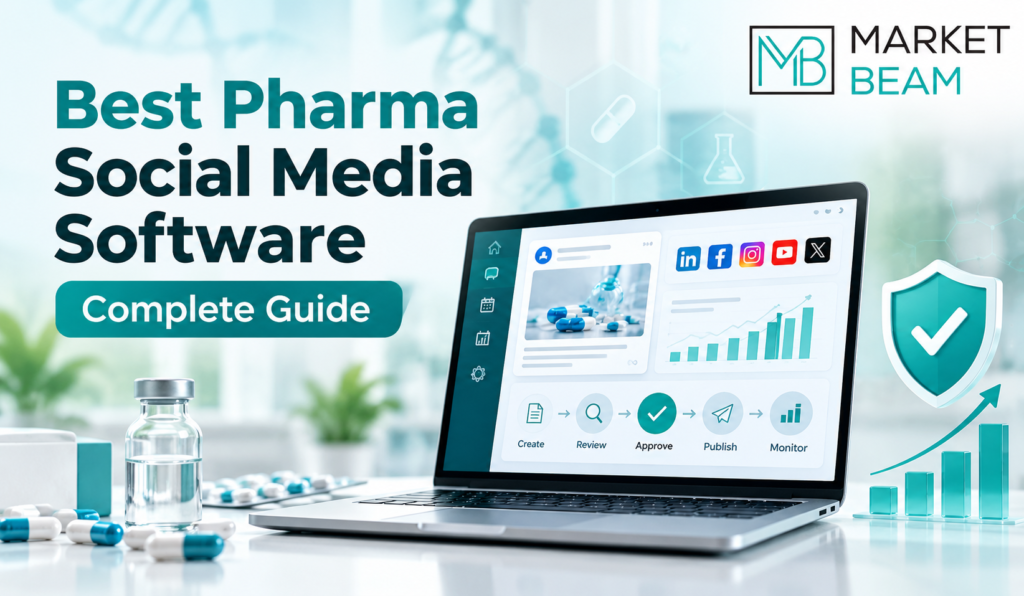
Create → Review → Revise → Approve → Publish → Monitor → Archive
Marketing creates the first draft. Medical teams can check scientific accuracy. Legal reviewers can assess legal concerns. Regulatory teams can evaluate promotional requirements. Once all required reviews are complete, the approved version moves to publishing.
The main goal is version control.
Without a connected system, teams can easily lose track of which social post received final approval. Email attachments, spreadsheets, and shared folders can create multiple versions of the same asset.
Building a Pharma Social Media Compliance Workflow
A strong workflow should connect every stage of the content lifecycle.
| Stage | Main Activity | Key Control |
|---|---|---|
| Planning | Define campaign and audience | Approved strategy |
| Creation | Draft post and assets | Approved sources |
| Medical review | Check scientific claims | Medical approval |
| Legal review | Review legal risk | Legal approval |
| Regulatory review | Check promotional requirements | Regulatory approval |
| Publishing | Release approved content | Publishing gate |
| Monitoring | Track comments and interactions | Escalation process |
| Archiving | Store final records | Audit trail |
This model turns FDA social media guidance into an operational process.
The workflow also helps reduce confusion about ownership. Each team knows when it needs to act and what happens after approval.
Social Media Monitoring After Publication
Compliance does not end when a post goes live.
Comments and messages can create new risks. A user may ask a medical question. Another person may report a potential adverse event. Someone else may make a claim about the product that needs review.
Therefore, monitoring should form part of the original campaign plan.
MarketBeam’s current life sciences platform describes real-time social monitoring, response guidance, and workflows that can escalate potential adverse events to pharmacovigilance teams.
This type of monitoring can help separate ordinary engagement from activity that may require a specific response.
The important point is that technology should support, not replace, the company’s pharmacovigilance and medical procedures.
Adverse Event Detection and Pharma Social Media
Pharma social channels can receive patient comments that contain possible safety information.
That creates a direct connection between social media management and pharmacovigilance.
A strong process should answer several questions:
Who monitors comments?
What counts as a potential safety signal?
Who receives an alert?
How quickly should the issue be escalated?
Who approves the response?
How is the interaction documented?
MarketBeam states that its platform uses AI-based monitoring to identify potential adverse events in social comments and route them to pharmacovigilance teams with supporting documentation.
However, companies should configure these workflows according to their own safety procedures and regulatory responsibilities.
Employee Advocacy and FDA Social Media Guidance
Employee advocacy can help pharma companies expand the reach of approved content.
However, employees should not create or change regulated product claims without the required review.
A controlled advocacy process can give employees access to pre-approved content. This approach lets employees share company messages while limiting the risk of accidental changes.
MarketBeam’s current life sciences offering describes controlled employee advocacy with a library of pre-approved content. It also describes one-click sharing and controls intended to keep employees within approved messaging.
This is especially useful for large organizations where hundreds or thousands of employees may participate in brand advocacy.
FDA Social Media Guidance and AI
AI can speed up pharma content creation. Teams can use AI to generate drafts, suggest variations, organize content, or flag possible risks.
However, AI also creates new compliance questions.
Employees should not enter confidential or sensitive information into unapproved AI systems. Furthermore, AI-generated text may contain incorrect facts, unsupported claims, or wording that does not match approved materials.
As a result, FDA social media guidance should be considered alongside internal AI governance.
MarketBeam states that its platform offers AI-assisted content creation and compliance pre-checks before the MLR submission stage.
AI can help identify potential problems early. Still, qualified medical, legal, and regulatory reviewers should remain responsible for important decisions.
Pharmaceutical Advertising and Social Media
Pharmaceutical advertising requires careful attention to how benefits, risks, product information, and intended uses are communicated.
The FDA maintains a collection of advertising and promotion guidance documents that includes social media-related materials, risk and benefit information, product communication guidance, misinformation guidance, and other resources.
This means social media teams should not treat Facebook, Instagram, LinkedIn, or other platforms as separate from the wider promotional review process.
The channel may change, but the underlying review questions remain important.
What is the communication saying?
Who is the audience?
What product or indication does it discuss?
What evidence supports the claim?
What risk information is relevant?
Has the appropriate team approved the final version?
Content Libraries and Approved Assets
A central content library can make FDA social media guidance easier to apply.
Instead of recreating product messages for every platform, teams can work from approved claims, images, references, response language, and templates.
This also reduces the risk of using outdated materials.
For example, a social post might include an approved image from a controlled repository, while the caption uses approved language that has already gone through review.
MarketBeam states that its Veeva Vault PromoMats integration can support approved images and references within social content workflows.
A centralized source of truth can reduce manual handoffs and make version tracking easier.
Veeva PromoMats and Social Media Workflows
Veeva Vault PromoMats is widely used in life sciences for content review and approval.
MarketBeam states that it integrates with Veeva Vault PromoMats so social media content can move into MLR review and return with approval status for publishing.
For pharma teams, that integration can reduce duplicate submissions and manual tracking.
A connected workflow can look like:
Create Social Content → Submit to PromoMats → MLR Review → Approval → Publish → Monitor
This structure helps make FDA social media guidance part of a larger content control process.
Audit Trails and Recordkeeping
Regulated teams need to know what they published and how they approved it.
An audit trail can show the original draft, revisions, reviewers, approvals, publishing action, and later activity.
MarketBeam states that its life sciences platform logs publishing, monitoring, and approval activity and provides audit-oriented records for regulatory review.
Organizations should still define retention periods and record requirements with their own legal and compliance teams.
Technology can make records easier to capture and retrieve, but it does not decide which records the organization is legally required to keep.
FDA Social Media Guidance: Common Compliance Risks
Several mistakes appear repeatedly in pharma social media programs.
Unsupported Claims
A post can create risk when it includes a claim that lacks appropriate support or goes beyond approved messaging.
Incomplete Risk Information
Short formats can make teams focus on benefits while giving too little attention to risk information.
Off-Label Communication
Unsolicited off-label questions can require special handling. Teams need clear guidance on when to escalate them.
Version Control Problems
Publishing an old version can create a serious workflow issue even when a newer version has already received approval.
Uncontrolled Employee Sharing
Employees may unintentionally edit approved messaging or add new claims.
Poor Comment Monitoring
Potential safety information or sensitive customer questions can remain unnoticed without a reliable monitoring process.
Incomplete Audit Records
Disconnected tools can make it difficult to reconstruct the history of a post.
How to Evaluate Pharma Social Media Software
When selecting technology to support FDA social media guidance, focus on workflow rather than simple feature counts.
A useful buyer’s framework includes:
| Capability | What to Ask |
|---|---|
| MLR integration | Can social content move through the existing review process? |
| Approval gates | Can unapproved content stay blocked? |
| Version control | Can teams identify the approved version? |
| Monitoring | Can comments and messages be reviewed? |
| AE workflows | Can potential safety issues be escalated? |
| Employee advocacy | Can employees share only approved content? |
| Audit trail | Can teams retrieve workflow history? |
| Analytics | Can campaign results be measured? |
| Access control | Can administrators control user permissions? |
| Scalability | Can the process support global teams? |
The FDA social media guidance process becomes much easier to manage when these controls work together.
Common Mistakes When Implementing FDA Social Media Guidance
One common mistake is treating the FDA guidance as a standalone marketing document.
It works better as part of a complete governance program.
Another mistake is putting all responsibility on the regulatory team. Marketing teams also need to understand the approval process and the limits of what they can publish.
Some organizations also focus heavily on pre-approval but ignore post-publication monitoring.
Finally, teams can create unnecessary delays by using manual workflows for every small task.
A better approach is to automate repeatable steps while keeping human review for decisions that require expertise.
How MarketBeam Supports Pharma Social Media Compliance
MarketBeam positions its life sciences platform as a purpose-built social media compliance solution for pharmaceutical, biotech, and medtech companies.
Its current materials describe MLR review integration with Veeva Vault PromoMats, controlled publishing, adverse event monitoring, employee advocacy, audit trails, and social analytics.
MarketBeam also states that its Veeva integration can automatically submit social content for MLR review, attach references and approved assets, and return approval status to the social workflow.
For organizations working to operationalize FDA social media guidance, this type of connected workflow can reduce manual handoffs between marketing and compliance teams.
However, companies should evaluate any software against their own procedures, applicable rules, data requirements, and review structure.
A Practical Implementation Plan
Pharma companies can implement a social compliance program in stages.
Step 1: Map the workflow. Document how content moves today.
Step 2: Identify review points. Decide where medical, legal, regulatory, and safety teams need to participate.
Step 3: Classify content. Separate promotional, educational, corporate, advocacy, and response content.
Step 4: Create approved assets. Build a central source for approved claims, visuals, references, and response guides.
Step 5: Add publishing controls. Prevent content from going live until required approvals are complete.
Step 6: Add monitoring. Monitor comments, messages, and other interactions.
Step 7: Create escalation rules. Define how safety issues and sensitive questions move to the right team.
Step 8: Build audit records. Keep the information needed to explain what happened during the content lifecycle.
Step 9: Train teams. Teach marketing and social teams how to work within the workflow.
Step 10: Review performance. Measure approval time, publishing volume, engagement, errors, and other useful metrics.
This approach allows organizations to turn FDA social media guidance into an everyday process.
The Future of FDA Social Media Compliance
Pharma social media will continue to evolve.
New platforms will introduce new formats. AI will increase content volume. Employees will play a larger role in content distribution. Customers will continue to ask questions in public forums.
At the same time, regulatory review will remain important.
That means companies need systems that can adapt.
The future of FDA social media guidance will not be about reading one document and creating a fixed checklist. Instead, teams will need flexible workflows that can respond to new platforms, new content formats, updated guidance, and changing internal policies.
AI can help teams find risks faster. Integrated approval systems can reduce manual work. Monitoring tools can improve response times.
Still, human judgment will remain central to regulated communications.
Conclusion
FDA social media guidance covers a range of topics rather than one simple rule set. FDA resources address character-limited communications, misinformation, interactive media, off-label requests, and communications consistent with FDA-required labeling. Some documents are final, while several social media-related documents remain draft and nonbinding.
For pharma organizations, the best approach is to connect these regulatory considerations with everyday marketing operations. MLR review, approved content, version control, employee advocacy, monitoring, adverse-event escalation, and audit records should work as one process.
MarketBeam provides a life sciences social media platform that connects social publishing with Veeva Vault PromoMats, MLR workflows, monitoring, employee advocacy, and audit-oriented controls.
Ultimately, effective FDA social media guidance implementation is about building a process that helps marketing teams move with confidence while giving medical, legal, regulatory, and safety teams the visibility they need.
Connect With Us
Looking to build a more controlled approach to FDA social media guidance and pharma social media management?
MarketBeam helps pharma, biotech, and medtech teams connect content creation, MLR review, approved publishing, monitoring, employee advocacy, and analytics through a structured workflow.
Sales
Tech Support
FAQs
1. What is FDA social media guidance?
FDA social media guidance refers to FDA guidance and resources that address Internet and social media communications involving FDA-regulated medical products. These resources cover different communication situations rather than one universal social media rule.
2. Does FDA have one rule for all pharma social media?
No. FDA has multiple guidance documents and resources covering different digital communication situations. Some are final, while others remain draft and nonbinding.
3. Does FDA social media guidance apply to short posts?
FDA has draft guidance specifically addressing Internet and social media platforms with character-space limitations. It discusses how firms should approach benefit and risk information when making product claims in such formats.
4. How should pharma teams handle off-label questions on social media?
Organizations should establish a defined process for identifying and escalating unsolicited off-label requests. FDA maintains draft guidance addressing such requests in public forums and emerging electronic media.
5. Why is MLR review important for pharma social media?
MLR review helps marketing, medical, legal, and regulatory teams assess content before publication. A connected process can also help teams maintain version control and document approvals.
6. Can software help companies manage FDA social media guidance?
Yes. Social media software can help connect content creation, MLR review, approval, publishing, monitoring, employee advocacy, and audit records. MarketBeam describes these capabilities for life sciences organizations.