
Make Smarter Enterprise Decisions with the Right Social Media Platform
Enterprise social media operations have become more complex as organizations manage multiple brands, channels, teams, campaigns, and compliance requirements. Choosing the right Social media management platform is no longer just about scheduling posts or tracking engagement. Businesses need technology that connects marketing execution with governance, collaboration, security, and measurable performance.
A suitable Social media management platform can help enterprises centralize social activities, reduce manual processes, maintain brand consistency, and give teams better control over their digital communication. However, not every platform is designed to handle enterprise-level complexity.
Before investing in a solution, decision-makers should evaluate the platform’s capabilities, integrations, scalability, workflow flexibility, and long-term business value. This guide explains how enterprises can make an informed buying decision.
Why Enterprises Need a Social Media Management Platform
Enterprise organizations often manage dozens of social accounts across different brands, regions, departments, and business units. Without centralized technology, teams may rely on spreadsheets, disconnected tools, email approvals, and manual publishing processes.
A modern Social media management platform brings these activities together in one workspace. Marketing teams can manage publishing calendars, collaborate on content, monitor conversations, and analyze performance without switching between multiple applications.
For enterprises, centralization also improves visibility. Leadership can understand what different teams are publishing, administrators can control account access, and marketers can maintain consistent messaging across channels.
The right solution should support both day-to-day marketing operations and the organization’s wider business objectives. It should reduce operational complexity while providing enough flexibility for individual teams to work efficiently.
8 Factors to Evaluate Before Choosing a Platform
1. Multi-Account and Multi-Brand Management
Enterprise businesses may operate several brands, subsidiaries, regional accounts, or product lines. Managing each account separately can create unnecessary administrative work and increase the possibility of inconsistent communication.
Look for a Social media management platform that allows administrators to organize accounts by brand, region, department, or business unit. The interface should make it easy to switch between accounts while maintaining visibility over the entire organization.
Evaluate whether the platform supports multiple social networks, centralized calendars, account grouping, campaign coordination, and permissions for individual teams.
2. Approval Workflows and Content Governance
Content governance is essential when multiple stakeholders participate in social media publishing. A post may require approval from marketing managers, brand teams, legal departments, medical reviewers, or compliance professionals.
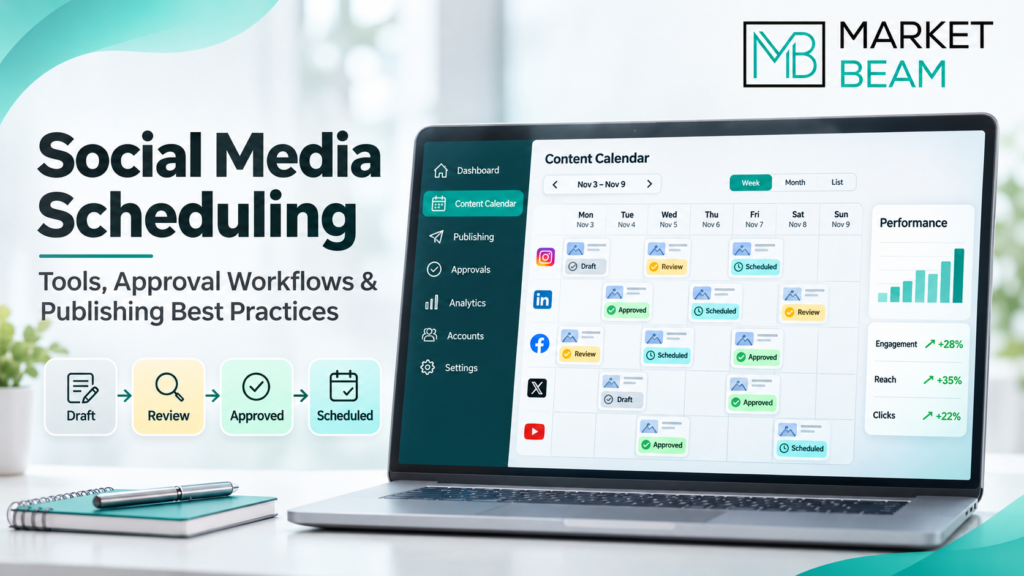
An enterprise-ready Social media management platform should support configurable approval workflows. Organizations should be able to assign reviewers, define approval stages, manage revisions, and maintain records of completed approvals.
Ask vendors whether approvals can be configured according to content type, brand, campaign, region, or regulatory requirements. A flexible workflow can help reduce unnecessary communication while maintaining the required level of control.
3. Security, Permissions, and Access Control
Security should be a major consideration during the purchasing process. Enterprises need to protect social accounts, internal information, campaign assets, and customer interactions from unauthorized access.
A reliable Social media management platform should provide role-based permissions, secure account connections, administrator controls, and clear access management. Organizations should also examine how user access can be updated when employees change roles or leave the company.
Security evaluation should include data protection policies, authentication options, audit records, vendor security documentation, and account management procedures.
4. Integration With Existing Enterprise Systems
Enterprise teams rarely work with social media software in isolation. They may already use CRM systems, collaboration tools, compliance software, analytics platforms, advertising tools, and content management systems.
A connected Social media management platform can reduce repetitive tasks and prevent information from becoming fragmented across different applications.
| Integration category | What enterprises should evaluate | Business benefit |
|---|---|---|
| CRM systems | Contact activity, engagement records, lead data | Better sales and marketing coordination |
| Compliance tools | Review status, approved content, audit records | More controlled publishing |
| Collaboration tools | Notifications, tasks, reviewer communication | Faster team coordination |
| Analytics platforms | Campaign reporting and performance data | Better decision-making |
| Advertising platforms | Paid campaign management and measurement | Unified campaign oversight |
Before purchasing, confirm whether integrations are native, API-based, or dependent on third-party connectors. Ask about integration limitations, setup requirements, synchronization frequency, and ongoing maintenance.
5. Analytics, Reporting, and Business Performance
Enterprises need more than basic likes and follower counts. A Social media management platform should help organizations understand how social activity contributes to campaign objectives, audience engagement, brand awareness, website traffic, and business outcomes.
Evaluate dashboards, reporting customization, campaign comparisons, data exports, and the ability to measure performance across multiple accounts.
The reporting system should support different stakeholders. Social media managers may need detailed post-level metrics, while executives may prefer consolidated performance summaries and business impact.
Ask vendors how reporting data is collected, how historical data is maintained, and whether reports can be customized for internal teams or clients.
6. Scalability and Ease of Administration
Your enterprise requirements today may be different from those of the next two or three years. The organization may add new brands, markets, employees, social accounts, agencies, or campaigns.
A scalable Social media management platform should accommodate growth without requiring a completely new workflow. Review account limits, user capacity, administration features, onboarding processes, and the platform’s ability to support different teams.
Ease of use is equally important. Even powerful software can fail if employees find it difficult to understand. Request demonstrations for both administrators and everyday users to assess navigation, workflow complexity, and training requirements.
7. Social Listening, Monitoring, and Response Management
Publishing content is only one part of enterprise social media management. Organizations must also monitor brand mentions, audience conversations, customer questions, industry discussions, and potential reputation risks.
A capable Social media management platform should provide monitoring and response tools that help teams identify important conversations and coordinate timely responses.
For regulated organizations, monitoring can be particularly important when social interactions involve complaints, product safety concerns, or potential adverse events. Evaluate whether the platform supports alerts, response guides, escalation processes, and appropriate documentation.
8. Employee Advocacy and Controlled Content Distribution
Employee advocacy can expand brand reach by encouraging employees to share approved corporate content through their professional networks.
However, enterprises need a structured approach. A Social media management platform should allow administrators to distribute approved content, manage participation, establish sharing guidelines, and measure advocacy performance.
Consider whether employees can easily discover relevant content, whether sharing permissions can be controlled, and whether administrators can measure reach and engagement. A well-governed advocacy program can support brand visibility without making participation unnecessarily complicated.
Enterprise Platform Evaluation Scorecard
A structured scorecard makes vendor comparisons easier. Instead of choosing a tool based on its interface or a single feature, evaluate each platform against your organization’s requirements.
| Evaluation criteria | Priority | Questions to ask vendors |
|---|---|---|
| Publishing and scheduling | High | Can we manage multiple accounts and campaigns centrally? |
| Workflow approvals | High | Can approval stages and reviewers be customized? |
| Governance and security | High | Are permissions, access controls, and audit records available? |
| Integrations | High | Does it connect with our CRM and compliance systems? |
| Analytics | High | Can we measure performance across brands and campaigns? |
| Scalability | High | Can it support additional accounts, teams, and regions? |
| Monitoring | Medium–High | Can we detect conversations and route responses? |
| Employee advocacy | Medium–High | Can approved content be shared with employees? |
| Customer support | High | What onboarding, training, and ongoing assistance are included? |
Use this scorecard during vendor demonstrations and assign weighted scores based on business priorities. A regulated enterprise may place greater emphasis on compliance and auditability, while a global consumer brand may prioritize multi-account publishing and campaign analytics.
How MarketBeam Supports Enterprise Social Media Management
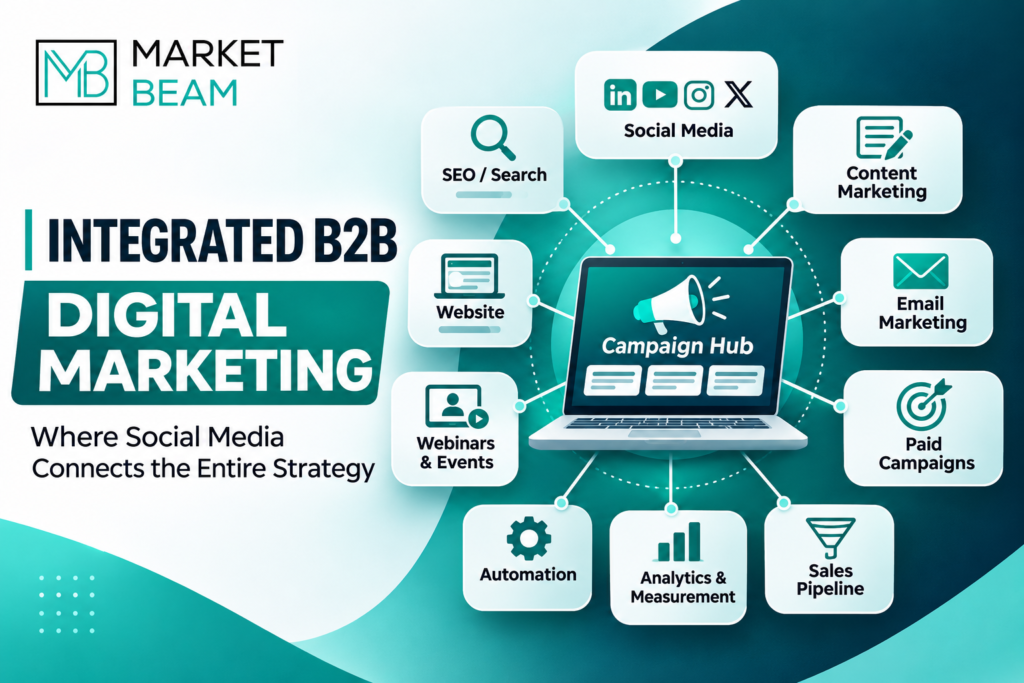
MarketBeam provides a centralized solution for organizations that need publishing, collaboration, monitoring, analytics, and governance within their social media operations.
Its capabilities include social media publishing, employee advocacy, social analytics, social monitoring, prospect intelligence, and compliant paid campaigns. These capabilities help teams manage different stages of their social media lifecycle through connected workflows.
For regulated industries, MarketBeam also supports compliance-oriented workflows and integration with Veeva PromoMats, helping connect social media activities with established Medical, Legal, and Regulatory review processes.
The platform includes AI-supported content prechecks designed to flag potential issues such as unapproved claims, missing disclosures, risky language, and policy concerns before content moves further through review.
For enterprises evaluating a Social media management platform, these capabilities can be especially relevant when marketing teams need operational efficiency without compromising internal governance requirements.
MarketBeam also supports employee advocacy and social monitoring, helping organizations extend approved content reach while maintaining visibility over social interactions.
Rather than evaluating the platform only on publishing features, enterprises can assess how its connected capabilities fit their marketing, compliance, collaboration, and reporting requirements.
Questions to Ask During a Vendor Demonstration
Before making a final decision, request a demonstration using your actual enterprise workflow. A generic presentation may not reveal the practical limitations of a platform.
Ask vendors to demonstrate how a campaign is created, reviewed, approved, scheduled, published, monitored, and measured. Include different user roles so you can see how administrators, marketers, reviewers, and employees interact with the system.
You should also ask about implementation timelines, training, customer support, pricing structure, integrations, security documentation, and contract flexibility.
A Social media management platform should solve your existing operational challenges while remaining adaptable to future requirements. Involving marketing, IT, compliance, and leadership during evaluation can help prevent expensive decisions based on incomplete requirements.
Conclusion
Choosing an enterprise social media solution requires a careful assessment of workflows, security, integrations, governance, scalability, analytics, and user adoption. The right Social media management platform should help organizations simplify operations, improve collaboration, maintain consistent communication, and measure meaningful results.
Instead of choosing a platform based only on scheduling features or pricing, evaluate how well it supports your complete enterprise social media lifecycle. Prioritize capabilities that align with your business objectives, regulatory responsibilities, and future growth.
MarketBeam offers organizations a connected approach to social publishing, monitoring, analytics, employee advocacy, and compliance-oriented workflows. By evaluating these capabilities against your requirements, your team can make a more confident and informed technology decision.
Connect with Us
Looking for an enterprise social media solution that combines publishing, analytics, employee advocacy, monitoring, and compliance-oriented workflows? Connect with MarketBeam to discuss your organization’s needs and explore a platform built for enterprise social media operations.
Sales: sales@marketbeam.io
Tech Support: support@marketbeam.io
Frequently Asked Questions
1. What is a social media management platform?
A social media management platform is software that helps organizations create, schedule, publish, monitor, and analyze social media content across multiple channels from a centralized workspace. Enterprise solutions also support collaboration, approvals, permissions, governance, and reporting.
2. What features should an enterprise social media management platform have?
Important features include multi-account publishing, approval workflows, role-based access controls, analytics, social monitoring, employee advocacy, integrations, security controls, and scalable administration. Regulated businesses may also require compliance workflows and audit records.
3. How do I choose the right social media platform for a large organization?
Start by documenting your requirements, prioritizing essential capabilities, and evaluating vendors against a scorecard. Test actual workflows during demonstrations and review integrations, security, scalability, onboarding, pricing, and customer support before making a decision.
4. Why are approval workflows important for enterprise social media?
Approval workflows help ensure that content is reviewed by the appropriate stakeholders before publication. They improve accountability, reduce errors, maintain brand consistency, and support internal governance and regulatory requirements.
5. Can enterprise social media management platforms integrate with CRM and compliance tools?
Yes. Many enterprise solutions support integrations with CRM systems, collaboration applications, analytics platforms, and compliance technologies. Integration capabilities can reduce manual work, improve data visibility, and connect social media operations with existing enterprise workflows.
6. How does MarketBeam help enterprises manage social media?
MarketBeam combines social publishing, employee advocacy, analytics, monitoring, prospect intelligence, and compliant paid campaigns. For regulated organizations, its compliance-oriented capabilities and Veeva PromoMats integration help connect social media workflows with established review and approval processes.