Marketing content moves through multiple stages before it reaches customers. A campaign may begin with a creative idea, move through copywriting and design, receive feedback from several departments, and finally require formal approval before publication. When these steps are managed through email threads, spreadsheets, shared folders, and disconnected tools, delays and compliance risks can quickly increase.
A well-designed content approval workflow gives regulated marketing teams a structured way to manage this entire process. It establishes who reviews content, what each reviewer checks, how feedback is handled, which version is approved, and when content can be published.
For organizations in life sciences, healthcare, financial services, and other regulated sectors, the goal is not simply to approve content faster. The goal is to create a repeatable process that combines marketing efficiency with governance, accountability, and compliance.
What Is a Content Approval Workflow?
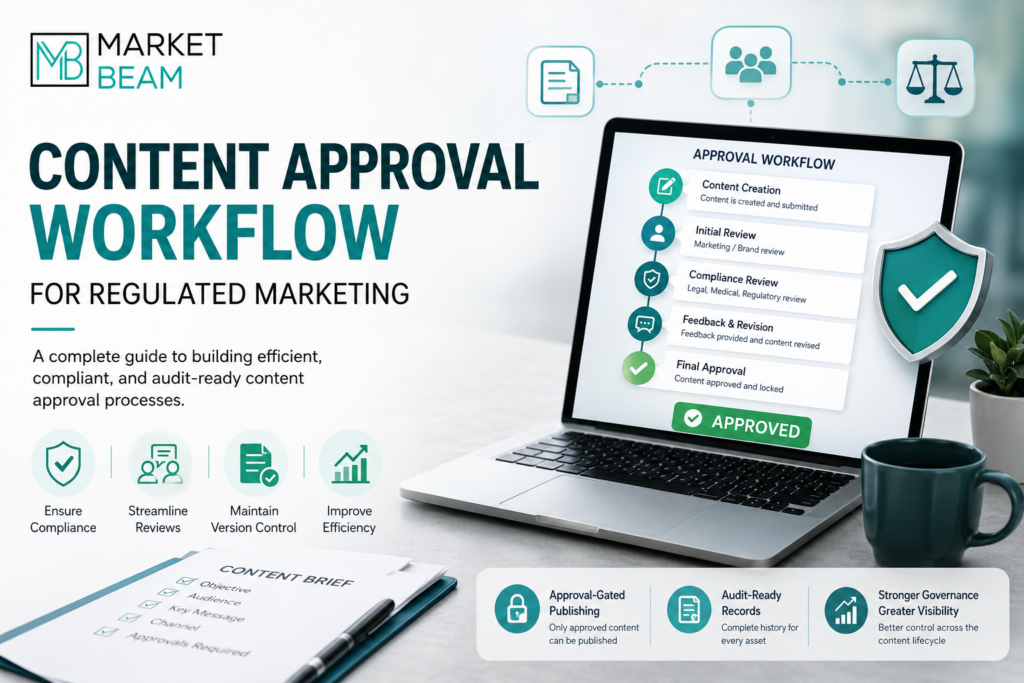
A content approval workflow is a structured process that moves marketing content from creation through review, revision, final approval, and publication. Each stage has defined responsibilities, so teams know exactly what needs to happen before content can move forward.
Depending on the organization, the process may involve marketing, medical, legal, regulatory, compliance, brand, product, or senior leadership teams. The level of review can also depend on the type and risk of the content.
For example, a routine corporate announcement may require marketing and brand approval, while a pharmaceutical product claim may need Medical, Legal, and Regulatory review. A financial services campaign may require compliance or principal approval before publication.
The most effective content approval workflow makes these differences manageable through defined approval stages and clear routing rules.
Why Content Approval Matters in Regulated Marketing
Regulated marketing cannot rely on informal review practices. Claims may need supporting evidence, disclosures may need to be present, and promotional language may need to comply with applicable regulations and internal policies.
MarketBeam focuses on regulated social media and marketing operations, with workflows designed to help teams identify compliance issues before publication. Its platform describes an AI precheck that scans content against policies and regulations before human reviewers focus on higher-value compliance decisions.
A structured content approval workflow can also create accountability. Instead of relying on an email saying that someone approved a campaign, organizations can maintain records of reviewers, decisions, revisions, timestamps, and final versions.
This becomes particularly valuable during audits or internal reviews. Teams can demonstrate how content moved through the required process and identify the people responsible for each approval.
Key Stages of a Content Approval Workflow
1. Content Planning
The process begins before anyone writes the final copy. Marketing teams define the campaign objective, audience, channel, message, content type, and required approvals.
At this point, teams should determine whether the content is low, medium, or high risk. Risk-based planning helps prevent every piece of content from being subjected to the same approval requirements.
2. Content Creation
Writers, designers, and marketers then create the content. This may include website copy, advertisements, email campaigns, social media posts, videos, product materials, sales collateral, or employee advocacy content.
Content should be created using approved messaging, brand guidelines, references, disclaimers, and other required resources.
3. Initial Review
The first review typically focuses on quality and completeness. Marketing or brand reviewers may check tone, messaging, formatting, accuracy, and consistency.
Early review is important because it prevents obvious problems from reaching specialist reviewers. This can reduce unnecessary revision cycles later.
4. Compliance Review
Higher-risk content moves to the appropriate compliance, medical, legal, or regulatory reviewer. These reviewers evaluate the elements relevant to their responsibilities.
For pharmaceutical and life sciences organizations, this may form part of an MLR process. MarketBeam explains that its MLR workflows can bring Medical, Legal, and Regulatory review into a structured process before content is published.
5. Feedback and Revision
Reviewers may request changes, add comments, identify unsupported claims, or require additional disclosures. The creator then updates the content and resubmits it.
A good content approval workflow should make feedback easy to understand. Reviewers should be able to identify what needs to change rather than sending vague instructions through separate communication channels.
6. Final Approval
Once all required changes are completed, the designated approver provides final sign-off. This stage should clearly identify the approved version.
Approval should also prevent unauthorized modifications. MarketBeam highlights approval-gated publishing and controls designed to ensure that only approved content can move toward publication in regulated workflows.
7. Publishing and Archiving
After approval, content can be published through the appropriate channel. The final version, approval decision, reviewer information, and relevant timestamps should be retained according to organizational and regulatory requirements.
This creates a complete record of the content lifecycle.
Content Approval Workflow: Manual vs. Automated
Many organizations begin with manual processes because they are easy to set up. Email, spreadsheets, shared drives, and messaging platforms can support basic collaboration, but they become harder to manage as content volume increases.
| Manual Process | Automated Workflow |
| Approvals handled through email | Approval routing is centralized |
| Versions stored across folders | Version history is easier to manage |
| Review status requires manual tracking | Status is visible in the workflow |
| Feedback can become fragmented | Comments remain connected to content |
| Publishing may be disconnected from approval | Publishing can be approval-gated |
| Audit preparation can require reconstruction | Approval records can be retained automatically |
Automation does not mean removing people from the review process. Instead, it can reduce repetitive administrative work so reviewers can focus on decisions that require professional judgment.
MarketBeam describes this approach as AI-assisted compliance review, where AI identifies potential issues early while human reviewers concentrate on the risks that require expert evaluation.
Common Challenges in Content Approval
One of the biggest challenges is fragmented communication. When comments arrive through email, chat, documents, and meetings, creators may struggle to determine which feedback is current.
Version control is another major concern. A team may approve one document while a different version is later uploaded for publishing. Without clear controls, small changes can create significant compliance issues.
Approval bottlenecks can also slow campaigns. If every piece of content follows the same path regardless of risk, reviewers can become overloaded.
Another challenge is the lack of visibility. Marketing leaders may know that a campaign is waiting for approval but not know which reviewer currently owns the next action.
A modern content approval workflow addresses these issues by connecting content, reviewers, feedback, status, and approval history in one process.
The Role of Version Control
Version control is essential when multiple stakeholders edit marketing content. Every significant revision should be identifiable so teams can understand what changed and which version received approval.
Consider a campaign that has been approved by legal and regulatory teams. If a marketer later changes a product claim, headline, image, or disclosure without triggering another review, the published material may no longer match the approved version.
A strong process therefore connects approval with the specific version that was reviewed. MarketBeam’s financial services workflow, for example, describes approved-version controls designed to prevent modifications to approved content before distribution.
| Version Control Requirement | Benefit |
| Revision history | Shows how content changed |
| Approved version lock | Protects the reviewed asset |
| Reviewer comments | Preserves feedback context |
| Approval timestamps | Establishes accountability |
| Final asset identification | Reduces publishing confusion |
Managing Feedback More Efficiently
Feedback management can determine whether an approval process is efficient or frustrating. When several reviewers provide comments at different times, creators can receive contradictory requests or repeat work unnecessarily.
Teams should establish clear reviewer responsibilities. Each stakeholder should understand whether they are reviewing claims, regulatory requirements, brand consistency, legal risk, design, or another specific area.
Centralized feedback also makes it easier to identify unresolved issues. Instead of searching through long email chains, users can see comments alongside the content being reviewed.
An effective content approval workflow should therefore treat feedback as part of the content record rather than as separate communication.
Building a Risk-Based Approval Process
Not every asset carries the same level of risk. A useful approach is to create approval paths based on content type, audience, market, channel, and regulatory sensitivity.
| Content Type | Possible Review Level |
| Corporate announcement | Marketing and brand |
| Educational content | Marketing and subject expert |
| Product promotion | Medical, legal, and regulatory |
| Financial promotion | Compliance or principal review |
| Paid advertising | Marketing plus compliance |
| Executive communication | Communications plus relevant compliance |
| Employee advocacy content | Compliance and governance |
Risk-based routing prevents low-risk content from being unnecessarily delayed while ensuring that higher-risk material receives appropriate scrutiny.
For financial services, MarketBeam describes workflows supporting FINRA, SEC, FCA, and other regulatory considerations, including principal approval and examination-ready records.
How Automation Improves Content Operations
Automation can improve the speed and consistency of content review without compromising human oversight. Automated routing can send content to the right reviewer, notify users about pending actions, track status, and prevent content from moving forward before required approvals are completed.
AI can provide an additional layer before formal review. MarketBeam states that its AI precheck can identify high-risk language, policy violations, unapproved claims, outdated information, and missing disclosures before content reaches human reviewers.
This approach can reduce avoidable revisions. If a simple compliance issue is identified before specialist review, the creator can address it earlier instead of waiting for a later approval stage.
The result is a content approval workflow that supports both efficiency and governance.
Best Practices for a Better Approval Process
Start by documenting every approval stage. Teams should know who creates content, who reviews it, who can request changes, who gives final approval, and who is responsible for publication.
Next, define approval criteria. Reviewers should have clear guidance rather than relying entirely on personal interpretation.
Use risk-based routing wherever possible. This keeps straightforward content moving while directing sensitive content to the appropriate specialists.
Centralize feedback and version history. This creates a single source of truth and reduces confusion.
Finally, measure workflow performance. Useful metrics include average review time, number of revision cycles, rejection rates, approval bottlenecks, and publishing delays.
These measurements can reveal where process improvements or automation will have the greatest impact.
How MarketBeam Supports Regulated Content Approval
MarketBeam is designed for organizations that need stronger governance around social media and digital content. Its platform combines content creation, AI compliance prechecks, human review, publishing, monitoring, analytics, and compliance reporting.
For life sciences organizations, MarketBeam supports MLR-oriented workflows and integration with Veeva PromoMats. Its published materials describe a process where content is created, prechecked, submitted for review, approved, published, monitored, and archived.
For financial services organizations, MarketBeam describes approval workflows that include principal review, regulatory segmentation, approval records, and 17a-4 recordkeeping capabilities.
This connected approach can help organizations reduce the dependence on email chains and spreadsheets while keeping compliance within the marketing process rather than treating it as a separate final checkpoint.
Conclusion
A reliable content approval workflow gives regulated marketing teams the structure they need to balance speed, creativity, governance, and compliance. By defining approval stages, assigning clear reviewer responsibilities, centralizing feedback, protecting approved versions, and maintaining audit records, organizations can make content operations more predictable.
The strongest processes do not add unnecessary approval layers. Instead, they apply the right level of review according to content risk and regulatory requirements. Automation and AI can further reduce repetitive work by identifying potential problems early and routing content to the appropriate reviewers.
For organizations managing regulated social media and digital marketing at scale, MarketBeam provides a connected environment for AI-assisted compliance checks, human review, publishing, monitoring, and reporting.
Connect with Us
Ready to improve your content operations and build a more efficient approval process?
Sales: sales@marketbeam.io
Tech Support: support@marketbeam.io
Connect with MarketBeam to explore how a compliance-focused platform can help your team manage regulated content with greater efficiency, visibility, and control.
Frequently Asked Questions
What is a content approval workflow?
A content approval workflow is a structured process that takes marketing content through creation, review, feedback, revision, approval, publication, and recordkeeping. It defines responsibilities and helps ensure that the correct people review content before it goes live.
Why is a content approval workflow important for regulated marketing?
Regulated marketing often requires careful review of claims, disclosures, accuracy, and compliance requirements. A structured process helps reduce the risk of publishing unapproved or incorrectly modified content while creating a record of the approval process.
Who should be involved in content approval?
The participants depend on the content and industry. Marketing, brand, legal, compliance, medical, regulatory, product, and leadership teams may participate. Risk-based routing helps determine which reviewers are necessary for each asset.
How does version control support content approval?
Version control helps teams identify changes and determine which version was reviewed and approved. It reduces the risk of publishing an asset that differs from the version evaluated by compliance or other required reviewers.
Can AI automate content approval?
AI can assist with prechecks, issue detection, routing, and repetitive review tasks, but human judgment remains important for complex compliance decisions. MarketBeam positions AI as a tool that accelerates review rather than replaces human reviewers.
How can MarketBeam improve content approval?
MarketBeam connects AI prechecks, human review, approval workflows, publishing controls, monitoring, and compliance reporting. For regulated teams, this can help create a more connected process from content creation through publication and recordkeeping.