How to Create a Social Media Governance Policy
A strong social media presence helps businesses build trust, share updates, answer customer questions, and connect with their audiences. However, managing several accounts across departments, locations, and marketing teams can create challenges. Without clear rules, employees may publish unapproved content, use outdated brand assets, or respond to sensitive issues in different ways.
A social media governance policy gives employees and marketing teams a clear process for managing company social media accounts. It defines account ownership, publishing rules, approval responsibilities, access permissions, and procedures for handling potential risks. As a result, organizations can maintain brand consistency while allowing their teams to work efficiently.
For enterprise and regulated marketing teams, an effective social media governance policy also supports accountability, documentation, and consistent decision-making. This guide explains how to build a practical policy, which sections to include, common mistakes to avoid, and how technology can support better social media governance.
What Is a Social Media Governance Policy?
A social media governance policy is a set of rules and procedures that explains how an organization creates, reviews, publishes, monitors, and manages social media content. It defines who can access company accounts, who can approve posts, and how employees should respond to complaints or potential risks.
A basic social media policy often focuses on employee behavior and acceptable use. In comparison, a social media governance policy covers the wider operating process, including account ownership, content standards, approval workflows, monitoring, escalation, and recordkeeping.
For example, a company may allow its regional marketing teams to publish local updates while requiring central approval for major campaigns. A financial services or pharmaceutical company may also require specialist review for certain promotional statements. Clear rules help employees understand these responsibilities before content goes live.
Why Does Your Business Need a Social Media Governance Policy?
As social media activity expands, informal agreements and email-based approvals can become difficult to manage. A documented policy gives employees a reliable process and helps leaders understand who is responsible for each activity.
First, it protects brand consistency. Shared content standards help teams use approved messages, visual assets, and brand language across channels. This creates a more consistent experience for customers.
Second, it helps reduce avoidable risks. A post might disclose confidential information, make an unsupported claim, or create confusion during a customer complaint. A social media governance policy defines the checks employees should complete before publishing and the steps they should follow when problems arise.
Third, clear access rules improve account security. Organizations can assign permissions based on job responsibilities, review access regularly, and remove permissions when employees or external partners leave a project.
Finally, a well-defined process can improve approval speed. When employees understand who must review a post and who has final approval, content moves through the workflow with less confusion.
Organizations in regulated industries should also account for applicable legal requirements. For example, the Federal Trade Commission provides guidance on disclosing material connections in endorsements, while SEC-registered investment advisers may have specific marketing and recordkeeping responsibilities. The relevant requirements depend on the organization’s activities and should be reviewed with qualified legal and compliance professionals.

How to Create a Social Media Governance Policy
Creating a useful policy begins with understanding how your organization currently manages social media. Then, define responsibilities, set publishing rules, and introduce practical controls that employees can follow.
1. Audit Social Media Accounts and Ownership
Start by listing all official social media accounts, including corporate profiles, regional accounts, product pages, employer-brand channels, and accounts managed by agencies.
Record each account’s purpose, owner, administrator, backup contact, and authorized users. This audit helps identify abandoned accounts, duplicate profiles, outdated permissions, and accounts without clear ownership.
Every official account should have a responsible owner. Your social media governance policy should also explain how employees request new accounts, receive approval, and close profiles that are no longer needed.
2. Define Roles and Permissions
Decide who can create content, review drafts, approve posts, publish updates, monitor activity, and manage account settings. These responsibilities do not always need to belong to the same person.
For example, a content creator may prepare a post, a marketing manager may review its message, and a compliance specialist may assess sensitive claims. Separating these responsibilities helps prevent unauthorized publishing.
Use individual accounts and role-based access wherever possible. Review permissions on a regular schedule, and remove access promptly when responsibilities change. A clear social media governance policy should explain how employees, agencies, contractors, and temporary team members receive and lose access.
3. Establish Content Standards and Publishing Rules
Document your organization’s expectations for brand voice, approved visual assets, accessibility, customer privacy, copyright, confidential information, and acceptable conduct.
Your policy should explain which content can follow a standard publishing process and which content needs additional review. Routine company updates may require only a brand check, while product claims, financial promotions, sponsored endorsements, or sensitive announcements may need specialist approval.
For endorsements, the FTC advises that relevant relationships between an endorser and a brand should be disclosed clearly when required.
Organizations should confirm which rules apply to their campaigns rather than relying on a general social media checklist.
4. Create a Clear Approval Workflow
Explain how content moves from a draft to a published post. Identify the required reviewers, expected response times, final decision-maker, and escalation process when an approver is unavailable.
Keep approvals and final content versions in a consistent location. If an approved post changes significantly, define when the edited version must be reviewed again.
This part of your social media governance policy should make the process easy to understand. Employees need to know where to submit content, how to check its status, and when they can publish it.
5. Define Escalation and Incident Procedures
Prepare clear instructions for handling mistakes, account security incidents, customer complaints, privacy concerns, and potentially misleading content.
The policy should name the person or team responsible for each type of issue. For example, routine service questions may go to customer support, while a compromised account should be reported to the designated security contact.
Employees should avoid making unapproved promises or public statements during an incident. Instead, they should preserve relevant information and follow the documented escalation process.
6. Set Monitoring and Recordkeeping Requirements
Explain who monitors comments, mentions, messages, and account activity. Set reasonable response expectations based on the platform, business needs, and potential risk.
Your social media governance policy should also describe what records need to be retained, where they are stored, who can access them, and how long they should be kept. Depending on the organization, records may include approved copy, published posts, reviewer decisions, publication dates, and incident responses.
Retention periods should follow applicable legal, regulatory, and company requirements. Consistent records make it easier to investigate concerns and understand why a particular decision was made.
7. Train Employees and External Partners
A policy works only when people understand how to apply it. Provide practical training for employees who create, approve, publish, or monitor social media content.
Use examples to explain acceptable posts, content that needs extra approval, account security responsibilities, and situations that require escalation. Agencies and contractors should receive the relevant instructions before they begin managing company accounts.
Keep training materials accessible and provide refreshers when platforms, roles, or company requirements change.
8. Review and Update the Policy
Assign an owner to review the policy on a planned schedule. Revisit it after major changes, such as a new platform, acquisition, security incident, new business activity, or relevant regulatory update.
Ask employees where instructions are unclear and identify approval steps that regularly create delays. The solution may be better training, clearer wording, or a revised workflow.
A social media governance policy should evolve with the business. Record each update, maintain a current version, and inform affected employees when the rules change.
What Should a Social Media Governance Policy Include?
A well-organized policy should answer practical questions quickly. Employees should be able to identify who owns an account, which content needs approval, and how to report a concern.
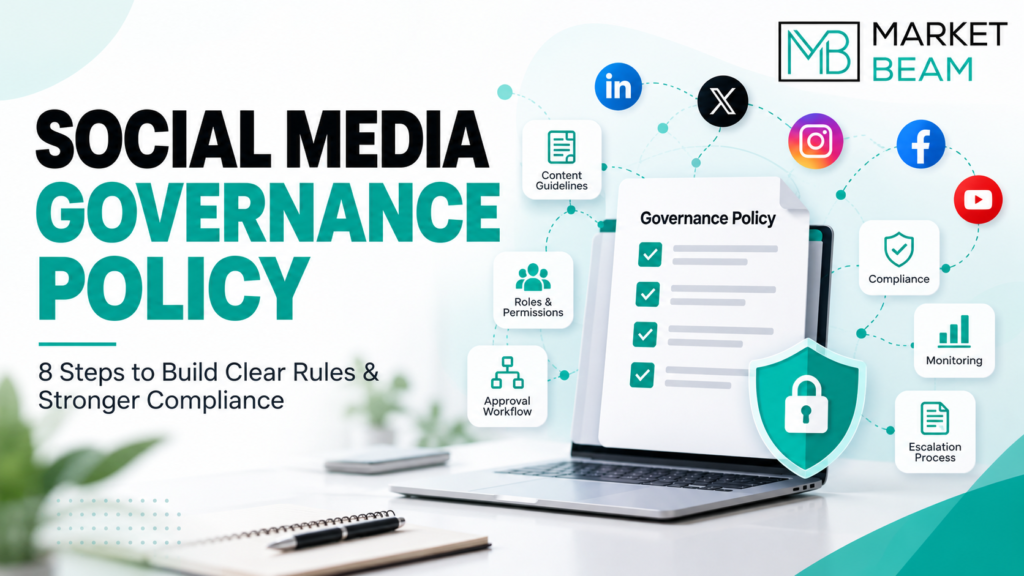
| Policy section | What to include | Main purpose |
|---|---|---|
| Account ownership | Account owner, purpose, backup contact, and authorized users | Establishes accountability |
| Roles and permissions | Drafting, review, publishing, administration, and monitoring rights | Controls access |
| Content standards | Brand voice, approved assets, privacy, copyright, and restricted content | Maintains consistency |
| Approval workflow | Reviewers, deadlines, final approval, and version control | Reduces publishing errors |
| Escalation procedures | Incident contacts, response steps, and reporting rules | Supports timely action |
| Monitoring and records | Monitoring duties, record storage, and retention requirements | Strengthens oversight |
| Training and review | Training plans, policy owner, and review schedule | Keeps the policy effective |
The document should also explain how employees can ask questions or request an exception. Define who can authorize an exception and how that decision must be recorded.
Common Social Media Governance Policy Mistakes to Avoid
One common mistake is using complicated language that employees cannot apply to daily work. Keep instructions direct, explain unfamiliar terms, and provide examples where necessary.
Another mistake is applying the same approval process to every post. This can delay routine communications and encourage employees to look for informal workarounds. Instead, create risk-based approval paths while maintaining appropriate controls for sensitive content.
Organizations may also overlook accounts managed by agencies, temporary contractors, or individual departments. Include these accounts in your audit and make sure the same core standards apply to everyone acting on the company’s behalf.
Finally, do not treat the document as a one-time task. Without regular reviews, a social media governance policy can become outdated as account ownership, tools, platforms, and business requirements change.
How Technology Can Support Social Media Governance
Technology can make governance easier to apply, but software should support a defined process rather than replace it. Before selecting a platform, identify the tasks that create the most risk or manual work.
A social media management or governance tool may help centralize account permissions, content approvals, publishing calendars, approved assets, monitoring, and activity records. When evaluating options, check whether the platform supports your required roles, approval stages, integrations, reporting, and recordkeeping needs.
Automation can route drafts to reviewers, send reminders, and help teams track pending approvals. However, sensitive content still needs appropriate human review. Organizations should also confirm that any selected platform meets their security, privacy, and regulatory requirements.
How to Measure Policy Effectiveness
Measure whether your policy improves daily operations and helps teams follow established controls. Useful indicators include account ownership coverage, completion of access reviews, training completion, average approval time, policy exceptions, and incident response time.
| KPI | What it measures | Question to ask |
|---|---|---|
| Account ownership coverage | Accounts with a documented owner | Which accounts lack clear responsibility? |
| Access review completion | Reviews completed on schedule | Is outdated access being removed promptly? |
| Approval turnaround time | Time required to approve content | Which stage causes the most delay? |
| Training completion | Assigned users who complete training | Which teams need additional support? |
| Incident response time | Time taken to acknowledge and address concerns | Are escalation steps clear? |
Review these results regularly and use them to improve the process. For example, slow approvals may indicate unclear responsibilities, while repeated mistakes may show that the policy needs clearer examples or better training.
The goal is to make governance effective and practical, not to add unnecessary paperwork.
Conclusion
A well-designed social media governance policy helps organizations protect their brand, clarify responsibilities, manage account access, and respond to social media risks consistently. By auditing accounts, defining roles, setting content standards, and establishing approval workflows, businesses can reduce confusion while keeping everyday publishing efficient.
The policy should also cover monitoring, recordkeeping, employee training, and regular reviews. For regulated organizations, legal and compliance specialists should confirm the requirements that apply to specific communications and activities.
Start with clear ownership and workable rules. Then train employees, review performance, and update the policy as the organization grows. With a consistent approach, social media governance can become a practical part of enterprise marketing operations.
Connect With MarketBeam
MarketBeam helps enterprise and regulated marketing teams organize social media workflows, content approvals, and governance processes. A structured approach can improve coordination while helping teams maintain the oversight their organization requires.
Sales: sales@marketbeam.io Tech Support: support@marketbeam.io
Frequently Asked Questions
1. What is a social media governance policy?
A social media governance policy documents how an organization manages social accounts, content, permissions, approvals, monitoring, and incidents. It establishes clear responsibilities and gives employees a consistent process to follow.
2. How do you create a social media governance policy?
Start by auditing accounts and access. Then define roles, publishing standards, approval workflows, escalation procedures, monitoring duties, recordkeeping, and training. Assign an owner to review the policy regularly.
3. What is the difference between a social media policy and a governance policy?
A general social media policy often focuses on employee behavior and acceptable use. A governance policy also defines operational controls, including account ownership, publishing permissions, approval workflows, monitoring, recordkeeping, and accountability.
4. Who should manage a social media governance policy?
A marketing or communications leader may coordinate the policy, with support from IT, security, legal, compliance, human resources, and relevant business teams. Responsibilities should be documented so every team knows its role.
5. How often should a social media governance policy be updated?
Review it on a planned schedule and after major changes, such as a new platform, acquisition, security incident, change in account ownership, or relevant regulatory update.
6. Does a social media governance policy help regulated businesses?
Yes. It can define approval requirements, access controls, documentation, monitoring, and escalation procedures. However, regulated organizations should confirm applicable legal and industry requirements with qualified legal and compliance specialists.