Marketing teams are expected to move quickly, but speed alone does not guarantee effective campaigns. Every social media post, advertisement, email, landing page, promotional asset, or campaign message may need review before it reaches the audience. When multiple stakeholders are involved, approval can quickly become slow, fragmented, and difficult to track. A structured marketing approval workflow provides the process enterprises need to move content from creation to publication with greater consistency and control.
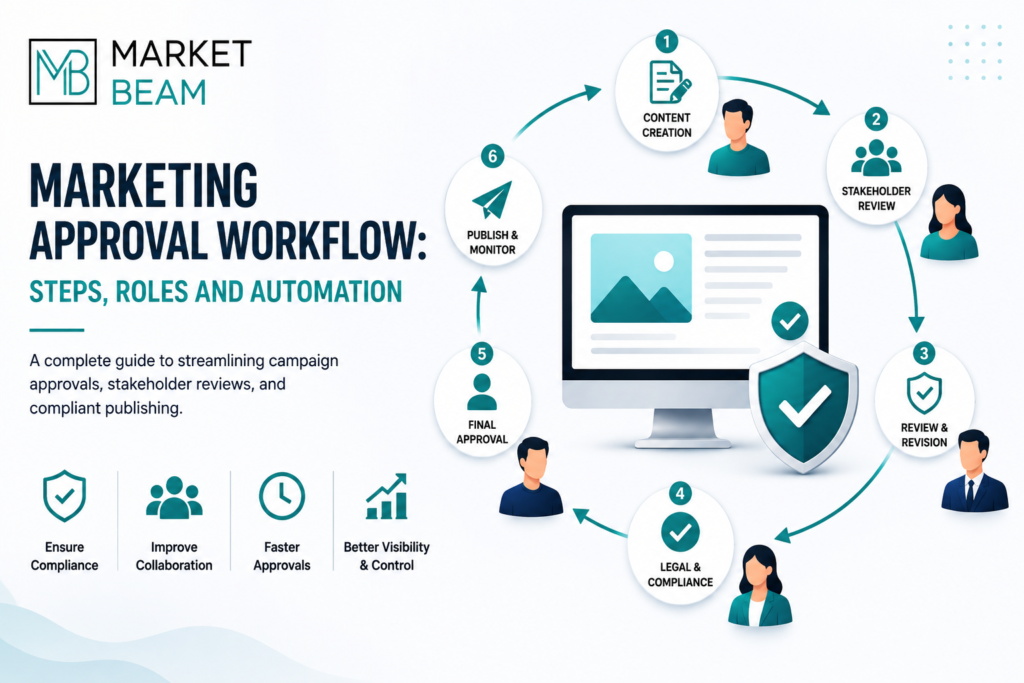
A well-designed marketing approval workflow defines who reviews content, what each stakeholder is responsible for, when approvals are required, and how changes are documented. It creates a clear path from the initial draft through campaign approval, stakeholder review, legal verification, brand validation, and final publication.
For enterprises operating in regulated industries, approval processes are even more important. Pharmaceutical, healthcare, financial, and other regulated organizations may need additional reviews to ensure promotional content meets internal and external requirements.
MarketBeam helps organizations manage enterprise social media operations through centralized workflows, collaboration, approvals, publishing, governance, and analytics, making it easier to coordinate campaigns while maintaining control.
What Is a Marketing Approval Workflow?
A marketing approval workflow is a structured process that determines how marketing content moves through review and approval stages before publication or distribution.
Instead of sending drafts through disconnected emails, spreadsheets, and messaging applications, teams can follow a predefined workflow with assigned responsibilities and deadlines. Each piece of content can move from creation to review, revision, approval, and publication while maintaining visibility into its status.
The exact workflow varies by organization. A simple campaign may require a content creator and marketing manager, while an enterprise campaign may involve marketing, legal, compliance, medical, communications, and brand teams.
The primary purpose of a marketing approval workflow is to provide accountability and consistency. Everyone knows what they need to review, when their input is required, and who has authority to approve the final content.
This reduces confusion while minimizing the risk of publishing incorrect, outdated, unauthorized, or non-compliant communications.
Why Enterprises Need a Marketing Approval Workflow
As organizations scale their marketing operations, the number of stakeholders involved in campaigns tends to increase. Regional teams may create localized content, corporate marketing may manage brand standards, and legal or compliance teams may review specific campaigns.
Without a structured process, these responsibilities can overlap and create bottlenecks.
A standardized marketing approval workflow creates a shared operating process across teams. Marketing managers can see which assets are awaiting review, content creators know which changes are required, and leadership gains better visibility into campaign readiness.
The workflow also improves accountability. Instead of relying on memory or email conversations, organizations maintain a documented record of approvals, revisions, and decisions.
For regulated organizations, this visibility is particularly important. A centralized approval process can help demonstrate that content passed through the required internal reviews before publication.
Campaign Approval: The Starting Point for Controlled Publishing
Campaign approval ensures that a marketing initiative has been reviewed against its objectives, target audience, messaging, and execution plan before individual assets move toward publication.
Campaign approval typically happens before final content approval. The marketing team confirms that the campaign aligns with business objectives, launch timelines, channel strategy, and available resources.
At this stage, stakeholders can review the broader campaign concept rather than individual social posts or creative assets. This helps identify problems early, before teams invest significant time in production.
A strong marketing approval workflow separates campaign-level decisions from asset-level decisions. This prevents teams from repeatedly revisiting strategic questions after creative production has already begun.
Once the campaign direction is approved, individual content items can progress through the appropriate review stages.
Stakeholder Review and Cross-Functional Collaboration
Stakeholder review is one of the most important stages in an enterprise approval process. Different stakeholders evaluate content from different perspectives, so the workflow should clearly define who needs to participate.
Marketing may review strategic alignment and audience relevance. Communications teams may evaluate messaging, while product specialists verify technical accuracy. Compliance or regulatory teams may be involved where applicable.
A successful stakeholder review process should avoid unnecessary approvals. Adding too many reviewers can slow campaigns without improving quality. Instead, organizations should assign reviewers based on content type, market, risk level, and campaign requirements.
Clear responsibilities also prevent conflicting feedback. Each reviewer should understand which areas they are authorized to evaluate and who has final decision-making authority.
Technology can improve stakeholder review by centralizing comments, revisions, deadlines, and approval status in one location rather than spreading feedback across email threads.
Legal Approval for Marketing Content
Legal approval becomes important when marketing content creates contractual, regulatory, intellectual property, advertising, privacy, or other legal considerations.
Legal teams may review claims, disclosures, licensing requirements, usage rights, promotional language, and other areas that could create legal exposure.
Within a marketing approval workflow, legal review should occur at the appropriate stage rather than being added as a last-minute checkpoint. Early involvement can prevent significant rework and reduce campaign delays.
Organizations should also establish criteria for determining when legal approval is mandatory. Not every piece of routine content requires the same level of legal involvement.
Automated routing can help direct only the relevant assets to legal reviewers, allowing standard content to move through a lighter workflow while higher-risk campaigns receive additional scrutiny.
Brand Approval and Consistency
Marketing content must do more than meet business and legal requirements. It should also represent the brand consistently.
Brand approval ensures that content follows approved visual identity, tone of voice, messaging standards, typography, templates, imagery, and other brand requirements.
For enterprises managing multiple teams or regional offices, brand approval becomes particularly important. Without consistent controls, different teams may publish content that is technically correct but visually or strategically inconsistent.
A marketing approval workflow can include brand reviewers or automated brand checks before content reaches final approval. Centralized access to approved templates and assets can further reduce errors.
Brand approval is especially valuable when multiple external agencies, freelancers, or distributed marketing teams contribute to campaign production.
Marketing Approval Workflow Stages
| Workflow Stage | Main Responsibility | Primary Purpose |
| Campaign Planning | Marketing Team | Define objectives and campaign direction |
| Campaign Approval | Marketing Leadership | Confirm strategic alignment |
| Content Creation | Content & Creative Teams | Develop campaign assets |
| Stakeholder Review | Relevant Departments | Validate messaging and accuracy |
| Legal Approval | Legal Team | Review legal and regulatory risks |
| Brand Approval | Brand Team | Confirm brand consistency |
| Final Approval | Authorized Owner | Confirm publication readiness |
| Publishing | Social/Marketing Team | Release approved content |
Common Approval Bottlenecks
One of the biggest challenges with a marketing approval workflow is delay. Content may remain stuck with a reviewer because there is no clear deadline, ownership is unclear, or feedback is being exchanged through multiple communication channels.
Another common problem is repeated revisions. If strategic, legal, and brand requirements are not communicated early, teams may discover issues only after content has already passed through several stages.
Organizations also struggle with version control. When multiple files circulate through email, reviewers may accidentally comment on older versions or approve content that is no longer current.
These issues can be reduced through standardized workflows, clearly defined responsibilities, centralized documentation, and automated notifications.
A modern workflow should make it immediately clear what is waiting for approval, who owns the next action, what changes were requested, and when the asset is expected to move forward.
Automating the Marketing Approval Workflow
As marketing operations grow, manual reviews become increasingly difficult to manage. Email chains, spreadsheets, shared folders, and messaging applications can make it unclear which content is approved, who still needs to review it, or whether a newer version has replaced an earlier draft.
Automation can make a marketing approval workflow more efficient by routing content automatically to the correct reviewers based on campaign type, market, content format, or risk level. Reviewers can receive notifications, provide feedback, approve assets, or request changes without leaving the centralized workflow.
Automated reminders also help prevent content from sitting with a reviewer for too long. When approval deadlines approach, the system can notify the responsible stakeholder rather than forcing marketing managers to follow up manually.
Version control is another important advantage. A centralized workflow helps ensure reviewers are working on the current version while maintaining a record of previous changes and decisions.
Automation does not remove human judgment. Instead, it reduces repetitive coordination so marketing, legal, brand, compliance, and other teams can focus on the quality of the content they are reviewing.
Choosing Workflow Software for Enterprise Teams
The right workflow software can turn a fragmented approval process into a repeatable enterprise system. Teams should look for software that supports configurable approval stages, user roles, notifications, version control, audit trails, deadlines, and reporting.
For larger organizations, flexibility is particularly important. A social media post may require a simple marketing and brand review, while pharmaceutical promotional content may require additional medical, legal, and regulatory approvals.
Effective workflow software allows organizations to create different paths without abandoning a common governance structure. This makes the approval process scalable across departments, brands, regions, and content types.
Integration is also important. Approval workflows should connect with content creation, publishing, asset management, analytics, and other marketing operations where possible.
Marketing Approval for Regulated Industries
Regulated organizations require a more controlled marketing approval workflow because promotional communications may be subject to legal, regulatory, or internal compliance requirements.
In pharmaceutical and healthcare marketing, for example, content may need medical, legal, and regulatory review before publication. Financial organizations may need compliance or legal review for specific communications. The exact process depends on the organization’s policies and applicable requirements.
A centralized workflow can help document campaign approval, stakeholder review, legal approval, and brand approval in a consistent process.
Organizations should clearly define which content requires additional review and which routine communications can follow a simpler path. This prevents unnecessary bottlenecks while ensuring higher-risk content receives appropriate oversight.
The workflow should also maintain an audit trail showing who reviewed the content, what changes were requested, when approvals occurred, and which version was ultimately published.
Roles and Responsibilities in the Approval Process
Clear roles are essential to an effective marketing approval workflow. Without defined ownership, content can become stuck between departments or receive conflicting feedback.
Marketing usually owns campaign objectives and coordinates the overall process. Content and creative teams produce the assets, while stakeholders review content based on their areas of expertise.
Legal teams address relevant legal risks, brand teams verify visual and messaging consistency, and compliance or regulatory teams review content where applicable.
One person should ultimately have authority for final approval. This prevents situations where multiple stakeholders approve parts of a campaign but no one is responsible for confirming that the complete asset is ready for publication.
Documenting these responsibilities within the workflow also improves accountability and makes onboarding easier for new team members.
Manual vs. Automated Marketing Approval Workflow
| Area | Manual Workflow | Automated Workflow |
| Approval Requests | Email or messages | Automated routing |
| Status Tracking | Spreadsheets | Centralized workflow |
| Reminders | Manual follow-up | Automated notifications |
| Version Control | Multiple files | Centralized versions |
| Stakeholder Review | Fragmented feedback | Shared review environment |
| Audit Trail | Manually maintained | Automatically recorded |
| Publishing Readiness | Difficult to verify | Clear approval status |
How MarketBeam Supports Marketing Approval Workflows
MarketBeam helps enterprise organizations coordinate social media and marketing operations through centralized workflows, collaboration, approvals, publishing, governance, and analytics.
A structured marketing approval workflow within an enterprise platform can help teams manage campaign content from creation through final approval and publication. Marketing teams can coordinate stakeholders while maintaining greater visibility into the status of each asset.
For regulated organizations, centralized workflows can support internal review procedures by bringing marketing, legal, compliance, brand, and other stakeholders into a controlled approval process. This can reduce reliance on disconnected email conversations and spreadsheets.
MarketBeam’s broader enterprise social media capabilities also connect approval and governance activities with publishing and analytics. This helps organizations maintain visibility after an asset is approved rather than treating approval as the end of the workflow.
By combining workflow automation with enterprise social media management, MarketBeam helps organizations reduce manual coordination, improve accountability, and support more consistent campaign execution.
Best Practices for a Successful Marketing Approval Workflow
The most effective approval workflows are designed around the organization’s actual operating model. Teams should start by defining the content types and campaign categories that require review.
Next, establish clear ownership for every stage and define realistic approval deadlines. Reviewers should know exactly what they are expected to evaluate and when they need to respond.
Organizations should also standardize feedback and revision procedures. Instead of creating multiple versions across different systems, teams should work from a centralized source of truth.
Finally, measure workflow performance. Approval turnaround time, revision frequency, bottlenecks, and publishing delays can reveal where the process needs improvement.
A good marketing approval workflow should ultimately make compliance and quality easier to manage without creating unnecessary friction for marketing teams.
Conclusion
An effective marketing approval workflow provides enterprises with a structured way to move campaigns from planning and content creation through campaign approval, stakeholder review, legal approval, and brand approval.
Automation can reduce manual coordination, improve version control, accelerate approvals, and maintain a reliable record of decisions. For regulated organizations, these capabilities are particularly valuable because approval documentation and controlled publishing are critical parts of responsible marketing operations.
MarketBeam provides enterprise social media management, workflow automation, governance, publishing, analytics, and collaboration capabilities that help organizations build more efficient approval processes.
Connect With Us
Ready to streamline your marketing approval process?
Sales: sales@marketbeam.io
Tech Support: support@marketbeam.io
🚀 Transform regulated marketing with smarter content approval workflows—combining AI-powered compliance checks, human review, version control, and approval-gated publishing with MarketBeam
Connect with MarketBeam to explore workflow automation, approvals, governance, and enterprise social media management.
Frequently Asked Questions
1. What is a marketing approval workflow?
A marketing approval workflow is a structured process that moves marketing content through defined review, revision, approval, and publishing stages before it is released.
2. Why is campaign approval important?
Campaign approval confirms that the overall campaign aligns with business objectives, target audiences, messaging requirements, and organizational policies before individual assets move toward publication.
3. What happens during stakeholder review?
Stakeholder review allows relevant teams to evaluate content based on their responsibilities, such as messaging, accuracy, product information, compliance, or communications requirements.
4. When is legal approval required?
Legal approval is typically required when content involves legal, regulatory, contractual, privacy, intellectual property, or advertising considerations. Requirements vary by organization and industry.
5. Why is brand approval important?
Brand approval ensures that content follows approved visual identity, tone, messaging, templates, and other brand standards before publication.
6. How does MarketBeam improve the approval process?
MarketBeam provides centralized collaboration, workflow automation, approval management, governance, publishing, and analytics that help enterprise teams manage a marketing approval workflow more efficiently and consistently.