Enterprise Social Media Governance: How to Build a Strong Framework
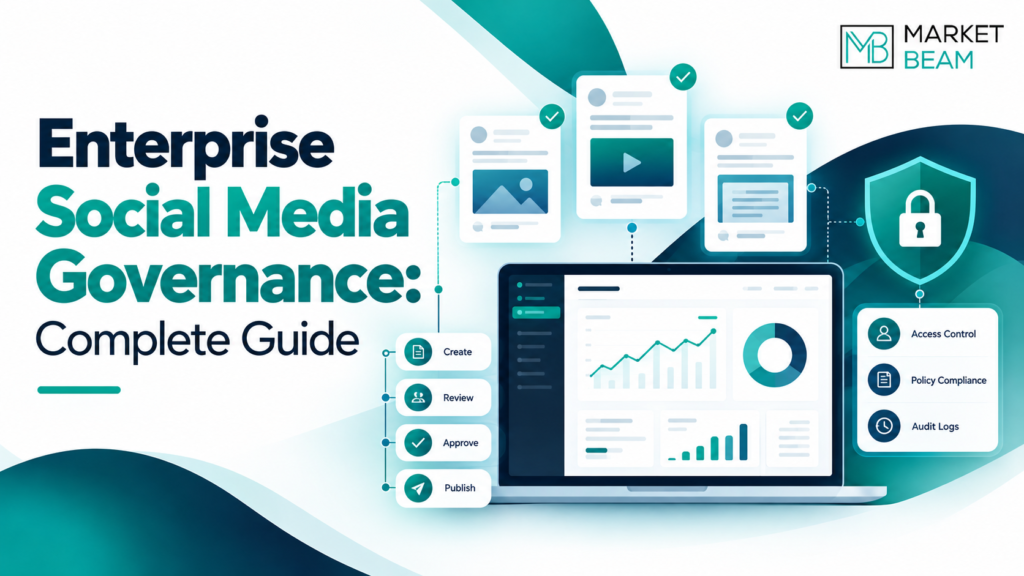
Enterprise social media governance helps organizations manage social media accounts, content, permissions, approvals, and compliance across teams. As companies expand across platforms, regions, and business units, they need clear rules to protect brand identity, reduce risk, and maintain consistent communication.
Without a defined governance model, teams may publish unapproved content, use inconsistent brand messages, overlook regulatory requirements, or lose control of account access. These problems can become more serious for organizations in regulated industries, where social media activity may create legal, reputational, and compliance risks.
A strong social media governance program gives employees clear responsibilities, establishes approval workflows, and creates consistent standards for publishing and monitoring. It also helps marketing leaders balance control with the flexibility teams need to work efficiently.
This guide explains how enterprise social media governance works, which policies and controls matter most, how to build a practical framework, and how technology can help organizations manage social media at scale.
What Is Enterprise Social Media Governance?
Enterprise social media governance is the system of policies, roles, processes, and controls an organization uses to manage its social media activity. It defines who can access accounts, who can create and approve content, which publishing rules apply, and how teams monitor activity and respond to risks.
Unlike a basic social media policy, which mainly explains acceptable behavior, governance covers the wider operating model. It connects company policies with daily workflows, account permissions, employee responsibilities, content approvals, recordkeeping, and performance oversight.
For example, a global company may have separate marketing teams for different products, regions, and business units. Each team needs enough freedom to communicate with its audience. However, the company must also protect its brand, apply consistent standards, and meet relevant legal requirements.
Enterprise social media governance creates that balance. It establishes shared rules while allowing approved teams to publish content within clear boundaries.
A practical governance program usually includes five core elements:
Policies that define acceptable social media activity.
Roles and permissions that establish ownership and access.
Approval workflows that guide content review and publishing.
Monitoring and documentation that support oversight.
Reporting and regular reviews that help improve controls.
Together, these elements give organizations a repeatable way to manage social media across teams, platforms, and markets.
Why Is Enterprise Social Media Governance Important?
As social media operations grow, informal processes become harder to manage. A small team may coordinate content through email and direct messages. However, an enterprise with many accounts, employees, and reviewers needs a more reliable approach.
Enterprise social media governance helps reduce confusion by making responsibilities and expectations clear. It also gives leaders a better view of how teams publish content, manage access, and handle potential issues.
1. Protect Brand Consistency
Different teams may use different messages, visual assets, tones, and product descriptions. Without shared standards, these differences can weaken brand identity and confuse audiences.
A governance framework provides approved brand guidelines, content standards, and asset libraries. As a result, regional and product teams can create relevant content without moving away from the company’s core identity.
2. Reduce Compliance and Reputation Risks
A social media post can create risk when it includes misleading claims, confidential information, unsupported statements, or content that violates applicable rules. In regulated industries, promotional content may also require specific review and documentation.
Enterprise social media governance establishes checks before publication and monitoring after publication. Therefore, teams can identify potential issues earlier and follow a defined escalation process.
3. Control Account Access
Employees change roles, contractors finish projects, and agencies move between clients. If account access is not reviewed, former team members may retain permissions they no longer need.
A clear access policy assigns permissions according to job responsibilities. Regular access reviews, secure authentication, and timely removal of outdated access help protect business accounts.
4. Improve Approval Speed
Unclear review responsibilities often create delays. Content may move between departments without a clear owner, or reviewers may repeat the same checks.
A defined workflow identifies who reviews each asset, which approvals are required, and when escalation is necessary. This structure can reduce avoidable delays while preserving the checks needed for higher-risk content.
5. Strengthen Accountability
Governance makes it easier to understand who created, reviewed, approved, and published a post. Clear records support internal reviews, incident investigations, and process improvements.
Most importantly, accountability helps teams learn from mistakes instead of relying on informal conversations or incomplete records.

Enterprise Social Media Governance Framework: Key Components
An effective enterprise social media governance framework turns broad policies into clear, repeatable actions. It defines how employees manage accounts, how content moves through review, and how the organization responds when something goes wrong.
The framework should fit the company’s size, industry, risk level, and operating structure. A global financial services company may need detailed supervision and recordkeeping controls, while a business with fewer regulatory obligations may use a simpler approval process.
The following components provide a practical starting point.
1. Social Media Policy and Content Standards
A social media policy explains how employees and authorized partners should represent the organization online. It should cover official brand accounts, employee advocacy, customer interactions, confidential information, acceptable conduct, and the use of personal accounts when employees discuss company matters.
The policy should also explain which content employees can publish without additional approval and which content needs review. For example, a routine company culture post may follow a standard process, while a product claim, financial promotion, or healthcare-related statement may need specialist review.
Keep the policy easy to understand. Employees are more likely to follow clear instructions than a long document filled with complex language.
2. Roles and Permissions
Roles and permissions determine who can access social media accounts and what each person can do. Enterprise social media governance should distinguish between account ownership, content creation, approval, publishing, monitoring, and administration.
A content creator may draft posts without permission to publish them. A reviewer may approve content but lack access to account settings. An administrator may manage access but should not automatically become the final approver for every promotional claim.
This separation reduces the risk of unauthorized publishing and accidental account changes. It also supports continuity when employees leave or move to another role.
Organizations should review permissions regularly and remove access that is no longer required. Shared credentials should be avoided where individual accounts and role-based access are available.
3. Content Approval Workflows
An approval workflow explains how a social media asset moves from an initial draft to publication. It should identify the required reviewers, approval stages, deadlines, and escalation paths.
A simple workflow might include content creation, brand review, specialist review when needed, final approval, publishing, and monitoring. Not every post needs every stage. Instead, enterprise social media governance should use risk-based rules so that routine content can move efficiently while sensitive content receives the right level of review.
For instance, a recruitment announcement may require a brand check, while a regulated product campaign may need marketing, medical, legal, and regulatory review. The workflow should record the final approved version so that a different draft is not published by mistake.
4. Monitoring and Escalation
Publishing a post does not end the governance process. Organizations also need to monitor comments, mentions, account activity, and emerging issues.
A monitoring plan should define who watches each channel, how frequently they check it, and what happens when they identify a concern. The plan should cover customer complaints, misinformation, security incidents, inappropriate comments, and possible adverse event reports where relevant.
Teams need clear escalation rules. A routine service question may go to customer support, while a security concern or potential regulatory issue may require immediate attention from a designated specialist.
5. Documentation and Recordkeeping
Good documentation helps organizations understand what happened and why. Depending on the industry and applicable requirements, records may include drafts, approvals, published versions, publication dates, reviewer comments, account changes, and incident responses.
Enterprise social media governance should define what needs to be recorded, where records are stored, who can access them, and how long they must be retained. Retention periods should follow applicable laws, regulations, and company policies rather than a universal time frame.
Centralized records also make it easier to investigate a complaint or confirm which version of a post appeared on a specific channel.
6. Training and Accountability
Policies work only when employees understand them. Training should explain the organization’s rules, approval process, account security requirements, and escalation procedures.
Different roles may need different training. Content creators need guidance on claims, brand voice, and approved assets. Account administrators need security training. Reviewers need to understand their responsibilities and the limits of their approval authority.
Organizations should also provide refresher training when policies change, new platforms are introduced, or repeated mistakes reveal a knowledge gap.

How to Build an Enterprise Social Media Governance Program
A successful program does not need to begin with a complicated technology rollout. Start by understanding current practices, identifying gaps, and assigning ownership. Then introduce controls in stages and review whether they work.
01
Audit Existing Accounts and Processes
List all official social media accounts, business units, regional profiles, agencies, and employee advocacy programs. Identify account owners, current permissions, publishing tools, approval steps, and recordkeeping practices. This audit gives enterprise social media governance a clear starting point and reveals duplicate accounts, unclear ownership, and unnecessary access.
02
Assess Business and Compliance Risks
Evaluate risks based on the organization’s industry, products, audiences, markets, and social channels. Consider misleading claims, confidential data, impersonation, account compromise, customer complaints, and regulatory obligations. Use the results to decide which activities require stronger controls.
03
Define Ownership and Decision Rights
Assign a program owner and document the responsibilities of marketing, communications, IT, legal, compliance, human resources, and business units. Clarify who can approve policies, grant account access, publish content, and manage incidents. Clear decision rights prevent teams from assuming that another department owns a task.
04
Create Policies and Standard Workflows
Write practical rules for account access, content creation, approvals, publishing, monitoring, employee advocacy, and incident handling. Establish standard workflows for routine posts and additional review steps for higher-risk content. Test the procedures with the people who will use them before applying them across the enterprise.
05
Select Suitable Tools and Controls
Review whether existing systems can support permissions, approvals, publishing, monitoring, and documentation. Enterprise social media governance tools should fit the organization’s risk requirements and integrate with established processes where practical. Avoid buying software before defining the problem it needs to solve.
06
Train Teams and Launch in Stages
Provide role-based training and pilot the framework with a small group or selected business unit. Collect feedback, correct unclear steps, and confirm that approval times remain practical. Then expand the program with documented guidance and a clear support process.
07
Measure, Review, and Improve
Track approval times, access reviews, training completion, policy exceptions, incident response, and audit findings. Review results on a regular schedule and update the framework when business needs or regulatory obligations change.
Enterprise Social Media Governance vs. Social Media Policy
These terms are related, but they serve different purposes. A social media policy sets expectations for behavior and activity. Enterprise social media governance defines the wider system that puts those expectations into practice and checks whether teams follow them.
| Area | Social media policy | Enterprise social media governance |
|---|---|---|
| Main purpose | Set rules and expectations | Manage the full operating model |
| Scope | Employee behavior and social media use | Policies, people, processes, tools, and controls |
| Account access | May state basic access rules | Defines owners, permission levels, reviews, and removal |
| Content approval | Explains when approval is required | Defines reviewers, workflow stages, escalation, and records |
| Monitoring | May describe expected behavior | Establishes monitoring ownership and incident response |
| Measurement | Often limited to compliance with rules | Tracks controls, performance, risks, and improvement |
A policy is therefore one part of the governance program. Even a well-written policy can fail if employees do not know where to find it, approval responsibilities remain unclear, or account access is never reviewed.
A mature approach connects the policy to daily work. Employees should know what the rule means, where to complete the required step, and whom to contact when they encounter an exception.
Enterprise Social Media Governance for Regulated Industries
Organizations in healthcare, pharmaceuticals, financial services, insurance, and other regulated sectors may face additional obligations when communicating through social media. Their governance programs must account for the rules that apply to their products, services, audiences, and jurisdictions.
In these environments, enterprise social media governance should connect content approval with the company’s broader compliance processes. A post that appears simple from a marketing perspective may contain a product claim, financial promotion, customer testimonial, or statement that requires specialist review.
For example, a pharmaceutical company may need to review promotional claims, assess risk information, and establish procedures for handling potential adverse event reports. A financial services firm may need controls for communications supervision, recordkeeping, and applicable advertising requirements. The exact requirements vary by organization and activity, so teams should consult their legal and compliance specialists.
A risk-based framework can help regulated teams manage these responsibilities without slowing every campaign unnecessarily.
Build Risk-Based Approval Paths
Classify content according to its potential risk and the review it requires. Routine corporate updates may follow a standard approval path. Product claims, financial promotions, patient-facing content, or other sensitive communications may require additional review.
Document the criteria for each path and explain who can make the final decision. This approach helps teams apply consistent controls rather than deciding from scratch for every post.
Maintain Approved Content and Version Control
Use a central location for approved copy, images, disclosures, and other content assets. Assign version identifiers and make it clear which materials are current.
When an asset changes, teams should know whether the change requires another review. A small wording update may affect the meaning of a regulated claim, so organizations should not assume that previously approved content remains valid after every edit.
Establish Monitoring and Escalation Procedures
Define how teams identify and handle complaints, questionable claims, sensitive comments, and other potential issues. Assign an owner to each type of concern and set response expectations based on its severity.
For regulated organizations, monitoring procedures should also reflect applicable reporting obligations and recordkeeping requirements. A monitoring tool can flag content for review, but trained personnel must evaluate the context and decide what action is appropriate.
Preserve Evidence of Decisions
Keep records of the content reviewed, approval decisions, changes made, and final published versions where required. Enterprise social media governance becomes more reliable when the organization can explain not only what it published but also how it reached that decision.
How Technology Supports Enterprise Social Media Governance
Managing several social media platforms through disconnected spreadsheets, email chains, and direct messages can make oversight difficult. Purpose-built software can bring key activities into a more organized process.
However, technology should support a governance framework, not replace it. Organizations still need clear policies, trained reviewers, and defined responsibilities.
| Capability | How it supports governance | What to evaluate |
|---|---|---|
| Role-based permissions | Limits account actions according to responsibilities | Granular access, user management, and access reviews |
| Content approval workflows | Routes content to the right reviewers | Flexible steps, ownership, and escalation |
| Publishing controls | Helps teams publish approved content | Scheduling, version checks, and publishing permissions |
| Content libraries | Keeps approved assets easier to find | Version control, search, and access restrictions |
| Monitoring and alerts | Helps teams identify relevant activity and possible issues | Coverage, alert quality, and escalation options |
| Audit records | Supports oversight and internal reviews | Searchable history, export options, and retention controls |
| Reporting | Shows how the program operates | Approval time, exceptions, incidents, and other useful measures |
When evaluating a platform, organizations should consider their actual workflows, security needs, integrations, reporting requirements, and regulatory obligations. They should also confirm which capabilities are available in the specific product and plan they intend to use.
Where AI Can Help
AI-enabled features may help classify content, identify selected risk indicators, summarize social conversations, and route items for human review. These features can reduce manual effort when they are configured and monitored appropriately.
Nevertheless, automated detection can miss context, misclassify language, or generate false alerts. AI should not make final legal, medical, or regulatory decisions without appropriate human oversight. Organizations should test the technology, document its limits, and keep clear accountability for decisions.
Common Enterprise Social Media Governance Mistakes
Even organizations with written policies can struggle when their operating processes are incomplete. The following mistakes are worth checking during a governance review.
Unclear account ownership. When no one owns an account, access reviews and incident response can fall through the cracks. Assign a named business owner and a backup for every official profile.
Too many approval steps. Requiring every reviewer to approve every post can create delays without reducing risk. Use risk-based review paths and define when specialist approval is necessary.
Outdated permissions. Former employees, agencies, or contractors may retain access after their responsibilities change. Review access regularly and remove permissions promptly when they are no longer needed.
Policies that employees cannot apply. A long policy is not enough if it does not explain daily actions. Add practical examples, decision rules, and links to the correct internal process.
Weak documentation. Approval messages spread across inboxes can be difficult to reconstruct later. Use a consistent system to preserve the relevant decisions and final versions.
No regular review. Social platforms, organizational structures, and business risks change. Schedule reviews of the framework and update procedures when new needs arise.
Enterprise social media governance should remain practical. If the rules are unclear, overly complex, or disconnected from how teams work, employees may create informal workarounds that weaken the controls.
How to Measure Enterprise Social Media Governance Success
A governance program should be measured by more than the number of posts published or the engagement those posts receive. Marketing performance matters, but governance also needs measures that show whether controls work.
Start with a small set of indicators tied to clear goals. For example, track the average time from submission to approval, the percentage of accounts with assigned owners, completion of access reviews, training completion, and the number of overdue compliance actions.
Incident measures can also help. Review response times, recurring causes, policy exceptions, and corrective actions. A rise in reported incidents does not always mean the program is getting worse. It may indicate that employees have become better at reporting concerns. Interpret results in context rather than treating one number as a complete measure of success.
| KPI | What it measures | Why it matters |
|---|---|---|
| Approval turnaround time | Time taken to review and approve content | Highlights bottlenecks |
| Account ownership coverage | Share of accounts with a documented owner | Reveals gaps in accountability |
| Access review completion | Whether scheduled access checks are completed | Helps maintain appropriate permissions |
| Training completion | Whether assigned users complete required training | Shows policy awareness coverage |
| Policy exception rate | Frequency of approved deviations from standard rules | Identifies areas needing clearer procedures |
| Incident response time | Time taken to acknowledge and address reported issues | Helps evaluate escalation readiness |
| Repeat incident rate | Recurrence of similar issues | Highlights opportunities for process improvement |
Set a baseline before making major changes. Then review trends over time and agree on realistic improvement targets. Enterprise social media governance is most useful when reporting leads to action, such as clearer policies, better training, simpler workflows, or stronger account controls.
Best Practices for Long-Term Governance
A sustainable program needs continued support from leadership and the people who use it. The following practices help keep enterprise social media governance useful as the organization grows.
First, assign an executive sponsor who can resolve ownership conflicts and support investment in the program. A designated program lead should coordinate policy updates, training, reporting, and cross-functional reviews.
Second, make guidance easy to find. Employees should have one reliable place to access current policies, approved assets, account procedures, and escalation contacts. Clear documentation reduces uncertainty and limits the need for informal workarounds.
Third, review controls after important changes. A new social platform, acquisition, product launch, agency relationship, or regulatory requirement may create new risks. Update the framework when these changes affect account ownership, content approvals, or recordkeeping.
Finally, gather feedback from the teams that use the process. If approval steps regularly create delays, investigate the cause. The solution may be clearer responsibilities, better templates, or a more suitable workflow rather than removing important controls.
Conclusion
Enterprise social media governance gives organizations a structured way to manage social media accounts, protect brand consistency, control access, and oversee content across teams. It combines policies, roles and permissions, approval workflows, monitoring, documentation, and training into one practical operating model.
For regulated organizations, this structure is especially valuable because social media activity may involve specific advertising, privacy, supervision, and recordkeeping obligations. A risk-based approach helps teams apply the right level of review while keeping routine work moving.
Start by auditing accounts and processes, defining ownership, and identifying the most important risks. Then introduce clear workflows, train employees, select suitable technology, and measure results regularly. With ongoing review and leadership support, enterprise social media governance can become a reliable part of enterprise marketing operations.
Connect With MarketBeam
MarketBeam helps enterprise and regulated marketing teams organize social media workflows, content approvals, and governance processes. A structured approach can help teams coordinate publishing while maintaining the oversight their organization requires.
Sales: sales@marketbeam.io Tech Support: support@marketbeam.io
Frequently Asked Questions
1. What is enterprise social media governance?
Enterprise social media governance is the system of policies, roles, workflows, permissions, and monitoring controls used to manage an organization’s social media activity. It helps teams maintain brand standards, assign responsibility, and manage risks across accounts and channels.
2. What is the difference between social media governance and a social media policy?
A social media policy sets rules for employee and company activity. Governance is broader because it defines how those rules are implemented, monitored, and reviewed through account permissions, approval workflows, training, documentation, and reporting.
3. Why do large organizations need social media governance?
Large organizations often manage multiple accounts, departments, regions, and external partners. Governance creates consistent standards, clarifies account ownership, supports controlled publishing, and helps reduce risks from unauthorized access or unreviewed content.
4. What should an enterprise social media governance framework include?
A framework should include a social media policy, roles and permissions, content approval workflows, account security, monitoring, escalation procedures, recordkeeping, employee training, and regular performance reviews.
5. How can technology improve enterprise social media governance?
Suitable tools can centralize approvals, manage permissions, organize approved content, support publishing, flag potential risks, and maintain activity records. Organizations should evaluate these features against their actual workflows and compliance requirements.
6. How can companies measure social media governance effectiveness?
Companies can track approval turnaround time, account ownership coverage, access review completion, training completion, policy exceptions, incident response time, and recurring issues. Regular reviews help turn these measures into practical improvements.