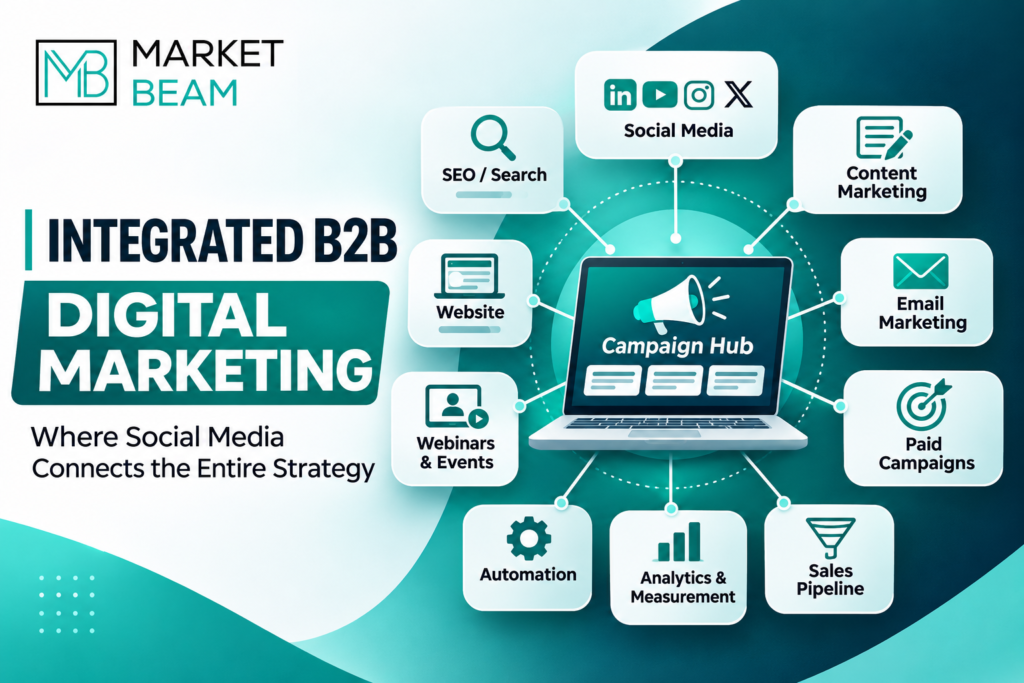

How Social Media Marketing Connects B2B Channels, Campaigns and Business Growth
B2B companies use social channels to educate buyers, build credibility, and generate demand. A strong social media marketing strategy connects audience insight, useful content, channel selection, campaigns, and measurement with business objectives. For enterprises managing multiple brands, regions, and reviewers, shared goals and clear ownership prevent fragmented activity. This guide explains how to connect social channels with the wider B2B marketing mix. Social media marketing is most effective when channel choices match the buying journey.
What Is Social Media Marketing?
Social media marketing uses networks to distribute content, build relationships, and support business goals through organic publishing, paid campaigns, employee advocacy, engagement, and listening. In B2B, a post may introduce a problem, an article explain an approach, and a webinar help a buying committee evaluate options. A coordinated social media marketing program connects these interactions and gives relevant audiences a clear next step. In B2B, social media marketing should support each stage rather than chase isolated engagement.
1. Set Goals and Understand the B2B Audience
Set goals such as target-account awareness, qualified traffic, registrations, lead generation, or retention. Give each campaign one primary objective. For demand generation, track landing-page visits, qualified leads, and conversion rates; for awareness, review relevant reach, video views, and engagement quality. A social media marketing plan should connect these measures to business priorities. Each social media marketing campaign should have an accountable owner.
Understand the buying committee. Executives may focus on business value, practitioners on usability, technical teams on integrations, and procurement on cost and risk. Use customer interviews, sales feedback, CRM insights, analytics, and support questions to identify priorities. Early-stage buyers need explanations; consideration-stage buyers need comparisons and proof; decision-makers need implementation details, security information, customer examples, and a clear next step. Effective social media marketing reflects the language buyers use. Buyer research keeps social media marketing relevant to real decisions.
2. Choose Channels Based on Audience and Purpose
Choose channels based on audience behavior, content capability, and campaign purpose rather than competitor presence. LinkedIn can support thought leadership, customer stories, and events; YouTube can host demonstrations and educational videos. Other networks may serve specific industries or communities. The right mix depends on audience behavior, capacity, and objectives. Social media marketing should focus on networks where priority buyers are active.
| Channel | B2B use cases | Useful measures |
|---|---|---|
| Thought leadership, events, customer stories, employee advocacy | Relevant reach, engagement, referral visits | |
| YouTube | Product demonstrations, interviews, explainers | Watch time, completion, referral conversions |
| Community updates, events, selected audiences | Reach, interactions, website visits | |
| Employer brand, visual storytelling, short videos | Saves, shares, profile actions | |
| X | Industry conversations and service updates | Relevant mentions, response time, link clicks |
Start with channels the organization can manage consistently. A focused social media marketing mix is easier to govern and measure than a presence spread thinly across every network. Fewer, well-managed channels often make social media marketing more consistent.
3. Build a Content Plan and Coordinate Campaigns
Define content pillars around industry education, customer outcomes, product knowledge, expert perspectives, and events. A shared calendar should record topic, audience, channel, format, owner, deadline, reviewer, approval status, and call to action. Organize it by campaign, brand, or region. A social media marketing calendar should leave room for timely updates. It gives social media marketing owners shared visibility into upcoming work and campaign dependencies. This makes social media marketing easier to coordinate across regions.
Adapt assets to each channel instead of copying identical posts. A research finding could become a LinkedIn carousel, short video, article, and webinar discussion. Repurposing extends its value while matching the format to the audience.
Organic content builds an ongoing presence. Paid campaigns extend selected messages, target defined segments, and promote offers or events. Employee advocacy distributes approved content through employees’ professional networks. These activities should share objectives, messaging, and timing. Integrated social media marketing avoids disconnected campaign messages.
For example, a webinar campaign may include organic posts, paid promotion, employee sharing, email invitations, and a landing page. Use consistent campaign names and tracking parameters so the team can understand how each activity contributes. A coordinated social media marketing program also uses audience questions and campaign engagement to inform future content.
4. Put Governance and Collaboration Into the Workflow
Define account ownership, access permissions, brand voice, content review, disclosures, escalation, and recordkeeping. Specify who can create, approve, publish, and respond. In regulated industries, claims, product references, customer interactions, and paid creative may require specialist review. Build these checks into workflows before scheduling content. A governed social media marketing process makes review responsibilities clear.
MarketBeam positions its platform around a governed social media lifecycle. Its website describes social publishing, AI-supported content prechecks, review and approval workflows, employee advocacy, analytics, social monitoring, adverse-event management, and compliant paid campaigns. It also highlights MLR workflow support and audit-ready reporting. These capabilities can support organizations that need social activity connected to oversight and documented processes. They help place social media marketing within a controlled publishing lifecycle. Explore the MarketBeam platform, its social publishing capabilities, employee advocacy, and social analytics.
5. Measure Performance Across the Journey
Measure channel activity and business contribution. Reach indicates exposure, interactions show engagement, clicks indicate traffic, and qualified leads or opportunities connect activity to commercial outcomes.
| Objective | Example KPIs | Review question |
|---|---|---|
| Awareness | Relevant reach, impressions, video views | Are priority audiences seeing the content? |
| Engagement | Shares, comments, saves, meaningful interactions | Is the message useful? |
| Traffic | Link clicks, engaged sessions, landing-page visits | Are people taking the next step? |
| Lead generation | Qualified forms, registrations, cost per lead | Are campaigns attracting suitable prospects? |
| Business impact | Opportunities influenced, pipeline, customer actions | Is social contributing to wider goals? |
| Operations | Approval time, publishing accuracy, response time | Is the workflow controlled? |
Combine platform, website, and CRM analytics with consistent campaign tags. Explain attribution carefully because a prospect may discover a brand on social and convert later through search or email. A useful social media marketing report explains what happened, why it matters, and what to improve. This helps teams keep social media marketing accountable to business outcomes.
6. Create a Repeatable Enterprise Operating Model
Assign owners across marketing, content, regional teams, sales, analytics, and compliance. Define briefing, review, approval, and escalation steps. Shared calendars and approved asset libraries reduce duplication. Review the model quarterly to confirm that channels reach priority audiences, workflows keep pace, and activity supports business goals.
Enterprise social media marketing should be consistent without becoming rigid. A repeatable social media marketing model protects standards while allowing regional teams to adapt. Central teams can protect brand standards while regional teams adapt messages to local audiences and market conditions.
Conclusion
A strong B2B social media marketing strategy connects business goals with audience insight, channel choice, useful content, coordinated campaigns, governance, and measurement. Treat social as part of the wider marketing and sales journey. Set clear objectives, assign responsibilities, connect organic and paid activity, and use performance data to improve campaigns.
Connect With MarketBeam
MarketBeam helps enterprise and regulated teams coordinate social publishing, employee advocacy, analytics, monitoring, compliant paid campaigns, and prospect intelligence through a connected platform. Explore how its governance-focused workflows can support your social media marketing operations.
Sales: sales@marketbeam.io
Tech Support: support@marketbeam.io
Website: https://marketbeam.io/
FAQs
1. What is social media marketing in B2B?
It is the use of social networks to educate business audiences, distribute useful content, build relationships, support campaigns, and contribute to qualified demand and customer engagement.
2. Which social media channels are most useful for B2B companies?
LinkedIn is useful for professional audiences and thought leadership. YouTube can support product education and demonstrations. The right mix depends on where buyers research and engage.
3. How often should an enterprise publish on social media?
There is no universal frequency. Set a sustainable schedule based on audience expectations, channel behavior, campaign needs, review requirements, and team capacity.
4. How can businesses measure social media marketing ROI?
Track relevant reach, engagement, referral traffic, conversions, qualified leads, and opportunities influenced. Combine platform analytics with website and CRM data, distinguishing direct conversions from assisted influence.
5. Why is governance important in enterprise social media?
Governance clarifies account ownership, access permissions, content approvals, disclosures, escalation, and recordkeeping. It helps organizations maintain brand consistency and manage risks across teams and regions.