How Social Media Advertising Drives Campaign Performance and Business Growth
Social media can help businesses reach targeted audiences, explain complex offers, and generate measurable demand. However, successful social media advertising requires more than investing in impressions or clicks. It starts with a clear business objective, a relevant audience, compelling creative, and a measurement plan that connects campaign activity with business outcomes.
For enterprise and B2B teams, campaign execution also involves coordination. Paid campaigns need to align with organic publishing, brand messaging, landing pages, sales follow-up, and, in regulated industries, the right review and approval processes. This guide explains how to plan, launch, measure, and optimize campaigns while building a repeatable workflow across teams and channels.
What Is Social Media Advertising?
Social media advertising is the paid promotion of content, products, services, or messages on social networking platforms. Businesses use it to increase brand awareness, drive website traffic, generate leads, promote events, encourage registrations, and support sales. Common formats include image ads, videos, carousels, sponsored posts, and lead-generation forms.
Unlike organic publishing, paid campaigns allow marketers to define budgets, audiences, placements, schedules, and performance goals. Social media advertising can complement organic content by extending the reach of useful posts, promoting high-value resources, and reaching selected audience segments beyond existing followers.
1. Set Campaign Objectives Before Choosing a Platform
Start with the business result, not the ad format. Decide whether the campaign should create awareness, bring qualified visitors to a website, generate leads, encourage registrations, or influence sales. Each objective requires an appropriate conversion destination and performance measure.
For example, an awareness campaign may prioritize reach and frequency, while a lead-generation campaign should focus on completed forms and lead quality. Meta Blueprint guidance emphasizes aligning campaign objectives with business goals and selecting relevant conversion settings.
Avoid treating clicks as the final outcome when the real goal is pipeline creation. Define a primary KPI and a small set of supporting metrics before launch. A focused objective helps the team evaluate whether social media advertising is producing meaningful business value.
2. Identify the Right Audience
Audience strategy should reflect customer research, not assumptions. Use buyer personas, CRM insights, website behavior, event participation, and sales feedback to understand who should see the campaign. For B2B organizations, audiences may include decision-makers, technical evaluators, practitioners, and procurement stakeholders.
Choose targeting criteria that connect to the campaign objective. Depending on platform capabilities and applicable privacy requirements, teams may use professional attributes, interests, geography, retargeting audiences, or permitted customer lists. Keep audience definitions relevant and avoid narrowing them so much that campaign delivery becomes inefficient.
Segment audiences by awareness and intent. People unfamiliar with your organization may need educational content, while visitors who have already explored a product page may be ready for a demo or consultation. Social media advertising is more relevant when the message matches the audience’s stage in the buying journey.
3. Select Platforms and Ad Formats
Choose platforms based on where your target audience spends time and the action you want them to take. LinkedIn can support professional and account-focused campaigns; Meta platforms can offer broad reach and visual storytelling; YouTube can support video education. Other networks may be useful for specific communities or sectors.
The best channel mix is not necessarily the largest one. Start with platforms that fit your audience, content strengths, budget, and measurement capabilities. Use formats that make the offer easy to understand: short video for product demonstrations, carousels for multi-step explanations, and lead forms when reducing conversion friction is important.
| Campaign goal | Suitable formats | Primary measures |
|---|---|---|
| Brand awareness | Short video, image, sponsored content | Reach, frequency, impressions, video views |
| Website traffic | Link ads, carousel, video | Click-through rate, landing-page views, engaged sessions |
| Lead generation | Native lead forms, offer ads, webinar promotions | Form completion, cost per lead, qualified lead rate |
| Event registrations | Event ads, video, reminder creative | Registrations, cost per registration, attendance |
| Retargeting | Case studies, testimonials, product demos | Conversion rate, cost per acquisition, assisted conversions |
A social media advertising plan should also account for placements and devices. Preview creative in the intended placements, check how text appears on mobile, and make sure the landing page loads and works well on smaller screens.

4. Build Creative That Connects With the Offer
Effective creative makes the audience, problem, and next step clear. Lead with a relevant insight or business challenge, explain the value of the offer, and use one direct call to action. Avoid cramming several messages into a single ad.
Use consistent brand elements, but adapt execution to the platform and audience. Test different headlines, visuals, opening hooks, and calls to action. Strong social media advertising should feel useful in the feed rather than like a generic sales interruption.
Keep the landing page aligned with the ad. The headline, offer, proof points, and form should continue the same message. If an ad promotes a report, the landing page should make that report easy to access. Track the conversion event that matters and verify analytics before increasing spend.
5. Coordinate Paid Campaigns With Organic Publishing
Paid and organic activity should reinforce each other. Organic publishing helps establish credibility, answer questions, and maintain a consistent presence. Social media advertising can extend the reach of selected content, target a defined audience, and create a more direct path to an offer.
Build a shared calendar that shows organic posts, paid campaign dates, key launches, events, and review deadlines. Reuse strong organic themes as campaign concepts, but adapt copy and creative for the paid objective. Likewise, use questions and reactions from paid campaigns to inform future organic content.
This coordination prevents teams from publishing conflicting messages or overwhelming audiences with repeated promotions. It also makes social media advertising easier to assess in context because teams can understand how paid exposure, organic engagement, and website activity contribute to the overall customer journey.
6. Establish a Governed Approval and Publishing Workflow
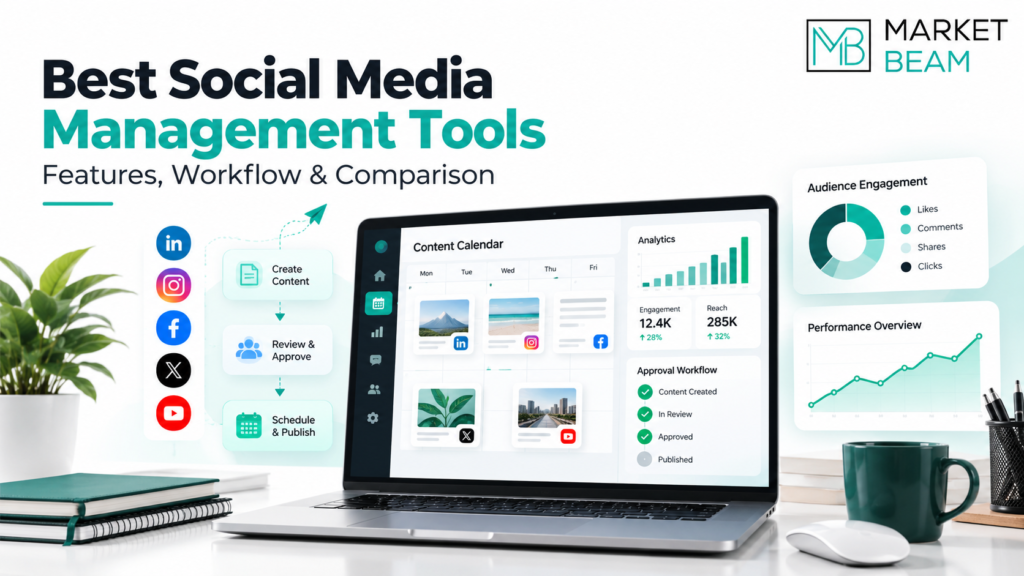
Enterprise campaigns often involve marketing, brand, legal, compliance, regional teams, and external media partners. Define who creates content, who reviews it, who approves the final version, and who is authorized to launch or edit campaigns. Keep version history and approval status visible.
In regulated industries, review requirements may apply to claims, disclosures, audience selection, creative, landing pages, and responses. Build the relevant checks into the workflow before launch. A process that relies on informal messages or disconnected files can make it difficult to confirm which version was approved.
MarketBeam describes a compliance-first platform for managing content creation, compliance prechecks, Medical, Legal, and Regulatory (MLR) review, approval, publishing, monitoring, and audit history. Its website also describes compliant paid campaign workflows and integration with Veeva PromoMats. These capabilities are relevant to organizations that need social media advertising connected to governed review processes. Teams should validate platform configurations against their own policies and regulatory obligations.
Connect with Us
Ready to streamline your social media advertising campaigns? Connect with MarketBeam to explore solutions for campaign planning, compliant publishing, social media monitoring, employee advocacy, and performance measurement. Our team can help you understand how to build more organized and effective social media workflows.
Sales
Have questions about MarketBeam’s platform or want to explore solutions for your business?
Email: sales@marketbeam.io
Tech Support
Need assistance with the platform or technical support? Our support team is here to help.
Email: support@marketbeam.io
7. Measure Campaign Performance and Business Impact
A campaign report should connect delivery metrics with the outcome the business wanted. Impressions and reach describe exposure; clicks and landing-page views describe traffic; conversions and qualified leads show whether the campaign is attracting useful actions. For B2B teams, connect campaign data with CRM stages and pipeline reporting wherever possible.
| Measurement area | Metrics to review | What it helps answer |
|---|---|---|
| Delivery | Spend, impressions, reach, frequency | Did the campaign reach the intended audience efficiently? |
| Engagement | Video views, reactions, comments, shares | Did the creative earn attention? |
| Traffic | Click-through rate, landing-page views, engaged sessions | Did people visit and explore the destination? |
| Conversion | Form completions, registrations, cost per lead | Did the campaign generate the intended action? |
| Business impact | Qualified leads, opportunities, pipeline influence | Did campaign activity support business results? |
Use consistent naming conventions and tracking parameters so campaigns can be compared across platforms. Check that pixels, conversion events, forms, and analytics are configured correctly before launch. Meta Blueprint’s measurement resources emphasize interpreting results against business goals and using testing to improve decisions.
Do not optimize social media advertising around a single metric in isolation. A low cost per click may still produce poor lead quality, while a higher-cost campaign may generate stronger opportunities. Review performance by audience, creative, placement, and conversion stage to understand what is driving results.

8. Optimize Through Structured Testing
Optimization should follow a clear hypothesis. Test whether a customer outcome performs better than a feature-led headline, or whether a shorter form increases completed registrations without reducing lead quality. Change one major variable at a time where practical, allow enough delivery to interpret results, and document what the team learns.
Set rules for budget adjustments, pausing underperforming creative, refreshing fatigued ads, and escalating unexpected comments or risk signals. Social media advertising is not a one-time setup; it needs ongoing review of audience response, frequency, cost, conversion quality, and business outcomes. Structured testing helps teams improve campaigns instead of making decisions based on isolated daily fluctuations.
Conclusion
Successful social media advertising combines clear objectives, audience insight, relevant creative, coordinated organic publishing, governed approvals, and meaningful measurement. Enterprise teams should connect campaign activity with website and CRM outcomes while building workflows that make responsibilities and review status clear. Start with a focused campaign, establish reliable tracking, and use structured tests to improve performance over time.
Connect with Us
Ready to streamline your social media advertising campaigns? Connect with MarketBeam to explore solutions for campaign planning, compliant publishing, social media monitoring, employee advocacy, and performance measurement. Our team can help you understand how to build more organized and effective social media workflows.
Sales
Have questions about MarketBeam’s platform or want to explore solutions for your business?
Email: sales@marketbeam.io
Tech Support
Need assistance with the platform or technical support? Our support team is here to help.
Email: support@marketbeam.io
FAQs About Social Media Advertising
1. What is social media advertising?
Social media advertising is the paid promotion of products, services, or content across social platforms such as LinkedIn, Facebook, Instagram, and YouTube. It helps businesses reach targeted audiences, increase brand awareness, generate leads, and drive conversions.
2. Which social media platform is best for advertising?
The best platform depends on your target audience and campaign objectives. LinkedIn is useful for B2B campaigns, Facebook and Instagram support broad audience targeting, and YouTube is effective for video-based campaigns and brand awareness.
3. How much should a business spend on social media advertising?
There is no fixed budget. Spending depends on business goals, audience size, platform, competition, and campaign duration. Start with a test budget, measure performance, and increase investment in campaigns that generate valuable results.
4. How do you measure social media advertising performance?
Track impressions, reach, click-through rate, engagement, cost per click, conversions, cost per lead, and return on ad spend. For B2B campaigns, also measure lead quality, qualified opportunities, and pipeline contribution.
5. What is the difference between paid and organic social media marketing?
Organic social media marketing uses unpaid posts to build relationships, share information, and engage followers. Paid social media advertising uses sponsored content to reach targeted audiences and achieve specific campaign objectives. Combining both approaches can improve brand visibility and campaign performance.