How Content Marketing Helps B2B Teams Build Trust, Engage Buyers and Drive Growth
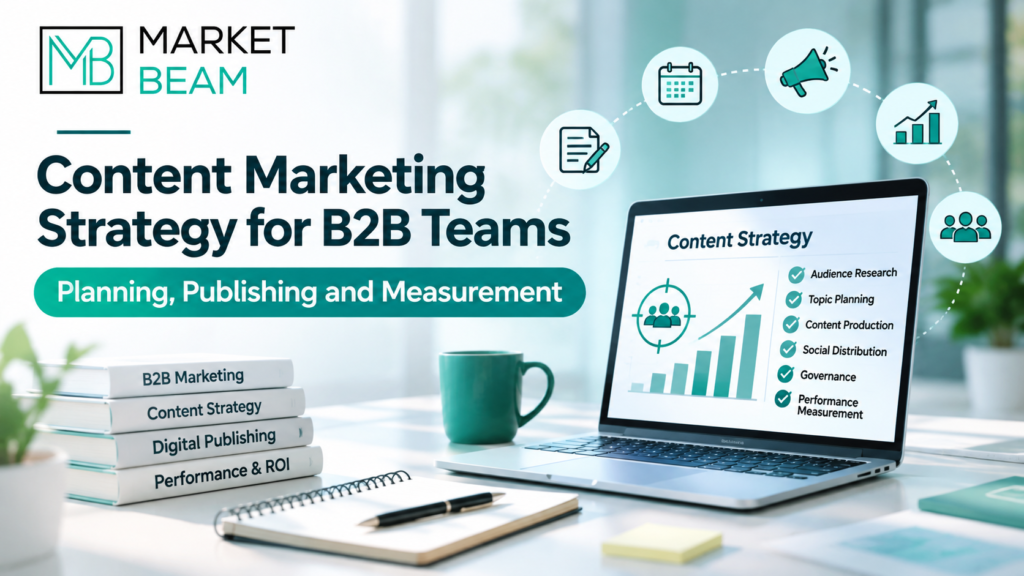
B2B buyers rarely make decisions after reading a single article or seeing one social media post. They research business challenges, compare solutions, consult colleagues, and look for evidence before contacting a provider. A well-planned content marketing strategy helps businesses support this journey with useful information at every stage. It connects audience research, topic planning, content creation, distribution, and measurement instead of treating every blog or social post as a separate activity.
For enterprise teams, the challenge is coordination. Marketing, sales, product, regional teams, and compliance reviewers may all contribute to the same program. An effective content marketing approach gives these teams shared priorities, defined responsibilities, consistent messaging, and a way to measure whether published assets are supporting business objectives.
What Is Content Marketing?
Content marketing is the strategic creation and distribution of valuable, relevant information to attract and engage a defined audience. B2B formats include blog articles, research reports, case studies, webinars, product explainers, newsletters, videos, and social media posts.
The objective is to answer buyer questions, demonstrate expertise, build trust, and help potential customers make informed decisions. Unlike promotional advertising that focuses directly on selling, content marketing provides useful information that helps audiences understand problems and evaluate possible solutions.
An effective program is not simply about publishing frequently. Every asset should serve a specific audience need and business purpose. It should explain who the information is for, what question it answers, where it will be distributed, and what outcome it should support.
1. Set Business Goals Before Creating Content
Begin by identifying the business results your content program should support. Common objectives include generating qualified leads, educating target markets, supporting product launches, improving customer retention, enabling sales conversations, and strengthening brand authority.
Translate these objectives into measurable indicators. For example, a demand-generation campaign may be evaluated through qualified form submissions, target-account engagement, and opportunities influenced. An educational article may be measured through relevant organic traffic, engaged reading, assisted conversions, and usage by sales teams.
A strong content marketing plan avoids relying only on vanity metrics. Pageviews, impressions, and social reactions can indicate attention, but they do not automatically demonstrate commercial impact. Establish one primary objective and a few supporting KPIs for every major campaign.
2. Understand Your B2B Audience and Buying Committee
B2B purchases often involve several decision-makers with different priorities. A daily user may care about usability, a technical evaluator may focus on integrations and security, while a senior leader may need evidence of business value and return on investment.
Build audience profiles around responsibilities, challenges, decision criteria, and information needs rather than relying on job titles alone. Use customer interviews, sales conversations, support questions, CRM insights, search queries, and social discussions to identify recurring problems.
Map these questions to the buying journey. Early-stage readers need educational explanations. Comparison-stage buyers need practical evaluation criteria. Decision-stage stakeholders need proof, implementation details, and information about potential risks.
The most effective content marketing programs reflect the language customers actually use. Validate audience assumptions with sales and customer-facing teams, then update your topics when buyer priorities change.
3. Build Topic Clusters and an Editorial Calendar
Organize topics around business problems your organization is qualified to explain. A pillar article can introduce a broad subject, while supporting articles answer narrower questions in greater depth. This structure helps readers explore related information and gives your editorial team a repeatable planning framework.
Prioritize topics using audience relevance, business value, search intent, subject expertise, and available evidence. Avoid selecting subjects only because a keyword has high search volume. A topic that attracts an unrelated audience may generate traffic without producing meaningful engagement.
A content marketing calendar should include the target audience, funnel stage, keyword or theme, format, owner, reviewer, deadline, publishing channel, call to action, and performance objective. Include content refresh dates for information that may become outdated.
This makes the calendar an operational tool rather than simply a spreadsheet of blog titles.
4. Match Content Formats to Buyer Questions
Different audience questions require different formats. Educational articles explain concepts and processes, comparison guides support evaluation, case studies demonstrate results, webinars encourage deeper discussion, and short social posts distribute useful insights.
For B2B teams, format selection should reflect the complexity of the subject and the audience’s available time. Do not turn every idea into a lengthy report. Similarly, avoid compressing a complicated technical or compliance subject into a short post that leaves important questions unanswered.
Strong content marketing maintains a consistent message across formats while adapting the detail and presentation to each channel.
For example, a webinar insight can become a detailed article, a short video, a sales enablement document, and several social media posts. Repurposing helps extend the value of original research without simply duplicating identical content everywhere.
5. Coordinate Content Creation, Review and Approval
Enterprise production involves writers, subject matter experts, designers, product marketers, sales contributors, and sometimes legal or compliance reviewers. Define who owns the brief, who supplies evidence, who verifies accuracy, who approves the final version, and who publishes it.
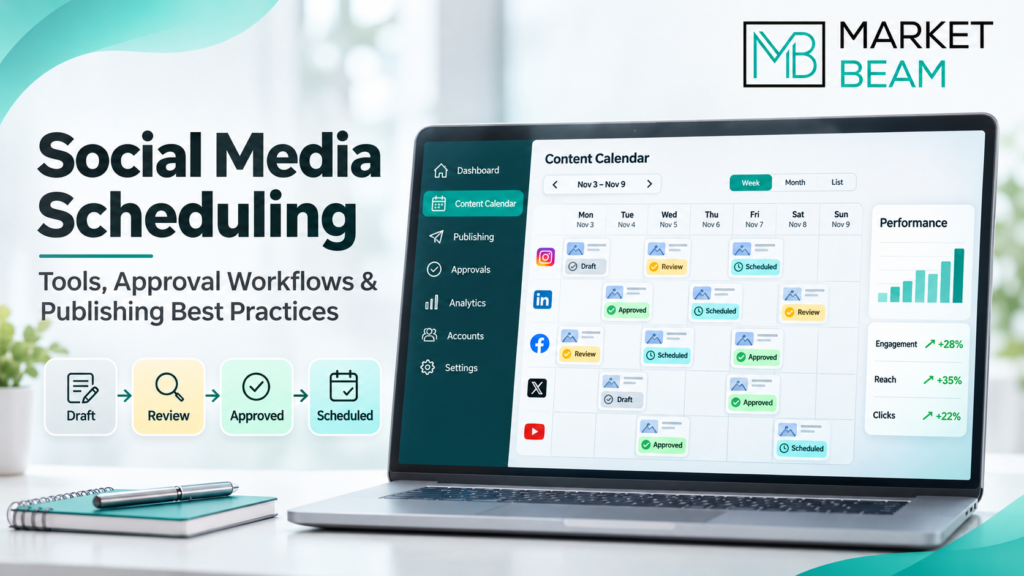
Create a documented content marketing workflow with clear statuses such as planned, drafting, subject review, compliance review, approved, scheduled, published, and refresh needed.
Keep source files, approved claims, visual assets, and final versions organized. This reduces duplicate work and prevents teams from distributing outdated information.
For regulated industries, review requirements should be included in the production schedule. Identify content that needs legal, medical, or regulatory approval and allow enough time for revisions. AI can assist with drafting and identifying potential issues, but human reviewers remain responsible for accuracy, context, and approval.
MarketBeam supports the social distribution and governance side of this process. Its platform describes AI compliance prechecks, human review, approval, publishing, monitoring, employee advocacy, and analytics through a connected workflow. These capabilities are particularly relevant to organizations that need social content to move through controlled review before distribution.
6. Distribute Content Where Your Audience Is Active
Publishing an article on your website is only the beginning. Distribution should be planned alongside production. Owned channels include websites, email newsletters, resource centers, and webinars. Social networks extend reach, while employees and subject matter experts can share approved insights through their professional networks.
Choose channels based on audience behavior and content format. LinkedIn can be useful for professional audiences, while YouTube can support product demonstrations and educational videos. Email helps nurture subscribers who have requested updates. Paid promotion can reach specific audience segments when the landing page and follow-up experience match the campaign promise.
An effective content marketing distribution plan identifies the channel, audience segment, publishing date, owner, creative adaptation, tracking method, and next step. Avoid assuming that every asset belongs on every platform.
7. Align Content With Social Media and Sales
Social media can turn a long-form resource into several useful touchpoints. Share an important finding, ask a relevant question, publish a short video, and direct interested readers to the full resource.
Employee advocacy can extend distribution when employees receive approved content and clear sharing guidance. This is particularly useful for B2B organizations where professional networks and subject matter expertise can support brand visibility.
Sales teams also need information they can use in real conversations. Provide comparison sheets, customer examples, implementation notes, product explainers, and answers to common objections. Ask sales representatives which materials help prospects understand business problems or progress through the buying journey.
A connected content marketing process makes social distribution and sales enablement part of the same plan. It also helps marketing understand which subjects generate meaningful conversations rather than surface-level engagement.
8. Measure Performance and Improve Your Strategy
Measure performance at three levels. Asset metrics show whether an individual item attracts and engages the intended audience. Channel metrics show how distribution performs. Business metrics indicate whether the program contributes to qualified demand, opportunities, customer retention, or education.
| Goal | Useful metrics | What to measure |
|---|---|---|
| Brand awareness | Relevant reach, target-account visits, branded search | Is the intended audience discovering the brand? |
| Engagement | Engaged sessions, video completion, shares, return visits | Is the information useful? |
| Demand generation | Qualified conversions, demo requests, lead quality | Does the content attract potential buyers? |
| Sales enablement | Asset usage, influenced opportunities, sales feedback | Does it support buyer conversations? |
| Governance | Review time, revision cycles, approval completion | Is the workflow controlled and efficient? |
Use analytics, CRM information, campaign tracking, and qualitative feedback together. Be careful with attribution because buyers may interact with several assets and channels before contacting sales. Report direct conversions and assisted influence separately, explaining the limitations of each measurement method.
Review results regularly. Update outdated information, improve distribution for high-value assets, and stop producing formats that consume resources without serving a clear audience or business objective.
A mature content marketing program learns from every campaign and applies those findings to future planning.
Conclusion
A successful B2B content marketing strategy connects business objectives with audience research, useful topics, suitable formats, coordinated production, distribution, and measurement. Enterprise teams also need clear responsibilities and governance so information remains accurate and consistent across channels.
Start with genuine buyer questions, plan distribution before production, and measure meaningful business outcomes beyond website traffic. Review performance regularly, refresh outdated resources, and give sales and social media teams reliable information they can confidently share.
Connect With MarketBeam
MarketBeam helps enterprise and regulated teams coordinate social content creation, AI-supported compliance prechecks, review, approval, publishing, employee advocacy, monitoring, and analytics through a connected platform.
Explore how MarketBeam can support governed social content distribution and help your organization manage the complete social media lifecycle.
Sales: sales@marketbeam.io
Tech Support: support@marketbeam.io
Website: https://marketbeam.io/
FAQs
1. What is content marketing in B2B?
It is the creation and distribution of useful information that helps business buyers understand challenges, evaluate solutions, and make informed decisions. Common formats include articles, research reports, webinars, case studies, and social content.
2. How do you build a content marketing strategy?
Define business goals, research your audience, map buyer questions, prioritize topics, select formats and channels, assign owners, establish review workflows, and choose relevant KPIs before production begins.
3. Which content formats work best for B2B companies?
The right formats depend on the audience and buying stage. Articles explain concepts, comparison guides support evaluation, case studies provide proof, webinars enable deeper learning, and social posts distribute insights.
4. How often should a B2B business publish content?
There is no universal publishing frequency. Choose a schedule your team can maintain without reducing accuracy or usefulness. Prioritize audience relevance and consistency over publishing volume.
5. How can businesses measure content marketing ROI?
Track qualified conversions, lead quality, pipeline influence, customer engagement, and sales asset usage. Combine analytics and CRM data, and distinguish direct conversions from assisted attribution.